HiMCM awarded paper library & study packs
STUDY THE
WINNERS.
Awarded HiMCM papers are the clearest record of what a defensible modeling argument looks like. This library curates Outstanding, Finalist, and Meritorious exemplars together with the training materials to learn from them properly – for structure and reasoning, never for copying.
Three study packs
WHAT THE LIBRARY
CONTAINS.
 01 / PAPERS
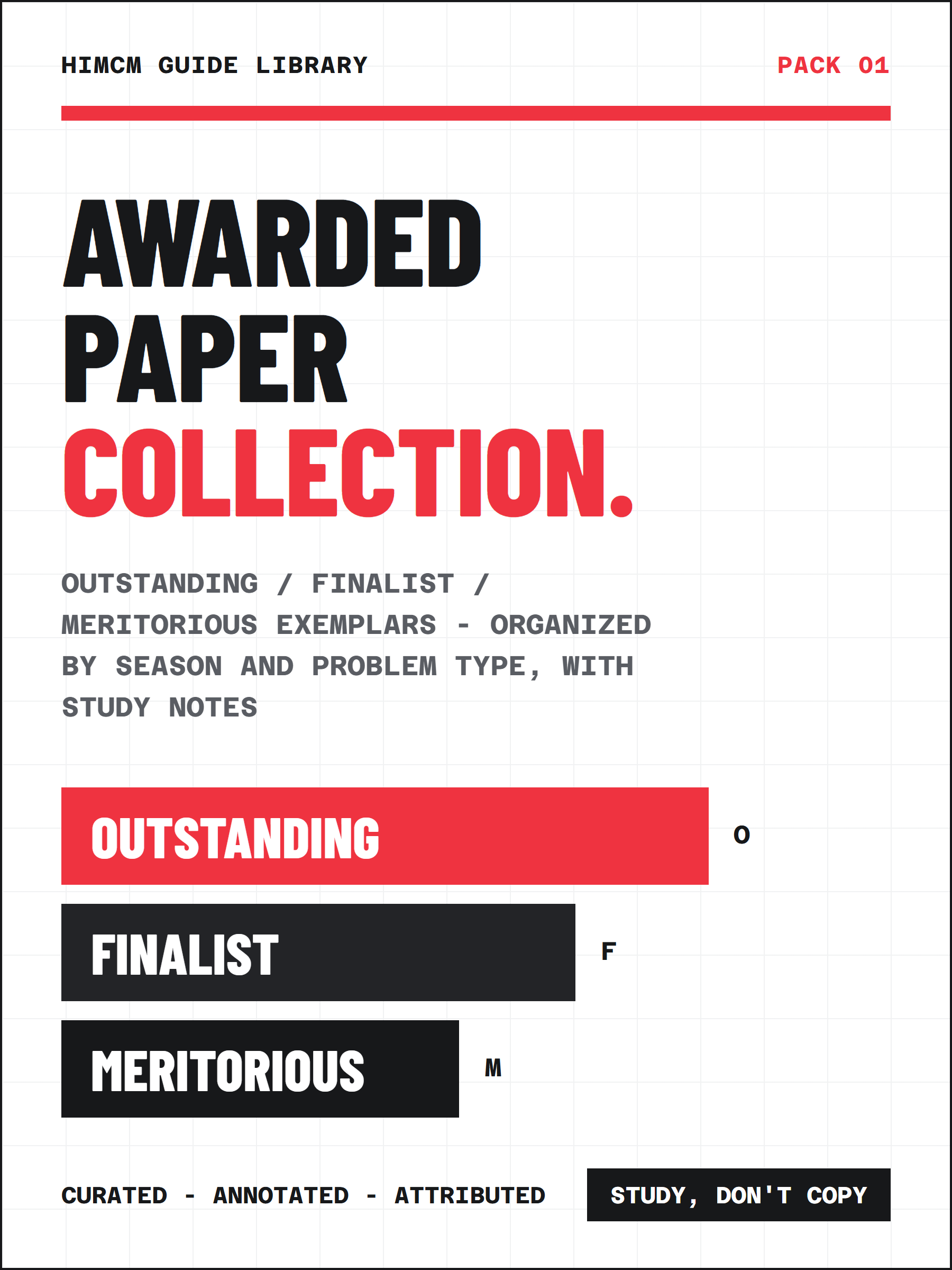
Awarded Paper Collection
A curated collection of HiMCM award-winning papers across the Outstanding, Finalist, and Meritorious levels, organized by season and problem type – optimization, simulation, ranking and scoring, network, and data-driven problems – so a team can always find an exemplar close to the problem it is practicing.
 02 / METHOD
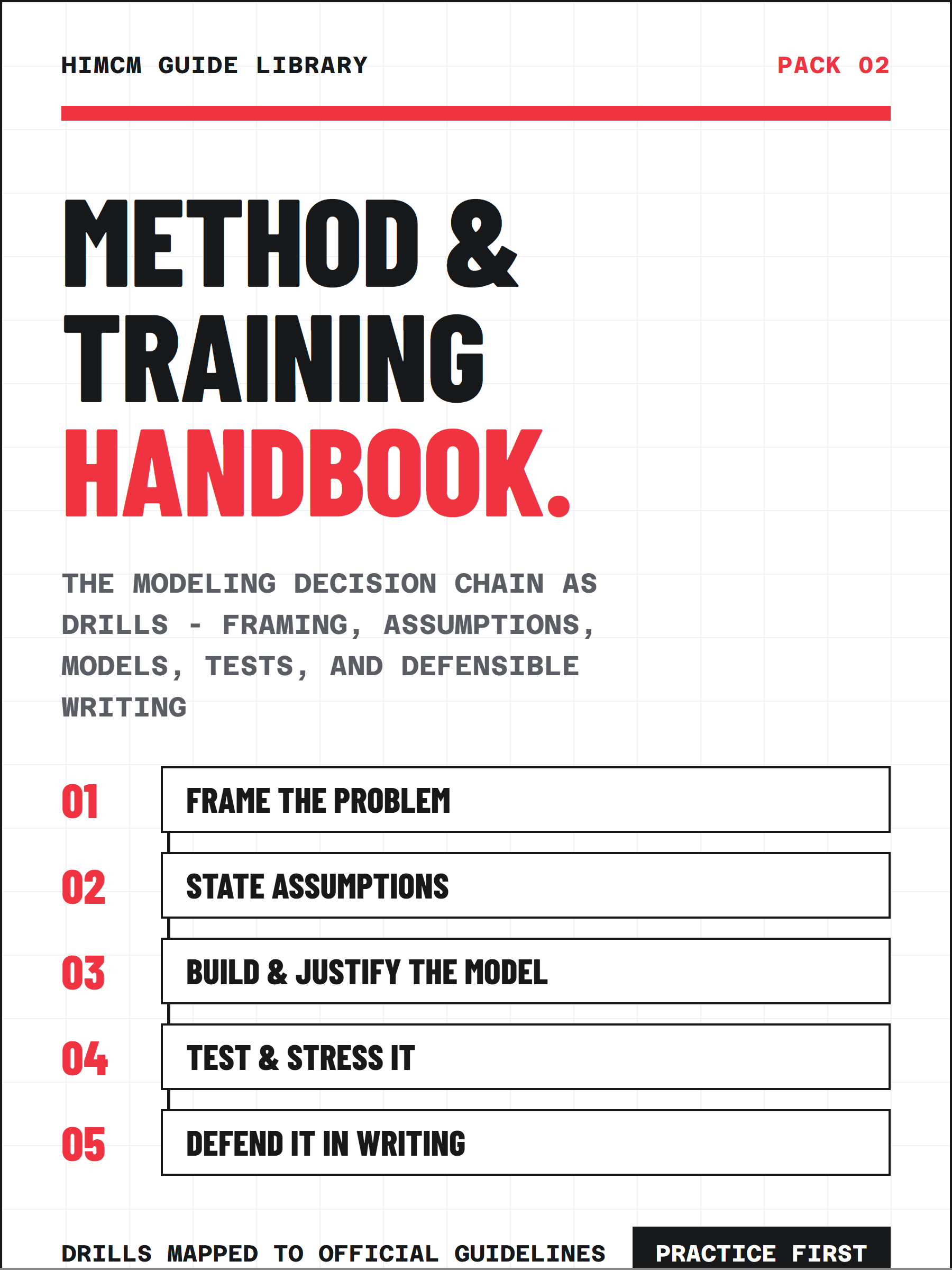
Methodology & Training Handbook
A practical workbook on the modeling decision chain: framing a messy prompt, choosing variables and assumptions, selecting and justifying a model family, validation and sensitivity analysis, and turning results into a defensible written argument – with drills mapped to COMAP’s official solution guidelines.
 03 / TOOLING
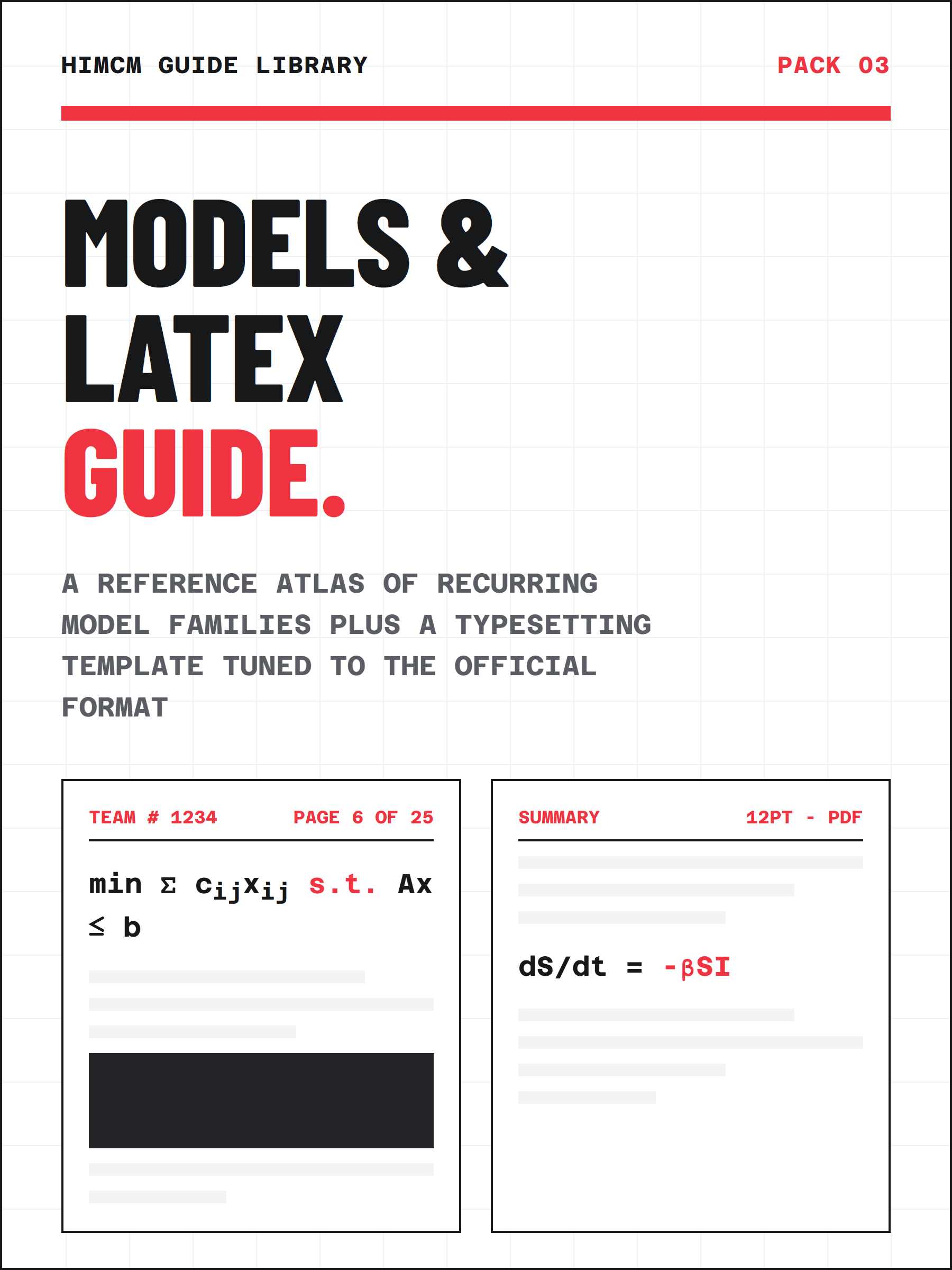
Model Compendium & LaTeX Guide
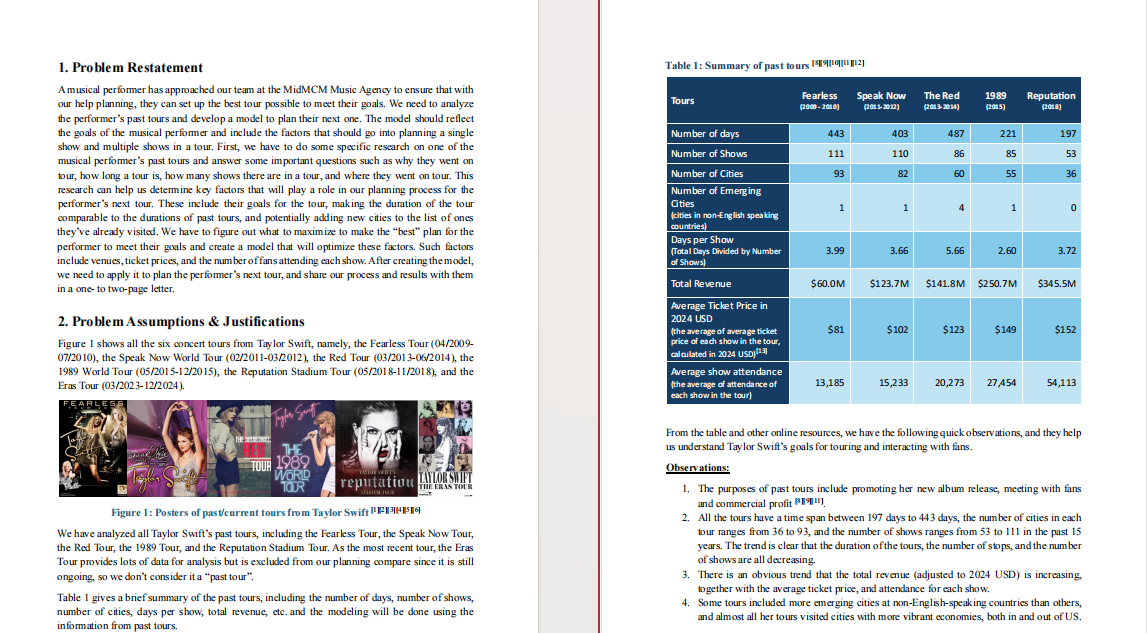
A reference atlas of the model families that recur in HiMCM problems, paired with a LaTeX typesetting guide and template tuned to the official format: summary sheet first, 25-page limit, control-number page headers, 12-point type, and a clean reference section.
WHY EXEMPLARS
WORK.
COMAP itself points students to past work: Outstanding papers may be published by COMAP as examples of exemplary student work, portions of top solutions appear in COMAP’s Consortium newsletter, and the official Director’s Article and Judges’ Commentary explain what judges look for in each section of a solution. Reading awarded papers alongside that commentary is the closest thing to sitting beside a judge.
Every paper in the collection is studied with attribution and used under the same standard we teach: read for structure, argument, and evidence handling – then practice on a different problem. Our annotations point to the decisions that earned credit, not to reusable text.
How to get the packs
REQUEST THE
LIBRARY.
Contact an advisor
Use the site’s contact channel and mention which pack you need – papers, methodology handbook, or the model compendium and LaTeX guide.
Tell us where the team stands
Share the student’s grade, team status, and target season so the materials match the team’s level – first-time teams and returning teams study different exemplars.
Receive materials with guidance
Packs arrive with usage notes: which papers to read first, what to log while reading, and how to convert observations into practice tasks.
Verified from COMAP’s official problem pages
PAST PROBLEMS,
YEAR BY YEAR.
Every title below is taken directly from COMAP’s official per-year problem pages, and each year links to the official problem statements and results. HiMCM teams choose Problem A or B; from 2021 onward, Problem C is the MidMCM problem, reserved for teams whose members are all aged 14½ or younger.
| Year | HiMCM Problem A | HiMCM Problem B | MidMCM Problem C | Official pages |
|---|---|---|---|---|
| 2025 | Emergency Evacuation Sweeps | Environmental Impact of Sport Mega-Events | Responsible and Interesting Zoos! | Problems · Results |
| 2024 | To Play or not to Play: Modeling Future Olympic Games | Examining the Environmental Impact of High-Powered Computing | The Modeling Musical Tour | Problems · Results |
| 2023 | Dandelions: Friend? Foe? Both? Neither? | Charging Ahead with E-buses | Preparing for Olympic Medal Ceremonies | Problems · Results |
| 2022 | The Need for Bees (and not just for honey) | CO2 and Global Warming | Polygon Paradise Park | Problems · Results |
| 2021 | Storing the Sun | Tackling the Drought | Dog Park | Problems · Results |
| 2020 | The Best Summer Job | Funding Biodiversity Conservation | – | Problems · Results |
| 2019 | Charge! | Bottle Battles | – | Problems · Results |
| 2018 | Roller Coaster | Cozy Smart House | – | Problems · Results |
Titles verified against COMAP’s official per-year problem pages, July 2026. Earlier seasons (1999-2017) are indexed on COMAP’s Previous Contests page; the Consortium’s Director’s Article and Judges’ Commentary describe what judges look for in each section, with exemplars.
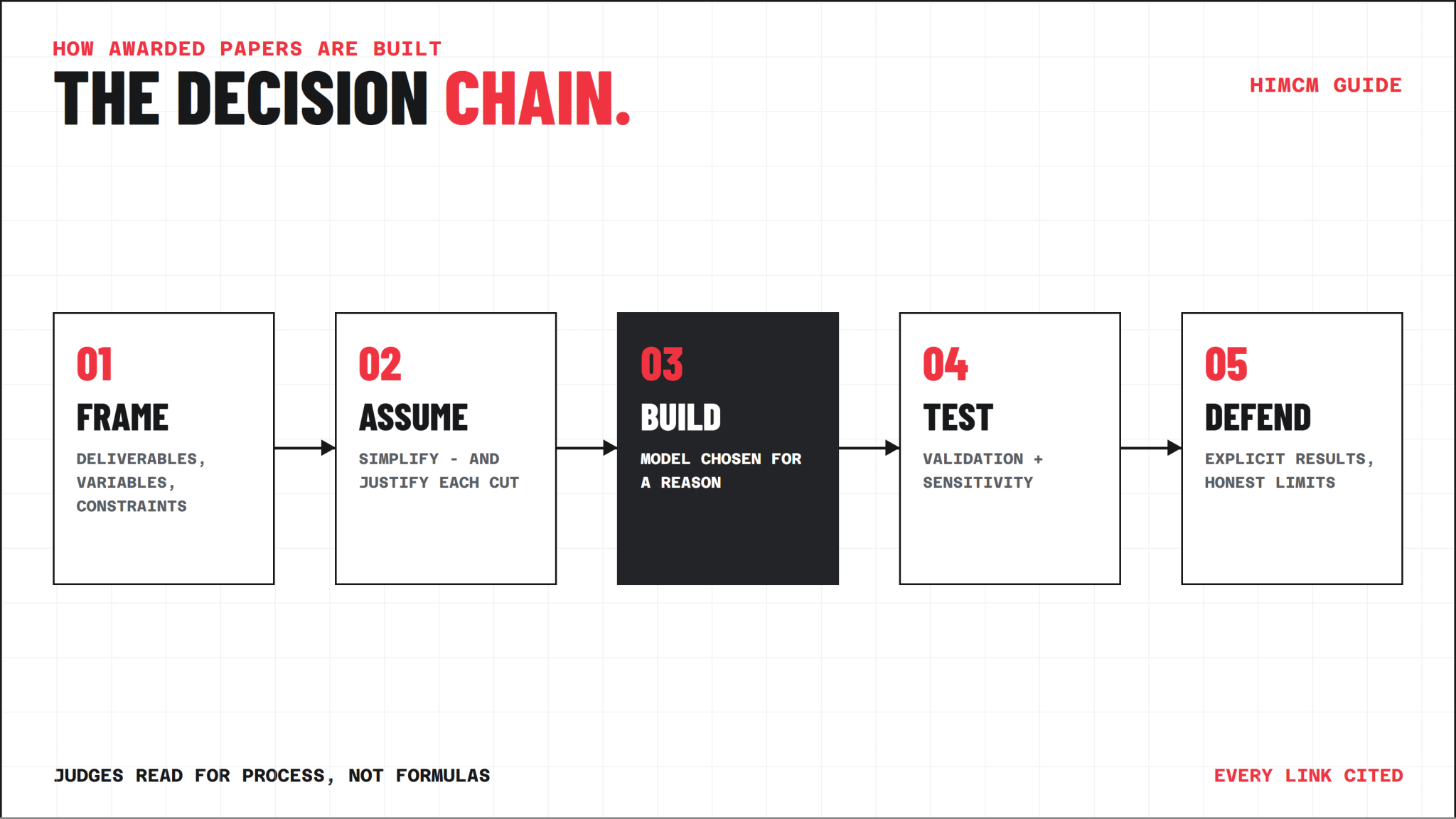
A SIX-PASS
READING METHOD.
Map the question
List the deliverables and decide whether the solution actually answers each one.
Trace assumptions
Identify every assumption that changes the feasible model or interpretation.
Rebuild the pipeline
Sketch how data and parameters flow through equations or algorithms to results.
Audit evidence
Check whether figures, tables, validation, and sensitivity support the claims made.
Study communication
Observe section order, notation, captions, transitions, and how limitations are stated.
Transfer a principle
Write one general lesson in your own words, then test it on a different problem.
STUDY LOG
FIELDS.
| Field | Record |
|---|---|
| Problem | Year, problem identifier, official source URL, and the deliverables |
| Model family | Why the team selected it and what alternative might have worked |
| Evidence | Data source, validation, sensitivity, and uncertainty treatment |
| Strongest choice | A specific decision that made the argument more credible |
| Weakest link | A claim, test, assumption, or explanation that needs improvement |
| Transfer task | A new mini-problem on which to apply the lesson independently |
Paper library FAQ
COMMON
QUESTIONS.
What is included in the HiMCM awarded paper collection?
The collection curates HiMCM award-winning papers at the Outstanding, Finalist, and Meritorious levels, organized by season and by problem type (optimization, simulation, ranking and scoring, network, and data-driven problems), each with study notes pointing to the decisions that earned credit.
What is the difference between Outstanding, Finalist, and Meritorious?
Per COMAP’s official definitions: Outstanding recognizes the “best of the best” in the final round of judging; Finalist recognizes exemplary papers that reached the final round – complete, logical, and comprehensive; Meritorious papers are excellent in many aspects of modeling, analysis, conclusions, and communication and address all requirements in a clear, well-supported manner.
Are awarded HiMCM papers published officially?
Yes, in part. COMAP states that Outstanding papers may be published and used as examples of exemplary student work, that winning O Prize papers are stored in the COMAP global case library, and that select teams have portions of their solutions published in COMAP’s Consortium newsletter. Official past problems and solutions are available through COMAP’s Previous Contests pages and mathmodels.org.
Is it against the rules to read past papers before the contest?
No. COMAP explicitly encourages preparation before the contest and publishes past problems, solutions, and the Judges’ Commentary for that purpose. The rules restrict outside help and reuse during the contest window: teams may use inanimate resources they find on their own, must cite every source, and may never reuse or fail to document material from any paper – COMAP’s pairwise comparison software screens all submissions.
What does the LaTeX guide cover?
The guide and template are tuned to the official submission format: summary sheet first, a 25-page total limit that includes the table of contents, references, and appendices, a control-number and page-number header on every page, readable type of at least 12 points, English text, and a single PDF under 20 MB named after the team control number.
How do I request the study packs?
Contact the site’s preparation advisor through the contact channel on this page, name the pack you need, and share the student’s grade and team status. Materials are provided with usage notes so teams study exemplars the way judges read them.
This page does not claim ownership of official contest problems or third-party papers. Awarded papers remain the work of their authors; availability should be verified at the linked source. Study packs are independent preparation materials and are not endorsed by COMAP.