Read COMAP’s published descriptions of its recognition levels and one word appears in most of the tier descriptions alongside modelling and analysis: communication. For a team writing in a second language that is not a warning — it is useful information. Communication in a technical report is a small, learnable set of sentence patterns, not fluency, and it can be practised long before November.
The words COMAP uses, and what each one asks of a sentence
COMAP describes what teams submit as “a complete technical report explaining their approach, assumptions, analysis, and conclusions,” and its contest instructions describe the designations using a recurring vocabulary. Wording changes between editions, so confirm current definitions on comap.org — but the recurring adjectives are stable enough to work from, and each one translates into something concrete you can do to a paragraph.
| COMAP’s word | Where it appears | What it asks you to do on the page |
|---|---|---|
| supported | “sound and supported processes” (Honorable Mention); “well-supported” (Meritorious) | Every number and every choice carries a stated basis in the same sentence or the one after it |
| clear | “clear… manner” (Meritorious); “in an organized and clear manner” (COMAP’s description of the best contest papers) | One idea per sentence; define a symbol before you use it; no pronoun without a visible antecedent |
| well-organized | Meritorious | A reader can find your assumptions, your model and your conclusion without hunting |
| complete and logical | COMAP’s description of the best contest papers | No step is left to the reader’s imagination, and the order of paragraphs matches the order of the reasoning |
| addressing all requirements | Honorable Mention and Meritorious | Each thing the problem explicitly asks for has a visible, findable answer in the paper |
| communication | Named in the Outstanding, Meritorious and Honorable Mention descriptions | Treated as a judged dimension in its own right, not as presentation polish |
Look at that right-hand column and notice what is not there: sophisticated vocabulary, complex sentence structure, idiomatic phrasing, native rhythm. None of the qualities COMAP names require the English of a novelist. They require the English of an engineer — and that is a far shorter list of skills to acquire.
What a judge can and cannot recover
Here is the asymmetry that governs everything else. Your team spent fourteen days inside the problem. You know why you chose a discrete model, you remember the afternoon you discarded the first approach, you understand exactly what your third assumption is protecting against. A judge knows none of it. They have your document, they are reading it alongside many others, and everything you did not write down did not happen.
This is why HiMCM rewards defensible decisions rather than correct answers: the decision only exists on the page if a sentence defends it. A team can build a genuinely good model and still submit a paper in which the modelling is invisible, because every sentence reports what was done and none explains why.
The practical test is brutal and useful. Give your draft to a strong maths student who has not read the problem. If they cannot say, after twenty minutes, what you assumed and why you chose this model over an obvious alternative, the paper is not finished — regardless of how good the model is.
The four sentence patterns a modelling paper runs on
Almost every sentence that does real work in a HiMCM paper is one of four types. Learn the four shapes and the language problem shrinks to something manageable.
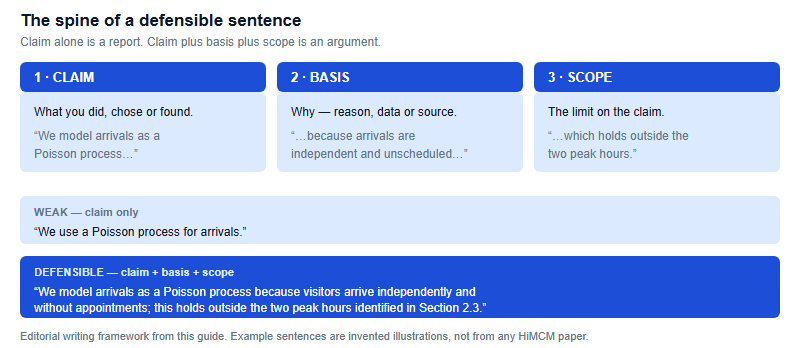
The four patterns, and the fault each one prevents:
| Pattern | Weak version | Defensible version |
|---|---|---|
| Assumption | “We assume the population is constant.” | “We assume the population is constant over the six-month horizon, because published growth is under 0.4% per year and our sensitivity test shows the output moves less than 2% across that range.” |
| Model choice | “We use linear regression.” | “We use linear regression rather than an exponential fit because the scatter plot in Figure 3 shows no acceleration, and a linear form keeps the two parameters interpretable for the decision-maker.” |
| Result | “The answer is 47 buses.” | “The model recommends 47 buses, which meets the stated 95% coverage target; the recommendation stays between 44 and 51 across the parameter ranges tested in Section 5.” |
| Limitation | “Our model has some limitations.” | “Our model treats demand as independent of price, so it will overstate ridership if fares rise; incorporating price elasticity is the first extension we would make.” |
Every defensible version above is longer, and none is more sophisticated. The extra length is all reason and scope. A student with intermediate English can write those sentences; a student with excellent English who has not learned the pattern will write the left column.
The register problem: over-claiming and under-claiming
Chinese-curriculum students writing technical English tend to land at one of two extremes, and both cost credibility.
Over-claiming is the more common. “Our model perfectly predicts…”, “this proves that…”, “the optimal solution is…”, “our model is highly accurate…”. Some of this comes from translating a Chinese academic register that tolerates stronger assertion; some comes from a belief that confident writing sounds stronger. In a modelling report it does the opposite. A judge who reads “proves” about a model built on four assumptions immediately doubts everything around it. Use indicates, suggests, under these assumptions, within the tested range.
Under-claiming is rarer and just as damaging. “Our model may possibly be somewhat useful in certain situations” tells a reader nothing and reads as though the team does not believe its own work. If you tested it and it held, say so plainly: “the recommendation is stable across the ranges tested.”
The calibrated middle is a specific, bounded statement. Not “our model is accurate” and not “our model might be accurate”, but “the model reproduces the 2024 observed values to within 6%.” Bounded claims are the easiest kind of English to write in a second language, because they replace judgement words with numbers.
One related note: if your team uses translation or other AI tools while drafting in English, COMAP has its own disclosure requirements covering the use of such tools. Do not assume translation software falls outside them — read the current instructions on comap.org before you write, not after.
Figures, captions and notation are also language
Within the 25 pages COMAP allows for all solution work and additional material such as drawings, diagrams, calculations and tables — confirm the current limit on comap.org — a surprising proportion of your communication happens outside prose. Three rules cover most of it.
- A caption states the finding, not the contents. “Figure 4: Sensitivity of total cost to arrival rate” describes the axes. “Figure 4: Total cost rises 21% when arrival rate increases 10%, the largest response of any parameter tested” states what the reader should take away. The second costs one line and does the work of a paragraph.
- Define every symbol once, in one place, and never redefine it. A notation table early in the paper is worth its half-page. The most common consistency fault we see is a symbol that means one thing in Section 3 and something adjacent in Section 5 — usually because two team members wrote those sections separately.
- Units on every number, every time. In tables, in axis labels, in the text, and in the summary sheet. A number without a unit is not a result.
If you look at awarded papers to learn presentation conventions, study them for structure and reasoning only — how sections are sequenced, how a caption is phrased, how a notation table is laid out. Copying a model, prose, figures, code or citations is plagiarism and ends a team’s contest. Learning that captions should state findings is legitimate; reusing a caption is not.
A three-pass revision you can finish in two hours
Most teams “check” the paper by reading it once and fixing whatever they notice. That catches typos and almost nothing else, because a single read cannot hold structure, sentences and consistency in mind at once. Split it into three passes with different targets.
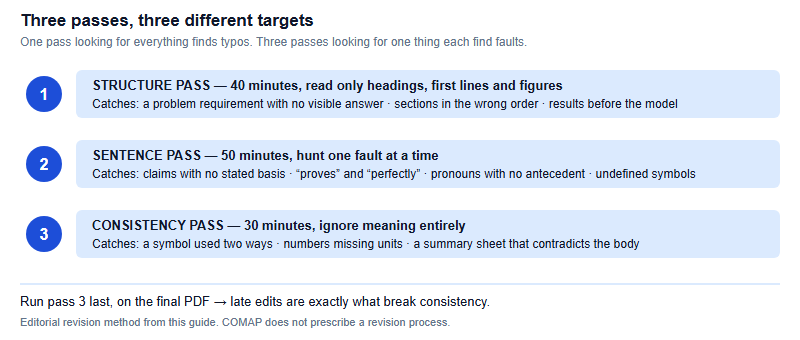
Two practical notes. The structure pass works best read aloud from headings only: if the sequence of headings does not narrate the argument by itself, the paper is disorganised no matter how good the paragraphs are. And the sentence pass should hunt one fault at a time — one sweep for unsupported claims, one for over-claiming words, one for undefined symbols. Searching for a single pattern is far more reliable than reading attentively, and it is a task a second-language writer can do as well as a native one.
Practising before November
Technical English improves through short, repeated, targeted exercises rather than through reading more. Two that cost under an hour a week: take any five sentences from your last science or maths write-up and rewrite each as claim plus basis plus scope; and take any figure you have made and write three candidate captions, keeping the one that states a finding.
Do that through September and October and the writing role stops being the job nobody wants. That matters more than it sounds, because the writing is where the modelling actually becomes visible — and COMAP puts communication next to modelling and analysis in the levels where it spells the criteria out.
Frequently asked questions
Does HiMCM judge English quality?
COMAP names communication alongside modelling and analysis in its published designation descriptions. Confirm current judging language on comap.org.
Will non-native English put our team at a disadvantage?
The qualities COMAP names — supported, clear, organised, logical — are structural rather than stylistic, and are learnable without native fluency.
What is the most common writing fault in a modelling paper?
In our editorial experience, claims with no stated basis: sentences that report what the team did but never say why that choice was made.
Can we use translation tools to write the paper?
COMAP has its own requirements on the use of such tools, including disclosure. Read the current instructions on comap.org before drafting.
This is an independent guide operated by Hanlin Education for China-based international-school students. We are not affiliated with, endorsed by, or sponsored by COMAP, which is the sole official authority for HiMCM rules, dates, registration and judging. Confirm all current details on comap.org before acting on anything here. Errors reported to us are corrected within 7 working days.