
Usually no. COMAP's contest instructions state that all students on a team must be enrolled at the same institution at the start of the contest, and that no exceptions are made. COMAP’s 2025 eligibility update widened that unit to include an approved Program, so a few genuine cross-school groups now qualify — confirm the current wording on comap.org. A tutoring or contest-prep centre never does.
This is the question we are asked most often in the weeks before registration opens, usually in one of two forms: my best two friends who could actually do this are at another school, or a training centre says it can enter us as a team. The first is sometimes solvable. The second is the one that gets papers disqualified. Both deserve a straight answer before anyone pays a registration fee, because team members are locked in before the contest window opens and cannot be changed afterwards.
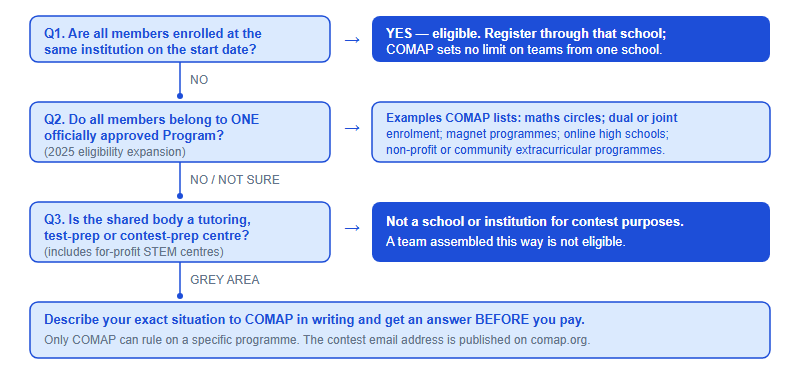
The rule that settles your roster before you argue about roles
COMAP's Procedures and Tips article for HiMCM and MidMCM — the document that accompanies the official rules on the contest website — puts it in capital letters: all students on the team must be enrolled at the same institution at the start of the contest, and COMAP states it will make no exceptions to this rule. The same document defines what an institution is for contest purposes: the primary and comprehensive full-time provider of all of a team member's education studies, in all subjects.
Read that definition twice, because it is doing the real work. Your day school is your institution. The place where you take Saturday classes is not, no matter how much mathematics happens there. COMAP names the excluded categories explicitly: tutoring, test-prep, contest-prep, and mathematics or STEM learning centres are not considered schools or institutions for registering and competing in its contests.
Two related permissions surprise people in the other direction. COMAP states there is no limit on the number of teams from any one school, and that an advisor may serve as advisor to multiple teams. So the constraint is never our school already has a team. If eight students at your school want in, that is two teams, both legitimate. And a team may have one, two, three or four students; four is the maximum, and COMAP notes that historically the best teams have four members. If you are still deciding how four people divide one paper, start with what HiMCM actually asks a team to produce — the deliverable is one written argument, not four separate answers.
What the 2025 eligibility expansion actually added
For most of the contest's history the unit was simply the school. In 2025 COMAP published an eligibility expansion that recognises a wider range of non-school educational programmes. Its definition of a Program is narrow and worth stating carefully: a non-school educational programme that was not founded for the exclusive purpose of participating in mathematics competitions. The examples COMAP gives include maths circles, dual or joint-enrolment programmes, magnet programmes, online high schools, academic or training programmes that bring students together from multiple schools for enrichment or specialised coursework, and community-based or non-profit extracurricular programmes.
COMAP's own advisor briefing slides now describe a team as up to four students from the same school, institution or program, and flag that wording as new. In the same expansion COMAP notes the advisor does not have to be a classroom teacher: it can be a programme leader, mentor or another responsible adult, and the advisor acts as the team's main point of contact.
Here is the honest complication, and the reason this article exists. The current Procedures and Tips article still states the same-institution requirement with no exceptions and still defines an institution as a full-time comprehensive provider, while the eligibility update adds the Program route. The two documents emphasise different things, and only COMAP can rule on whether a specific programme qualifies. If your team is a cross-school group, that is not a reason to give up and not a licence to assume you are fine — it is a reason to get a written answer first.
| Your situation | Where it sits | What to do now |
|---|---|---|
| Four students, one international school | Clearly eligible | Register through the school; nothing to check |
| Two students each from two different schools, nothing shared | Not eligible | Rebuild each team inside its own school |
| All four in one dual or joint-enrolment programme | Program route, category listed by COMAP | Confirm your case with COMAP, keep the reply |
| All four in one magnet programme or one online high school | Program route, category listed by COMAP | Confirm your case with COMAP, keep the reply |
| All four in one non-profit or community programme, or a maths circle | Program route, category listed by COMAP | Confirm; be ready to describe how the programme is run |
| A tutoring, test-prep or contest-prep centre assembles the team | Excluded by name | Do not register this way |
| A for-profit STEM learning centre offers to enter you | Excluded by name | Do not register this way |
| Two campuses of one school group, shared registrar | Grey area | Ask COMAP before paying; do not decide it yourselves |
Why a training centre cannot be your team's home, in the contest's own logic
It would be easy to read the exclusion as arbitrary paperwork. It is not. The whole contest rests on the claim that the work is the team's own. COMAP states that during the contest period teams may not seek help in obtaining answers, ideas or information, or in locating resources, from anyone outside the team — and that explicitly includes the advisor, other teachers, other students, and experts or professionals in a field relevant to the problem. It prohibits posting or sharing any part of the problem statement or any part of your work in any medium during the window, says it monitors the internet during the contest period, and runs comparison software over every submitted paper against all other submissions for the same problem.
Now picture a contest-prep centre that gathers strong students from six schools, drills them on last year's problem, and shepherds several teams through November. Every one of those rules becomes hard to guarantee. The exclusion is upstream enforcement: it removes the structure in which shared answers are both easiest to produce and hardest to detect. Reading it that way also tells you where the line falls in your own preparation. Learning to model before November is entirely legitimate, wherever you learn it. Having a team whose institutional identity is a preparation service is not.
One more warning from COMAP's own instructions belongs in the same paragraph. During the contest, websites may appear that look like COMAP and ask you to pay for data or for extra contest materials. COMAP says these are fake, that it will never ask you to purchase any material related to the contest, and that such sites should be reported to the contest email address. Any data files a problem requires are published with the problems.
The registration sequence, and the deadline that locks your roster
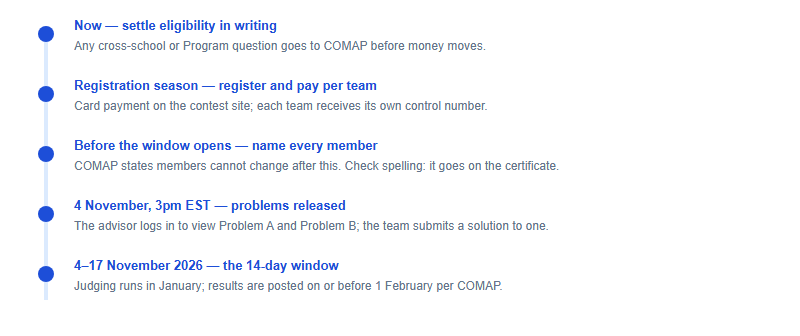
Two deadlines matter more than the contest window itself, and both fall before it. First, registration and payment happen before the contest starts; COMAP's instructions and advisor briefing material state a registration fee of one hundred US dollars per team, paid by card through the contest site, and note the payer can be a parent, teacher or administrator. Confirm the current fee on comap.org, since it is set per cycle. Second, and more often missed: an advisor may pay for and register several team control numbers without naming students immediately, but must designate the specific members of each team before the contest window opens. After that point, COMAP states team members cannot change.
That is why a grey-area roster question is a September problem, not a November one. If you wait until the window opens to discover that one member's enrolment does not fit the rule, you cannot substitute anyone. Note too that names are typed by the advisor at registration and are exactly what appears on participation and award certificates; COMAP corrects spelling errors and typos only.
If you cannot field four from your own school, do this instead
Most readers who arrive at this question are not in a magnet programme. They simply cannot find three more people in their own building. Four practical moves, in the order we recommend them.
- Recruit for the jobs, not for the mathematics ranking. A HiMCM paper needs someone who will write and edit English prose, someone who will get code running, someone who will chase data and sources, and someone who owns the modelling argument. The strongest recruitment pitch inside a school is therefore not are you good at competition maths but can you write, or code, or dig. Our team-matching page exists for exactly this within-school search.
- Enter with three if three is what you have. COMAP permits teams of one, two, three or four students and only observes that the best teams have historically had four members. A committed three beats a fourth member who disappears on day six.
- Ask whether a programme you are already in qualifies. If you are dual-enrolled, in a magnet stream, or enrolled with an online high school alongside your day school, you may already sit inside a listed category. Ask COMAP with specifics: what the programme is, who runs it, and whether it is genuinely the students' educational programme rather than a contest service.
- Do not let anyone else decide your eligibility for you. If an organisation tells you it can enter students from several schools as one team, ask which COMAP category it falls into and ask to see the confirmation. A disqualification does not land on the organisation; it lands on the students' paper, after fourteen days of work.
One closing perspective on scale, from COMAP's own results announcement: the 2025 contest drew 1,199 teams representing more than 500 schools across 24 countries and regions. Cross-school assembly is not how those teams got there. The overwhelming majority did the duller, harder thing — found three classmates, chose an advisor at their own school, and started early on the modelling habits the contest actually rewards.
Frequently asked questions
Can two students from different schools be on one HiMCM team?
Only if both belong to the same officially approved Program under COMAP rules. Otherwise the same-institution rule applies. Confirm on comap.org.
Does a tutoring centre count as our institution?
No. COMAP states tutoring, test-prep, contest-prep and STEM learning centres are not schools or institutions for registering and competing.
Can our school enter more than one team?
Yes. COMAP states there is no limit on the number of teams from any one school, and that an advisor may serve as advisor to multiple teams.
Can we swap a team member after registering?
No. COMAP states members must be designated before the contest window opens and cannot change after that. Fix roster problems now.
This is an independent guide operated by Hanlin Education for China-based international-school students. We are not affiliated with, endorsed by, or sponsored by COMAP, which is the sole official authority for HiMCM rules, dates, registration, eligibility and judging. Confirm all current details on comap.org before acting on anything here. Errors reported to us are corrected within 7 working days.