HiMCM 2026 runs from 4 to 17 November. Before you register a team, put that fortnight next to everything else your four students have already committed to — a maths contest sitting, a school assessment block, coursework deadlines. Teams do not usually fail HiMCM because the problem was hard. They fail because November was full and nobody checked in September.
The fortnight, and the shape it happens to have
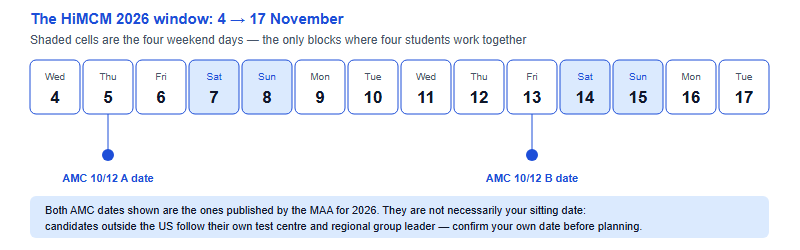
COMAP gives the 2026 contest window as 4 to 17 November 2026. In that year those dates fall as a Wednesday through to the following Tuesday, which means the window contains ten school days and four weekend days: Saturday 7, Sunday 8, Saturday 14 and Sunday 15 November. Confirm the current window, the submission deadline and its time zone on comap.org before you plan around any of it.
Those four weekend days are not one quarter of your capacity. They are closer to two thirds of it, because they are the only days on which four students can work in the same room for six hours instead of trading messages between 21:00 and 23:00. Anything that lands on a weekend day inside the window costs several times what the same commitment costs on a Tuesday.
What is likely to be sitting inside your window
Run this list against your own four students, one by one. The point is not to be discouraged; it is to find out in September which days are genuinely free, while you can still change the roster.
| Commitment | Where it usually lands | What it really costs the team | The September move |
|---|---|---|---|
| An AMC 10/12 sitting | The MAA published two 2026 dates, 5 and 13 November. Your own centre’s date may differ — confirm with your test centre or regional group leader. | Far more than the sitting itself. The three or four evenings of revision before it are the real loss, and they fall in exactly the days you wanted for building the model. | Decide which sitting each member takes. Protect the days after it, and give the writing role to someone who is not sitting it. |
| A school assessment or mock block | Many international schools in China run an assessment week in November. | The worst kind of collision, because it hits all four students simultaneously. Nothing gets done at all for five days. | Get the school calendar before you register, not after. If the block sits inside the window, you are effectively working a nine-day contest. |
| IB internal assessments, EE checkpoints, AP coursework | School-set dates, often clustered before the winter break. | Uneven damage: it removes one student for several days while the other three wait on their output. | Ask each member for their own deadline dates. The year-group average is useless; individual dates are what bite. |
| Grade 12 application work | Early-round outcomes and January deadlines sit either side of the window. | Usually removes your most experienced member at the moment the model needs a decision. | Think carefully about whether a grade 12 belongs on this year’s roster, or should advise it instead. |
| Illness, travel, family commitments | Unforecastable. | Whatever cost the role with no backup carries. | Name a second person for every role now. Not a plan — a name. |
Why a collision hurts HiMCM more than it hurts a timed contest
If you miss two evenings before the AMC, you sit the AMC slightly less prepared and the contest still happens on schedule. HiMCM does not work like that, and the reason is the thing that defines the contest: it is a modelling contest, not a problem-solving contest. There is no answer key and no fixed question set. What you are producing is a single written English paper in which every modelling decision has to be defensible, and that paper is built by a chain of dependent work.
The chain matters. Nobody can write the results section until the computation has run; the computation cannot run until the model is specified; the model cannot be specified until the team has agreed what the problem is asking. Remove one person for four days and you have not lost one quarter of the labour — you have potentially stalled everyone downstream of them. A team of up to four students is a small system with very little slack in it.
This is also why availability, not ability, is the variable most worth auditing in September. A team of four capable students who can only ever assemble on two of the four weekend days is in a worse position than a team of four ordinary students who can assemble on all four.
The September audit, in four steps
This takes one meeting and produces a number you can actually make a decision with.
- Step 1 — each student writes their own November grid. Fourteen rows, 4 to 17 November. Against each day, everything already committed: sittings, deadlines, family travel, training, part-time commitments. Individually, not as a group, and honestly.
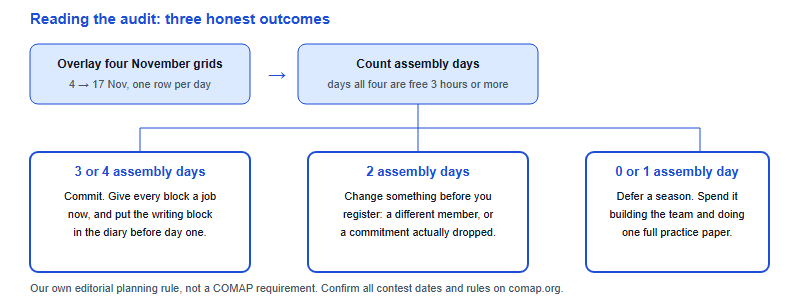
- Step 2 — overlay the four grids. Mark every day on which all four are free for a block of three hours or more. Those are your assembly days. Mark separately the days on which at least the modelling person and the computation person are free — those are your build days.
- Step 3 — identify the protected blocks. Take your assembly days and give each one a job in advance: problem selection, model specification, computation review, writing review. A weekend day with a job attached survives contact with a family lunch invitation. One without a job does not.
- Step 4 — count team-hours, not calendar days. Add up realistic working hours across the fortnight. COMAP’s tips article describes the problems as designed for teams to complete a solution within about 36 hours of work — confirm the current guidance on comap.org — and that is a useful planning anchor, provided you remember that a team also needs assembly time on top of it to argue, decide and review.
If the audit produces fewer than two full assembly days across the whole fortnight, you have found something important in September rather than on day nine.
Reading the result honestly
Three outcomes are legitimate, and only one of them is “enter as planned”.
Commit, with protected blocks. You have three or four genuine assembly days. Put a job against each one now, and put the writing block in the calendar before the contest starts — writing is the step teams under-budget, and a block that exists only as an intention gets eaten first.
Change the roster. If one student’s November is immovable, the honest fix is a different fourth member rather than a heroic assumption. Note that eligibility is wide: COMAP states the contest is open to “all students in high school grades or below”, so a capable grade 9 or 10 student is a legitimate answer to a grade 12 whose November has disappeared. Younger students should also check MidMCM, which COMAP describes as being for “students 14 1/2 years or younger on the start date of the contest”. Remember that your roster is bound by the same-institution and approved-Program rules — per COMAP’s contest instructions, confirm the current wording on comap.org — so a friend at another school is usually not available to you as a substitute.
Defer a season. A team that enters with two assembly days will usually produce a paper that was never tested and barely written, and that is a worse outcome than not entering. A deferred year spent forming the team, doing one full practice run on an old problem, and learning the tools is not lost time. Per Hanlin, across recent seasons the teams we have coached have taken 7 Outstanding, 35 Finalist and 30 Meritorious awards in HiMCM, and the 2022 Outstanding team also received the NCTM award, of which only two are given each year — that is our own tally rather than a COMAP statistic, results vary, and the pattern behind it is unglamorous: the teams that finish well are almost always the ones that decided their November in September.
What you can move, and what you cannot
Sort your collisions into three piles before the meeting ends.
- Fixed by someone else. The contest window, an external sitting date, a school assessment block. These are constraints, and the plan bends around them.
- Fixed only by habit. Weekly tutoring, a training session, a standing family commitment. Some of these can be paused for a fortnight if you ask in September. Almost none can be paused if you ask on 6 November.
- Fixed by you. When your team meets, who is in which seat, and when the writing starts. These are the ones you actually control, so decide them early and write them down.
One last check that costs nothing: confirm the submission deadline’s time zone on comap.org and convert it to China Standard Time yourself. A team that assumes local midnight on 17 November has invented a deadline. Results are expected in early February 2027, per the season briefings we have seen — confirm on comap.org — which puts them close to several application and contest dates, so grade 12 students in particular should understand what the contest does and does not evidence before building any plan around the result arriving in time.
Frequently asked questions
When exactly is HiMCM 2026?
COMAP gives the window as 4 to 17 November 2026. Confirm the dates, submission deadline and its time zone on comap.org before planning.
Can I sit the AMC and enter HiMCM in the same fortnight?
Many students do. Decide in September which sitting you take, protect the days after it, and give writing to someone not sitting it.
Is it better to skip HiMCM if my November is crowded?
Sometimes, yes. A deferred season spent building the team and doing one practice paper beats a rushed report nobody had time to test or write.
How many hours of work does a HiMCM solution take?
COMAP’s tips article describes the problems as designed for about 36 hours of work. Confirm current guidance on comap.org.
This is an independent guide operated by Hanlin Education for China-based international-school students. We are not affiliated with, endorsed by, or sponsored by COMAP or the High School Mathematical Contest in Modeling, and AMC dates referenced here are published by the MAA, which is a separate organisation. Rules, dates, eligibility and registration are set by the organisers — confirm current details on comap.org, and confirm your own AMC sitting date with your test centre, before acting on anything here. Factual errors are corrected within 7 working days of notice.