
A HiMCM team is at most four students, and COMAP requires every member to be enrolled at the same school. Within that constraint the real design question is not who is strongest at mathematics — it is who owns each of four jobs: modelling, computation, research, and writing with quality control. COMAP states only that historically the best teams have four members; how those four seats are divided into roles is our editorial recommendation.
This matters more in HiMCM than in almost any other contest a Chinese international-school student will meet, because HiMCM is not a harder AMC: the deliverable is a single written English paper arguing for a model, not an answer sheet. A paper has parts, and parts need owners.
First, the rules that decide who is even allowed on your team
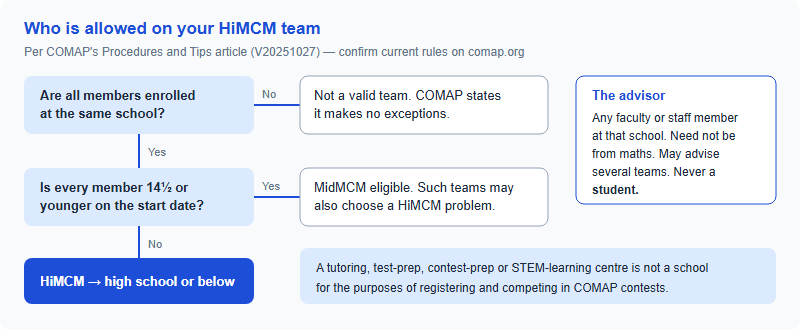
Before role design comes eligibility, and this is where families most often make a plan that cannot legally be executed. COMAP’s article Procedures and Tips for a Great Experience (version V20251027) states the constraints plainly. COMAP notes that this article “accompanies, but does not replace” the official rules and registration information, so treat the summary below as orientation and confirm current requirements on comap.org.
- Team size is one to four students, with four the maximum. COMAP adds a data point worth taking seriously: “Historically, the best teams have four members.”
- Every member must attend the same institution. COMAP states that all students on the team must be enrolled at the same institution at the start of the contest, and that it “will make no exceptions to this rule.”
- A training centre is not a school. COMAP defines a team’s school as the “primary and comprehensive full-time provider” of the members’ education in all subjects, and states that tutoring, test-prep, contest-prep and maths- or STEM-learning centres are not considered schools for the purposes of registering and competing. If a student is told they can be entered through a training programme rather than their day school, that is worth questioning before any money changes hands.
- The roster locks before the window opens. Advisors do not need named students when they first pay and register, but COMAP requires specific members to be designated for each Team Control Number before the contest window opens, after which “team members cannot change.”
- Eligibility is broad. COMAP states that all students in high school grades or below can participate in HiMCM, while MidMCM is for students 14½ years or younger on the start date of the contest.
For 2026 the contest window is 4–17 November 2026. The practical consequence of the roster rule is that team selection is a September and October activity, not a November one. A student who is still deciding in week one of the window is not on the team.
The four jobs a HiMCM paper actually requires
A HiMCM paper is not one task performed four times. COMAP’s guidance on what the strongest papers contain is unusually specific: they “usually include sections that address assumptions with justifications, modeling process(es), results of modeling/analysis, strengths and weaknesses, sensitivity, and conclusions”, and they carry “in-line documentation, footnotes, or endnotes with associated references”.
Read that list as a job description and four distinct roles fall out of it.
| Role | Owns | Heaviest days | What breaks if nobody owns it |
|---|---|---|---|
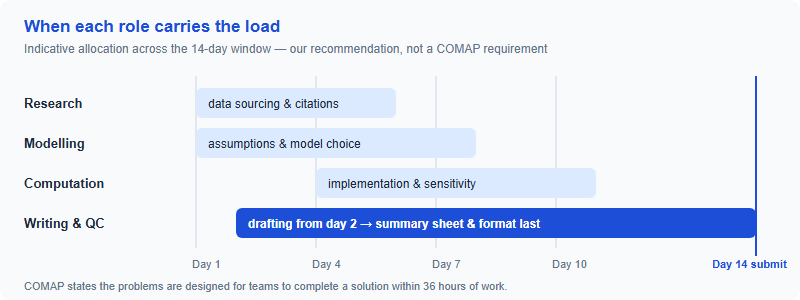
| Modelling | Framing the question, stating assumptions and their justifications, choosing a model family and arguing why that one | Days 1–7 | The paper describes a calculation but never explains why this model rather than another — in our editorial view the most costly weakness |
| Computation | Implementation, results, sensitivity analysis, testing how conclusions move when inputs move | Days 4–10 | Numbers appear with no evidence they are robust; a reader cannot tell whether the result is real or an artefact of one input |
| Research | Finding and checking data, and recording every source in a citable form as it is collected | Days 1–5 | Weak data silently invalidates strong mathematics, and untracked sources become a compliance problem at submission |
| Writing & QC | The summary sheet, the through-line, English clarity, and every formatting requirement | Days 2–14 | The team’s best thinking never reaches the judges, because the only artefact judged is the paper |
Two clarifications, because this table is easy to over-read. These are roles, not people: on a four-person team everyone contributes mathematically, and ownership means “this person makes sure it happens and is finished”, not “this person works alone.” And a three-person team is entirely legal — it simply means somebody carries two roles, which is a decision to make deliberately rather than discover on day eleven.
Why writing starts on day two, not day twelve
The most useful thing COMAP publishes about workload is easy to miss. The 14-day window replaced a previously required 36-hour working window, and COMAP is explicit that this was a scheduling change, not a difficulty increase: it “does not indicate an increase in difficulty of the problems, or a need for teams to spend more than 36 hours”, and the problems remain “designed for teams to complete a solution within 36 hours of work.”
So the real resource is not fourteen days. It is roughly 36 hours of working time, spread across fourteen calendar days, in whatever sessions the team can schedule around school. That reframing is what makes role ownership urgent: 36 hours divided four ways is not much, and the writing role has to draw from the same envelope as the modelling role.
What your advisor can do — and the rule that surprises everyone
COMAP’s advisor rules are more permissive than most families expect in one direction and far stricter in another.
Permissive: any faculty or staff member at the students’ school can be the advisor, the advisor does not have to be from the mathematics department, and one advisor may serve multiple teams. A physics teacher, an economics teacher or a librarian can hold the role. What is fixed is that a student can never act as advisor.
Strict, and this is the one that catches teams: during the contest period, teams may not seek help in obtaining answers, ideas, information or resources from anyone outside the team — explicitly including their own advisor, other teachers, other students, and experts in the relevant field. COMAP’s restriction extends to electronic social media, and it prohibits posting or sharing any part of the problem statement or the team’s work in any form during the contest. COMAP states that it monitors the internet during the contest period, and that violating teams will be disqualified or deemed unsuccessful.
The advisor’s actual contest-time duties are administrative: they must be present at the start to release the problems to the team, must verify that the team stops working at the end of the window, and sign the team control sheet after submission. So every question a team wants to ask a teacher has to be asked before 4 November. That is an argument for a serious practice run in October, not a light one.
A 30-minute exercise to assign the roles
Assign roles by evidence rather than by self-report, because everyone claims to be flexible in September and nobody wants the writing seat. Run this before the roster is locked.
- Give the whole team one past problem and 20 minutes. Do not solve it. Only produce a list of assumptions you would need to make, and for each one a sentence justifying it. Watch who naturally reaches for structure and who reaches for calculation — that is your modelling owner versus your computation owner.
- Ask each student to find one usable dataset in 10 minutes and cite it properly. The student who returns with a source, a date, and a note on how the data was collected is your research owner. Speed matters less than the instinct to record provenance.
- Ask everyone to write 150 words explaining a model they already understand to a reader who does not. The writing owner is whoever produces something a non-specialist can follow, not whoever writes most.
- Then check the calendar honestly. Early-to-mid November collides with mock examinations and, for Grade 12 students, application deadlines. A brilliant teammate with no free hours in the window is a liability to the other three.
If your school does not have four suitable students who can commit, a smaller team is a legitimate answer. Our team matching page works through building around complementary skills, and the introduction to how HiMCM differs from problem-solving contests is worth sharing with a candidate teammate before they commit — several students discover at that point that the contest is not what they assumed.
Frequently asked questions
Can students from two different schools form one HiMCM team?
No. COMAP requires all members to be enrolled at the same institution at the start of the contest and states it makes no exceptions.
Is a four-person team better than a three-person team?
COMAP notes that historically the best teams have four members. Fewer is permitted, but someone must then carry two of the four roles.
Can our advisor help us during the contest?
No. COMAP prohibits seeking ideas, answers or resources from anyone outside the team, explicitly including the advisor. Their contest-time role is administrative.
Can we swap a team member after the window opens?
No. Members must be designated for each Team Control Number before the window opens, and COMAP states they cannot change after that.
This is an independent English-language guide to HiMCM for China-based international-school students, operated by Hanlin Education. It is not affiliated with, endorsed by, or sponsored by COMAP. COMAP is the sole official authority for HiMCM rules, dates, registration and results — requirements change between editions, so always confirm current details on comap.org before registering or submitting. Confirmed errors are corrected within 7 working days.