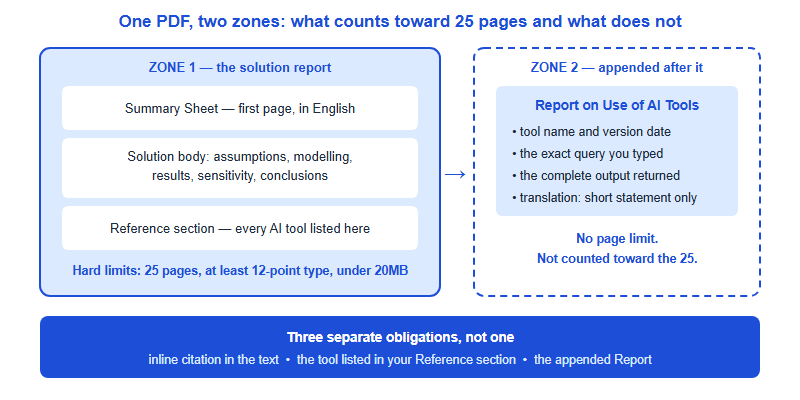
COMAP permits the careful use of AI tools in HiMCM, but only on one condition: you declare everything. Teams must clearly indicate which model was used and for what purpose, cite it inline, list it in the reference section, and append a Report on Use of AI Tools after the 25-page solution — a report that carries no page limit and does not count against the 25. Crucially, the policy covers translation software too.
That last clause is the one that matters most for teams in China, and it is the one almost nobody reads. It also lands close to the heart of the contest: the line between a tool that helps you write and a tool that does your thinking runs straight through what HiMCM is actually testing.
The policy in one paragraph
COMAP publishes a standalone document, Use of AI Tools in COMAP Contests (version v102025), and summarises it again inside the HiMCM/MidMCM Procedures and Tips for a Great Experience article (version V20251027). The two are consistent, and the framing is worth quoting because students routinely get it backwards: “Solving the problems does not require the use of AI tools, although their responsible use is permitted.”
The scope is deliberately wide. COMAP states the policy “applies to all aspects of student work, from research and development of models (including code creation) to the written report, even translations from a teams’ preferred language into English.” Teams “must be open and honest about all their uses of AI tools, including embedded AI” — and COMAP names mathematics software, translation software, code-copilots and auto-complete technologies as examples of that embedded category.
The stated consequence of silence is blunt. COMAP writes that “without open and clear citations and references of the role of AI tools, it is more likely that questionable passages and work could be identified as plagiarism and disqualified,” and adds that it “will take appropriate action when we identify submissions likely prepared with undisclosed use of such tools.” Requirements change between editions, so confirm the current policy on comap.org before you submit.
The translation clause is the trap for teams in China
A very common workflow in Chinese international schools is to think and draft in Mandarin, then translate the paper into English before submission. Nothing in COMAP’s policy forbids that. What the policy does is require you to say so.
You can tell this was written with our region in mind, because the very first worked example COMAP gives in the Report on Use of AI Tools is a Chinese translation tool: an entry naming Baidu Fanyi / Baidu Translate with its version date, and a one-line description stating that the entire paper, written in Mandarin, was uploaded to be translated into English. COMAP is not hinting that this is suspicious. It is showing you the correct way to declare it.
Translation also gets an easier disclosure than every other AI use. COMAP states that “if AI was used for translation purposes you are not required to include your full input query but simply include a statement” in the form of that first example. So the cost of compliance here is roughly two lines of text. The cost of non-compliance is that a machine-translated passage reads like text a human did not write, in a submission that says no AI was used — which is precisely the pattern the policy warns can be read as plagiarism.
What actually counts as an AI tool
Students tend to hear “AI policy” and think only of chatbots. COMAP’s list is much broader, and the categories below are the ones the policy names by type.
| Category named in the policy | What it looks like in a HiMCM team | Disclosure needed |
|---|---|---|
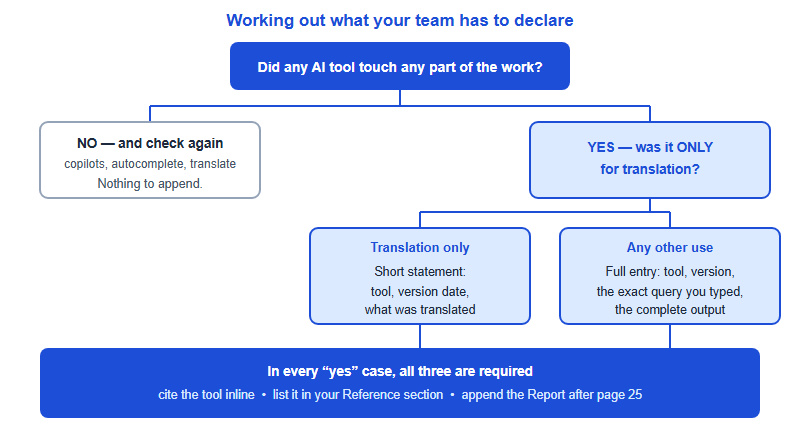
| Large language models / generative AI | Asking for an outline, summarising a source, paraphrasing, polishing English | Full entry: tool and version, the exact query, the complete output |
| Translation software | Drafting in Mandarin, translating the paper into English | Short statement only — tool, version, what was translated |
| Code-copilots | Autocompletion inside your editor while writing model code | Yes — COMAP’s own example lists a copilot used for “auto-completions for code used in preparing our models” |
| Auto-complete technologies | Writing assistants that rewrite or complete sentences as you type | Yes — explicitly inside the “embedded AI” category |
| Mathematics software | AI-assisted features in computational tools | Yes, where AI assistance was involved |
The practical reading: the question is not “did we use ChatGPT?” It is “did anything with a model inside it touch any part of this submission?” A team that answers the first question honestly and the second question carelessly is still exposed.
The four things COMAP requires teams to do
The policy sets out an explicit list. Paraphrased closely, teams are required to:
- Clearly indicate the use of AI tools in the report, “including which model was used and for what purpose”, using inline citations and the reference section, and appending the Report on Use of AI Tools after the 25-page solution.
- Verify the accuracy, validity and appropriateness of any content and any citations the tool generated, and correct errors or inconsistencies.
- Provide citation and references, double-checking that citations are accurate and properly referenced.
- Stay conscious of the potential for plagiarism, since AI tools “may reproduce substantial text from other sources” — so check the original sources yourself.
Requirement two deserves a moment. COMAP is telling you that generated citations are your problem, not the tool’s. The policy states plainly that AI tools “have been shown to generate citations that don’t exist.” A fabricated reference in your bibliography is not a technology failure in the judges’ eyes; it is an uncredited or false source in a contest where, separately, COMAP states that failure to credit a source “may result in a reduction of award level, or in disqualification if deemed plagiarism.” Note the phrasing: reduction of award level is a graded penalty, not an all-or-nothing one.
Why the report format is its own deterrent
Read the required format for a non-translation entry carefully and something becomes obvious. For each use, COMAP’s examples call for the tool and its version, then the exact wording you input, then the complete output from the tool.
Complete output. Not a summary, not the part you kept. A team that prompts casually forty times across two weeks and then tries to comply on the final evening faces an unpleasant arithmetic problem, and an impossible memory problem: nobody can reconstruct the exact wording of a query from eleven days ago. In our editorial view this is the real design of the policy — it does not ban anything, it simply makes undocumented, high-volume prompting expensive to declare and impossible to declare honestly after the fact.
The fix is procedural and costs nothing if you start on day one. Keep a single shared AI log alongside your source log, with five columns: date, tool and version, the exact query pasted in, the complete output pasted in, and where in the paper it ended up. The team member who owns writing and quality control should own this file too. Assembling the Report on Use of AI Tools then becomes a copy-and-paste job on the last day rather than an archaeology project.
Where COMAP tells you to be careful, and why it lines up with the judging
The policy separates tasks it considers reasonable from tasks it flags as risky. COMAP “recognizes the value of AI tools as productivity tools” for things like generating initial ideas for a structure, summarising, paraphrasing and language polishing. It then advises “caution when using these technologies for tasks such as model selection and building, assisting in the creation of code, interpreting data and results of models, and drawing scientific conclusions.”
That line is not arbitrary. It falls almost exactly where the contest’s value falls. HiMCM rewards defensible modelling decisions rather than correct answers, and the four items COMAP flags — choosing the model, building it, interpreting what came out, deciding what it means — are the four decisions the judges are actually reading your paper to assess. Outsourcing them does not just carry policy risk; it removes the thing you are being marked on.
COMAP also lists four specific risks teams should be aware of: objectivity (biases in previously published content resurfacing in generated text, and important viewpoints going unrepresented), accuracy (hallucination, content that is “linguistically but not scientifically plausible”, wrong facts, non-existent citations, and training data that stops at a fixed date), contextual understanding (idiom, sarcasm and metaphor misread), and training data (thin coverage in some domains and languages limiting output quality). For a modelling paper the accuracy risk is the expensive one: a plausible-sounding but wrong justification for an assumption will not survive contact with a judge who models for a living.
Two further mechanisms sit alongside the AI policy and are worth knowing. COMAP states it runs comparison software over every submitted solution against all other solutions to the same problem, to verify originality. And separately from AI, COMAP’s rules on sources are permissive but exacting: teams “may use any inanimate source of data or materials” — computers, software, references, websites, books — provided all of it is credited with in-line documentation, footnotes or endnotes plus a full bibliographic citation in a Reference section. Uncredited pictures, graphics, charts, background information and ideas all count. If you are already keeping a rigorous source log, adding an AI log next to it is a small extra step; our preparation resources work through both.
Frequently asked questions
Is using ChatGPT allowed in HiMCM?
Yes, carefully. COMAP states AI use is permitted but not necessary, and requires full disclosure in an appended Report on Use of AI Tools.
Do we have to declare translation software?
Yes. COMAP’s policy covers translations into English, though translation needs only a short statement rather than the full query and output.
Does the AI report count toward the 25-page limit?
No. COMAP states the Report on Use of AI Tools has no page limit and is not counted as part of the 25-page solution.
What happens if we use AI and do not disclose it?
COMAP states it will take appropriate action, and that undisclosed use makes passages more likely to be identified as plagiarism and disqualified.
This is an independent English-language guide to HiMCM for China-based international-school students, operated by Hanlin Education. It is not affiliated with, endorsed by, or sponsored by COMAP. COMAP is the sole official authority for HiMCM rules, dates, registration and results — requirements and policies change between editions, so always confirm current details on comap.org before registering or submitting. Confirmed errors are corrected within 7 working days.