COMAP recognises successful HiMCM papers as Outstanding, Finalist, Meritorious, Honorable Mention or Successful Participant, with Unsuccessful and Disqualified below that. What moves a paper up is rarely harder mathematics. It is covering every requirement, justifying assumptions, testing them, and writing so a judge never has to guess. Several compliance faults can pull a paper down mechanically.
Two things make this worth understanding in August rather than in February. First, the tiers are not a mystery ranking — COMAP publishes what strong papers contain, and the gap between tiers maps onto that list with unusual clarity. Second, the distribution is steep, and a team that expects Finalist on a first attempt will read its result as failure when it is in fact a good outcome. Judging is completed in January and results are posted on or before 1 February each year, so the expectations you set now are the ones you live with then.
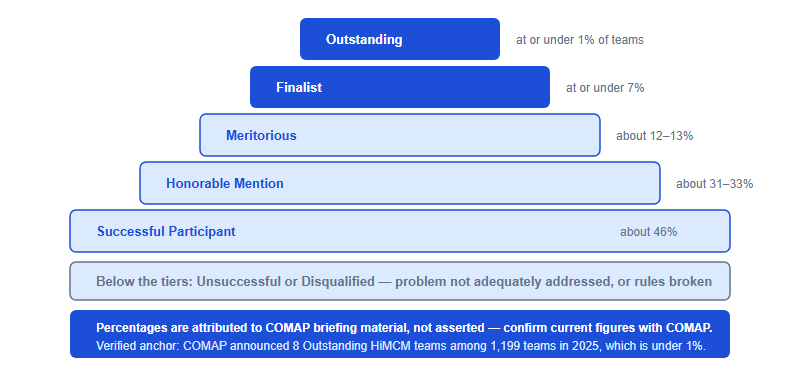
The five levels, plus the two designations nobody talks about
COMAP's contest instructions state that it recognises successful solution papers in the categories of Outstanding, Finalist, Meritorious, Honorable Mention and Successful Participant, and that papers which do not adequately address the problem or which violate contest rules are designated Unsuccessful or Disqualified. Those last two matter because they are not a low grade — they are outside the recognition ladder entirely.
The shape of the ladder can be anchored in one verified data point. In its own announcement of the 2025 results, COMAP reported that 1,199 teams representing more than 500 schools across 24 countries and regions took part, and that eight HiMCM teams were named Outstanding. Eight out of 1,199 is under one per cent. Briefing material shared with advisors puts the rest of the distribution at roughly seven per cent or fewer for Finalist, around twelve to thirteen per cent Meritorious, around a third at Honorable Mention and a little under half at Successful Participant. Treat those as attributed figures to confirm with COMAP rather than as published thresholds; they move a little from year to year.
Two procedural facts complete the picture. COMAP states it will not rejudge papers, so there is no appeal on a designation. And once results are public, PDF certificates become available for download, with the student names exactly as the advisor typed them at registration — COMAP corrects spelling errors and typos only.
What actually separates Meritorious from Finalist
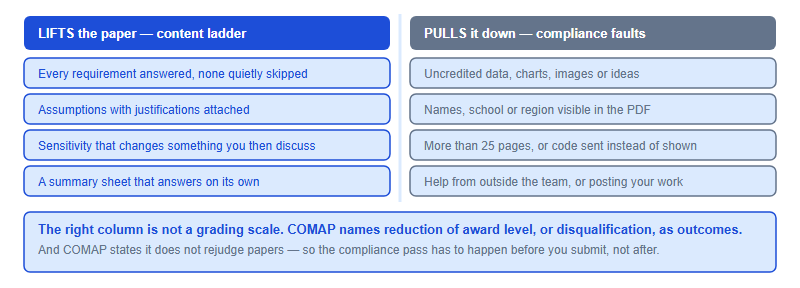
COMAP describes the best papers in terms that are unusually concrete: complete and logical analysis, organised and clear, above and beyond simply addressing the requirements, easy to read and easy to follow, usually containing sections that address assumptions with justifications, the modelling process, the results of the modelling and analysis, strengths and weaknesses, sensitivity, and conclusions — with in-line documentation, footnotes or endnotes and associated references.
Read that as a ladder rather than a checklist, and the tier boundaries stop feeling arbitrary. Our editorial reading, based on that description and on the published judges' commentaries, is that papers climb in this order.
| Step | What the paper does | Where it typically lands |
|---|---|---|
| 1 | Addresses some requirements; model stated but not justified; no test of assumptions | Successful Participant territory |
| 2 | Addresses every requirement in the problem statement, with results reported clearly | Honorable Mention territory |
| 3 | Assumptions carry justifications; sensitivity is present; strengths and weaknesses are specific rather than generic | Meritorious territory |
| 4 | Sensitivity changes the recommendation and the paper says so; sources documented in-line; the summary sheet alone conveys the answer | Finalist territory |
| 5 | Goes beyond the requirements with insight a judge had not expected, and remains readable throughout | Outstanding territory |
The jump from step two to step three is the one most teams can actually make in a first season, and it is almost entirely about discipline rather than talent. It costs a table of assumptions with reasons attached, one sensitivity sweep, and an honest limitations section. None of that requires mathematics beyond what the model already uses — it requires deciding on day two that these sections exist, which is the same habit described in our foundation piece on why the model, not the answer, is the object being judged.
The faults that cost a level mechanically
Some tier losses have nothing to do with quality. COMAP is explicit that failure to credit a source for data or materials — pictures, graphics, charts, background information, ideas — may result in a reduction of award level, or in disqualification if it is deemed plagiarism. It also runs comparison software over every submitted solution against all other submissions for the same problem, to verify originality.
- Uncredited sources. In-line documentation, footnotes or endnotes, plus a full bibliographic citation in a reference section. COMAP names reduction of award level as a possible consequence.
- Identifying information in the PDF. Student names, advisor name, institution and geographic region must not appear anywhere in the solution; only the team control number. If a letter needs a closing, sign as the team number.
- Overrunning the page limit. The entire solution is one PDF of at most 25 pages, in English, at least 12-point type, US Letter or A4, with the summary sheet as the first page of that same file.
- Sending code or data files. COMAP states programs, software and databases should not be included and are not used in judging — so anything essential must be visible inside the paper.
- Outside help or posting work. No answers, ideas, information or resource help from anyone outside the team during the window, including the advisor, and no sharing of the problem or any part of your work in any medium. COMAP states it monitors the internet during the contest.
- Administrative slips. Team control number and page number at the top of every page, the PDF named with the control number, attachment under the stated size limit, and a check 24 to 48 hours after the deadline that the submission was received.
- Missing AI-use report. Per COMAP's contest instructions, a team that uses AI tools must follow COMAP's AI-use policy and append a separate report on that use to the end of its PDF; confirm the current wording on comap.org.
Setting an honest expectation for a first HiMCM season
If the attributed distribution is roughly right, then about four in five recognised teams finish at Honorable Mention or Successful Participant. That is not a disappointing outcome; it is the modal outcome, in a field of well over a thousand teams from more than five hundred schools. A first-year team that answers every requirement, justifies its assumptions and submits a clean 25-page paper has done the thing the contest is for — and has produced a piece of evidence that a fourteen-day, four-person, open-ended project got finished, which is exactly what makes HiMCM readable on an application.
For transparency about where our own perspective comes from: across recent seasons, teams we have coached have earned 7 Outstanding, 35 Finalist and 30 Meritorious designations in HiMCM, and one Outstanding team from 2022 also received the NCTM award, of which we understand only two are given each year. Those are our own de-identified tallies, not COMAP statistics, and results vary from team to team and season to season — nothing here should be read as a predictor of any individual team's result. COMAP's own 2025 announcement separately named NCTM Winners alongside the Outstanding list, which is consistent with how rare that recognition is.
One tier target we would gently push back on: aiming at Outstanding as a first-season goal. Under one per cent means eight teams worldwide in 2025. Aim at step three or four of the ladder above, which is inside your control, and let the rest follow.
Using last season's results properly — and the line you must not cross
COMAP itself recommends reviewing the Outstanding papers and reading the judges' commentary after each contest, for insight into the content and presentation quality of the best papers, and says to look at the structure of Outstanding papers in terms of organisation and presentation. Note the word: structure. That is the legitimate use, and it is genuinely instructive — you learn how long a summary sheet runs, where the assumptions section sits, how figures are captioned, how a limitations section sounds when it is confident rather than apologetic.
The line is absolute. Studying structure and reasoning is preparation; reusing a model, prose, a figure, code or even a citation list from another paper is plagiarism, and COMAP states that plagiarism results in disqualification and that it compares every submission against all others for the same problem. A disqualified paper is fourteen days of a four-person team's work turned into nothing. If you want organised material to study from, our own compiled study pack — awarded-paper structure notes, methodology walkthroughs and templates we have put together ourselves — can be requested by scanning the WeChat QR code in the site footer; worked material is not available for every year, and what you receive is what our teachers have prepared. Everything in it is meant to be read the way COMAP suggests: for architecture and argument, then closed before you write a word of your own paper. If you are still building the habits that make that reading useful, start from what the contest is actually asking a team to do.
Frequently asked questions
How many HiMCM teams win Outstanding?
Very few. COMAP announced eight Outstanding HiMCM teams among 1,199 teams in the 2025 contest, which is under one per cent of entries.
When are HiMCM results released?
COMAP states judging is completed in January and results are posted on or before 1 February. The 2025 results came on 23 January 2026.
Is Honorable Mention a good HiMCM result?
It is a solid one. Briefing figures attributed to COMAP put Honorable Mention around a third of teams, so most recognised papers sit there or below.
Can a HiMCM award level be appealed or re-marked?
No. COMAP states it will not rejudge contest papers and stands behind the designations awarded, so the compliance check must happen before you submit.
This is an independent guide operated by Hanlin Education for China-based international-school students. We are not affiliated with, endorsed by, or sponsored by COMAP, which is the sole official authority for HiMCM rules, dates, registration, judging and award designations. Award proportions cited here are attributed to COMAP briefing material rather than asserted, and our own coaching tallies are de-identified and not COMAP statistics; results vary. Confirm all current details on comap.org before acting on anything here. Errors reported to us are corrected within 7 working days.