A HiMCM team of up to four students has fourteen days, one open-ended problem and no answer key. Most teams sort out who does what. Very few sort out who decides what — and that is the gap that turns a good model into a paper finished at 02:00 by whoever was still awake. Settle five decisions in September and the window becomes a schedule instead of an argument.
Roles tell you who does the work. They do not tell you who decides
Splitting a team into modelling, computation, research and writing is the right first move, and it is well covered ground. But a division of labour is silent on the questions that actually stall teams: when do we stop improving the model? Whose spreadsheet is the real one? Who gets to cut a section that someone spent two days on? Those are not work items. They are decision rights, and if nobody holds them the team resolves them by attrition — usually late, usually badly.
This matters far more in HiMCM than in a contest with an answer key, because the deliverable is an argument rather than an answer. When there is a correct answer, disagreement resolves itself: someone checks. When the question is whether your assumption about demand growth is defensible, four intelligent students can disagree indefinitely, and often do, for three days you did not have.
A team agreement is not a legal document and it is not about distrust. It is a one-page note, written before anyone is tired, that says what happens when a decision has to be made and the team is split.
The five decisions that need a named owner
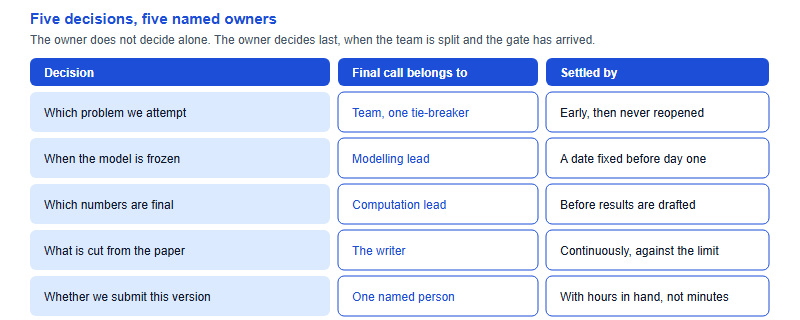
Name a person — not a role, not “the group” — against each of these. The owner does not decide alone; the owner decides last, after everyone has been heard and the clock has run out.
| Decision | Who should own it | Gate it must clear by | What happens if nobody owns it |
|---|---|---|---|
| Which problem we attempt | The whole team, with one named tie-breaker | Very early in the window; the choice is not revisited afterwards | A team quietly works on two problems for three days, then abandons one and keeps the weaker start. |
| When the model is frozen | The modelling lead | A pre-agreed calendar point, set before the window opens | Improvements keep arriving until there is no time to test or write. This is the single most common way a promising paper is lost. |
| Which numbers are final | The computation lead, via one results file | Before the writer drafts the results section | Two versions of a table circulate, the paper quotes one and the appendix the other, and a judge sees a contradiction. |
| What goes in the paper and what is cut | The writer | Continuously, as the page budget tightens | Everyone defends their own section, the report overruns the page limit, and the cut is made at random at the end. |
| Whether we submit this version | One named person, agreed in advance | With deliberate hours in hand, not at the deadline | Nobody presses submit because nobody feels entitled to, and the team discovers the deadline time zone the hard way. |
Two of those owners are worth a note. The model freeze should belong to the person most invested in the model, because they are the only one whose refusal to freeze is credible — if the writer calls it, it reads as impatience. The cut decision should belong to the writer, because the page limit is a writing constraint before it is a modelling one. COMAP’s contest instructions describe a limit of 25 total pages covering all solution work and any additional material; confirm the current limit and file requirements on comap.org, and note that a page budget assigned in advance is much easier to enforce than a page budget discovered on day twelve.
Three failure modes worth writing a clause against
These are the patterns we see repeatedly in coaching, described here as our own observation rather than as any kind of contest statistic. Each has a one-line clause that prevents it.
- The silent member. Someone goes quiet on day three. By day eight nobody wants to raise it, because raising it feels like an accusation, and by day eleven their section does not exist. Clause: every member posts one line each evening saying what they did and what is blocked. No line for two consecutive days triggers a call — not a judgement, a call. The rule is about visibility, not policing, and it works because it is symmetric.
- The two-truths spreadsheet. Two people run variants of the model on their own machines. Both sets of numbers are plausible, and the paper ends up quoting a mixture. Clause: one results file, one owner, and a rule that any number appearing in the paper is copied from that file and nowhere else. A judge who finds the same quantity stated twice with different values has been handed a reason to doubt everything else.
- The day-eleven writing start. The team treats writing as transcription that happens once the maths is finished. It is not; it is where the argument is actually constructed, and it always takes longer than the estimate. Clause: the writer starts drafting structure and assumptions while the model is still being built, and the agreement states a date on which a complete rough draft exists — complete meaning every section present, even if some contain the sentence “results pending”.
Notice that all three clauses are cheap. None of them costs an hour to implement in September, and each of them costs a team an award level in November.
Continuity: what happens when someone disappears for four days
In a fourteen-day window that sits inside a school term, somebody will be ill, sitting an exam, or travelling. This is not a hypothetical to plan for later; it is close to certain, and it is the one clause most teams never write.
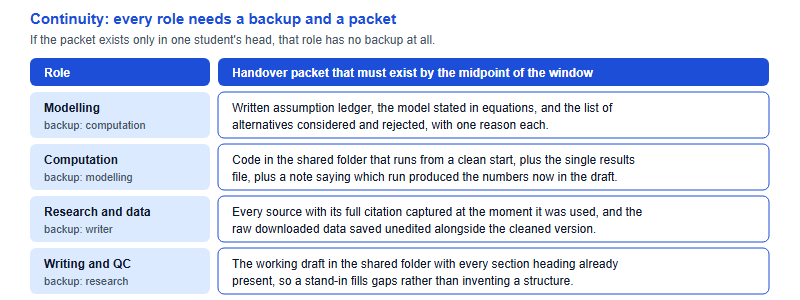
For each role, name a second person and define the handover packet — the minimum that must exist so that somebody else can pick the work up without an explanation. If the packet only exists in one student’s head, the role has no backup regardless of what the agreement says.
The clauses your agreement is not allowed to contradict
A team agreement sits underneath the contest rules, never over them. Four points are worth writing into the document explicitly, so that nobody proposes a convenient shortcut on day nine.
- The roster is bound before the window. Per COMAP’s contest instructions, members ordinarily come from the same school, and students from different schools may team up only where they belong to the same officially approved Program — an educational programme not run solely for contest preparation. A tutoring or test-preparation centre does not qualify. Confirm the current wording on comap.org. Practically: you cannot recruit a replacement from another school mid-window, which is exactly why named internal backups matter. If you are short of a fourth from your own school, the site’s team-matching page is the place to start that conversation early.
- The work is the team’s own. Per COMAP’s contest instructions, teams may not use any persons other than their own team members to discuss or obtain ideas for solving their problem — an advisor, a tutor or a parent may not contribute modelling ideas, code or text during the window; confirm the current wording on comap.org. Write this into the agreement so that asking is visibly out of bounds rather than a grey area at 23:00.
- AI use is logged as it happens. Per COMAP’s contest instructions, a team submits a separate report on its use of AI tools alongside the paper, stating whether such tools were used, which ones, and for what purpose — text generation, coding support, data analysis. Confirm the current requirement and wording on comap.org. The agreement clause is simple: anyone who uses a tool records it in a shared log the same day. Reconstructing that log from memory on the final evening is unpleasant and unreliable.
- Awarded papers are read for structure, never borrowed from. Studying past awarded papers is legitimate and useful for understanding how a modelling argument is built. Copying a model, prose, figures, code or citations from one is plagiarism, and it ends a team’s contest. Any preparation material we compile is our own, obtained by scanning the WeChat QR code in the site footer rather than from an official download, and worked material is not available for every year.
Three moments the agreement will actually be tested
A document nobody rereads is decoration. Rehearse the three conversations now, in September, while they cost nothing.
The freeze is called and someone objects. The right response is not to reopen the model but to log the objection: write the proposed improvement into the limitations section as future work. That sentence is worth credit in a HiMCM paper, because acknowledging what your model cannot do is part of the argument rather than an admission of weakness.
A section has to be cut. The author will feel it personally. The agreement should say in advance that cuts are made against the requirement list from the problem statement — if a section does not serve a stated requirement, it goes, however elegant it is. Deciding the criterion in September is what stops it being about people in November.
The team is behind and someone suggests a shortcut. This is when the rules clauses earn their place. A team that has already written down what it will not do finds this conversation short. A team that has not spends an hour in an argument it cannot afford, and occasionally makes a decision it cannot undo.
Write the agreement on one page, have all four students read it out loud once, and put it in the shared folder next to the draft. It is the cheapest preparation available, and it is the part of team formation that the fourteen-day, no-answer-key structure of this contest makes indispensable.
Frequently asked questions
Is a written team agreement required by COMAP?
No. It is our own editorial practice, not a contest requirement. The binding rules on teams and conduct are COMAP’s — confirm on comap.org.
Can a teammate be replaced during the contest window?
Treat the roster as fixed once registered, and note the same-school and approved-Program limits. Confirm the current rules on comap.org.
Who should have the final say on the model?
The modelling lead, at a freeze date agreed before the window opens. Later objections belong in the limitations section, not in a reopened model.
Do we have to declare our use of AI tools?
Per COMAP’s contest instructions a separate report on AI tool use is submitted with the paper. Confirm the requirement on comap.org.
This is an independent guide operated by Hanlin Education for China-based international-school students. We are not affiliated with, endorsed by, or sponsored by COMAP or the High School Mathematical Contest in Modeling. Rules, dates, eligibility, team composition and submission requirements are set by COMAP — confirm current details on comap.org before acting on anything here. Factual errors are corrected within 7 working days of notice.