Reading awarded HiMCM papers is the fastest way to calibrate what a defensible modelling argument looks like — COMAP itself tells teams to “look at the structure of the Outstanding papers in terms of organization and presentation.” But COMAP also compares every submitted solution against all other solutions of the same problem. So the skill worth learning is how to take structure and reasoning from a paper while taking nothing else.
The distinction matters because HiMCM has no answer key: two teams can model the same problem in completely different ways and both score well. What you are trying to extract from an awarded paper is therefore not a solution — there is no solution to extract — but the shape of an argument that judges found convincing.
What COMAP actually checks, stated precisely
Most students underestimate this because they picture a teacher skim-reading. The machinery is more systematic than that. According to COMAP’s Procedures and Tips for a Great Experience article (version V20251027) — which COMAP notes “accompanies, but does not replace” the official rules, so confirm current wording on comap.org — three separate mechanisms apply:
- Every paper is compared against every other paper on the same problem. COMAP states that it compares each submitted solution to all other solutions of the problem your team chose, and that the comparison “identifies solutions and/or parts of solutions that are exactly and/or similar to other papers”, used to verify originality. Note the scope: COMAP does not limit this to published winners, and states no year boundary for the comparison. Two teams that studied the same awarded paper too closely can flag each other.
- Uncredited material is penalised even when it is not plagiarism. COMAP states that failure to credit a source for data or materials — and it lists “pictures, graphics, charts, background information, ideas” — “may result in a reduction of award level, or in disqualification if deemed plagiarism.” Sloppy citation has a cost of its own.
- Plagiarism ends the contest. COMAP states plainly that plagiarism will result in disqualification, and that it investigates all suspected instances.
The reassuring half of the same rule is that sources are welcome. COMAP states that teams may use any inanimate source of data or materials — computers, software, references, websites, books — provided all sources are credited using in-line documentation, footnotes or endnotes, plus a full bibliographic citation in a Reference section. Using the literature is expected. Absorbing it silently is not.
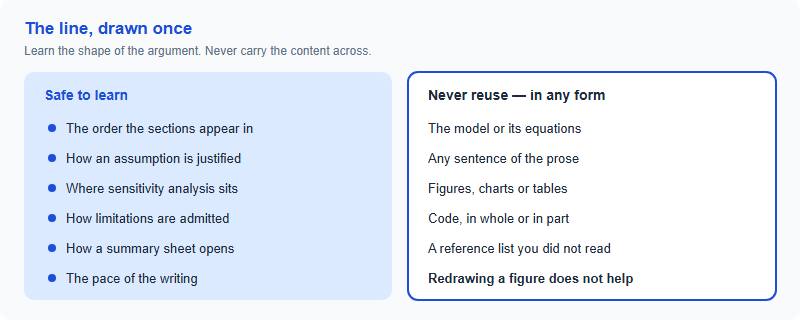
A reading protocol that keeps you on the safe side
The risk is rarely deliberate. It comes from having an excellent paper open in one window while drafting in another, at hour thirty of a tiring fortnight. The fix is procedural rather than moral: separate the reading from the writing so completely that transfer is physically inconvenient.
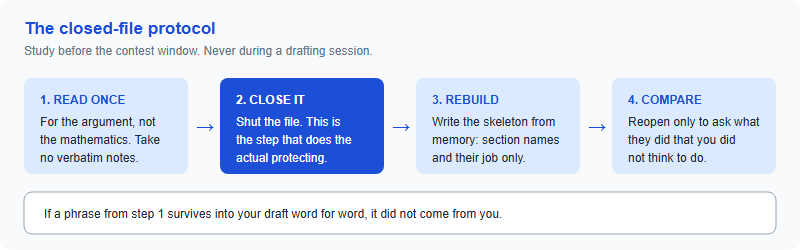
Step three is where the learning happens. Reconstructing a paper’s skeleton from memory forces you to encode it as function — “there is a section here whose job is to admit what the model cannot do” — rather than as text. Function is transferable. Text is not.
It also helps to read with one narrow question per pass rather than in general. On the first reading, ask only how the team justified their assumptions. On a second, ask only what they chose to leave out of the model and whether they admitted it. On a third, ask where the sensitivity analysis sits and what it actually tested. Reading a paper three times with a narrow question each time teaches far more than reading it once with none — and it produces notes about method, which are safe to keep, rather than notes about content, which are not.
What transfers, item by item
| Element | What you may take | What would cross the line |
|---|---|---|
| Section architecture | The ordering itself: assumptions, modelling process, results, sensitivity, strengths and weaknesses, conclusions | Lifting headings together with the content beneath them as a fill-in template |
| Assumptions | The move: state the assumption, give the reason, note what it costs you | Adopting their assumption list because your problem looks similar |
| Model choice | How they argued for one family over another | The model, its equations, or its parameter values |
| Sensitivity analysis | That it exists, where it sits, what question it answers | Their ranges, tables or charts, redrawn or not |
| Figures | The principle that a figure should carry an argument, not decorate | Any figure reproduced or reconstructed from theirs |
| Code | Nothing — COMAP states programs and software are not used in judging and should not be submitted | Pasting or lightly editing code from any source without credit |
| References | How sources are credited in line and listed at the end | Copying a bibliography for sources you never opened |
| Prose | Nothing. Register and pace can be imitated; sentences cannot | Any sentence, paraphrased or not |
The AI question, answered by the rule rather than by rumour
This is the point on which Chinese-language discussion is least reliable, and where the actual policy is more permissive and more demanding than most teams assume. COMAP’s stated position is that it permits careful use of AI tools such as ChatGPT, while noting such tools are not necessary to produce a solution. Two conditions attach:
- Teams choosing to use AI tools must follow COMAP’s published AI use policy, which COMAP states applies to all aspects of student work — from research and model development, including code creation, through to the written report.
- Use produces an additional report appended to the end of the PDF. Helpfully, COMAP states this report does not count toward the page limit for the solution.
Because COMAP says it will refine this policy as the technology evolves, read the current version on comap.org before the window opens rather than relying on last year’s summary — including this one. The practical reading for a team: undeclared AI use is the risk, not AI use itself. Decide your policy in October and write it down, so that nobody improvises at 1am on day thirteen.
The rule that suspends studying altogether
Everything above describes preparation before 4 November. Once the window opens, a stricter regime applies. COMAP states that teams may not seek help in obtaining answers, ideas, information or resources from anyone outside the team — including their advisor, other teachers, other students and subject experts — and that this extends to electronic social media. It also prohibits posting or sharing any part of the problem statement or the team’s work, partial or complete, in any form during the contest, and states that COMAP monitors the internet during the contest period.
So a group chat asking “has anyone modelled something like Problem B before?” is not a grey area. Neither is posting a screenshot of a chart for feedback. Both are the kind of thing a tired team does at midnight without thinking of it as cheating, which is exactly why it should be agreed as a team rule in advance.
Which is the real argument for doing this work properly in advance, and in the right order. Understand what the contest rewards, then read papers, then practise — not the reverse, because a student who reads awarded papers before understanding that HiMCM rewards defensible choices rather than correct answers tends to read them for the mathematics and miss the argument entirely.
COMAP publishes commentary alongside its results and recommends reviewing outstanding papers and reading the judges’ commentary after each contest for insight into the content and presentation of the strongest work. That commentary is often more instructive than the papers, because it states what the judges valued instead of leaving you to infer it. Our own compiled study material is assembled by our team to support this kind of structural reading; worked material is not available for every year, and none of it is a substitute for the current rules on comap.org.
One closing note on incentives. The reason to be careful is not only that disqualification is severe. It is that copying a structure you have not understood produces a paper that collapses at the first question a judge asks of it — the assumption that has no justification, the sensitivity section that tests the wrong input. Understanding transfers. Text does not.
Frequently asked questions
Can we look at past HiMCM papers before the contest?
Yes. COMAP encourages studying the structure of Outstanding papers for organisation and presentation. Study structure and reasoning, never content.
Is paraphrasing an awarded paper safe?
No. COMAP states its comparison identifies parts of solutions that are exactly or similar to other papers, so rewording is not protection.
Are AI tools allowed in HiMCM?
COMAP permits careful use, but requires teams to follow its AI use policy and append an additional report to the PDF. Confirm the current policy on comap.org.
What happens if we forget to credit a source?
COMAP states failure to credit data or materials may reduce your award level, or lead to disqualification if it is deemed plagiarism.
This is an independent English-language guide to HiMCM for China-based international-school students, operated by Hanlin Education. It is not affiliated with, endorsed by, or sponsored by COMAP. COMAP is the sole official authority for HiMCM rules, dates, registration and results — requirements change between editions, so always confirm current details on comap.org before registering or submitting. Confirmed errors are corrected within 7 working days.