A HiMCM team submits one PDF. The judges never see your code, your group chat, or the elegant idea you had on day four — COMAP states that programs and software are not used in the judging process and should not be sent. Everything the team did has to survive into a written English document that opens with a summary sheet and fits inside a 25-page limit. That document is the product.
This is the practical consequence of the fact that HiMCM rewards defensible choices rather than correct answers. An unwritten argument is an unmade argument.
Fourteen days, but a 36-hour job — and writing is what gets cut
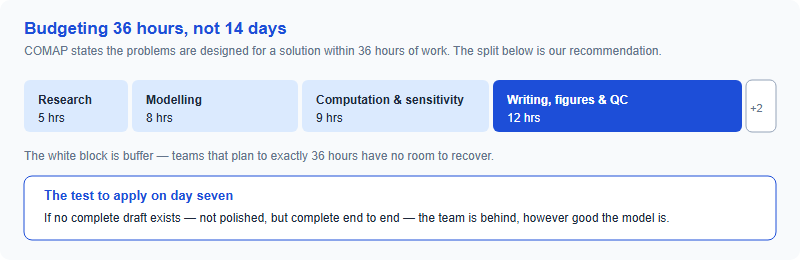
The single most useful workload fact COMAP publishes is one most teams never see. The 14-day window replaced a previously required 36-hour working window, and COMAP’s Procedures and Tips for a Great Experience article (version V20251027) is explicit that this was a scheduling change, not a difficulty increase: it “does not indicate an increase in difficulty of the problems, or a need for teams to spend more than 36 hours”, and the problems are still “designed for teams to complete a solution within 36 hours of work.”
COMAP adds that teams are not required to use the full fourteen days, and that students may work virtually rather than physically together. So the real budget is roughly 36 working hours spread across a fortnight, scheduled around school. Since COMAP notes this article accompanies rather than replaces the official rules, confirm current requirements on comap.org.
Once you see the budget as hours rather than days, the failure mode becomes obvious. Modelling and computation expand to fill whatever time exists, because they are the enjoyable parts and because there is always one more refinement available. Writing is what remains — and it is the only part the judges assess.
What goes into the PDF, and in what order
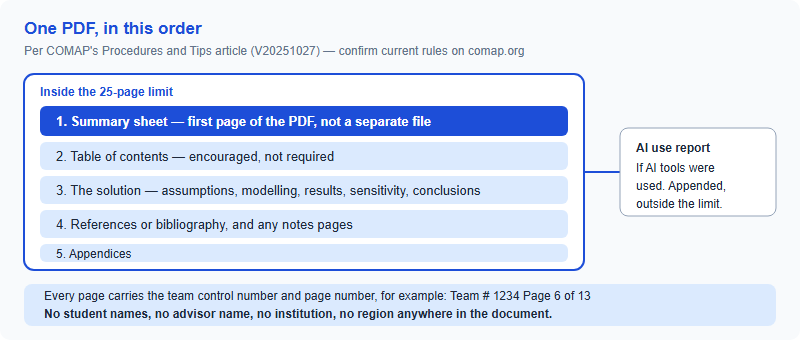
COMAP is specific about the shape of the document. The solution report starts with the summary sheet, followed by the team’s solution; a table of contents is encouraged to guide the reader; and the reference list or bibliography, notes pages and any appendices come after the solution presentation. The whole thing is one Adobe PDF of at most 25 pages.
Two details relieve pressure. COMAP states there is no required minimum page length, and that partial solutions are accepted. A shorter paper that argues its case cleanly is not penalised for brevity. The 25 pages are a ceiling covering the summary page, any letters or memos, the reference list and supporting appendices — COMAP describes this as enough room to present a complete solution.
The summary sheet is read first, and it sets the frame
COMAP requires the summary to be the first page of the PDF and not a separate file, and requires it — like the rest of the paper — to be in English and in at least 12-point type. Beyond placement and format, how you use the page is a craft question rather than a rule, so treat what follows as our editorial recommendation.
The most common weak summary is a table of contents written in prose: “First we introduce the problem. Then we state assumptions. Then we build a model.” That tells a reader nothing they could not get from the headings. A summary earns its page when it answers, in order: what problem did you actually solve, what approach did you choose and why that one, what did you find, and how much should the reader trust it. The “why that one” clause is the part students most often skip, and it is precisely what the contest is built to reward.
Write it last, when you know what the paper concluded, and then have the one team member who did least of the modelling read it cold. If they cannot restate your result and its main limitation afterwards, the page is not doing its job.
The six things COMAP says strong papers contain
This is the closest thing to a published blueprint. COMAP states that the best contest papers “present complete and logical analysis in an organized and clear manner above and beyond simply addressing the requirements”, that they are “easy to read, easy to follow, logical, and comprehensive”, and that they will usually include sections addressing the six items below, with in-line documentation, footnotes or endnotes and associated references.
| Section | The job it does | Failure mode |
|---|---|---|
| Assumptions with justifications | Shows which parts of reality you set aside and why that was reasonable | A bare bullet list with no reasons — the most frequent weakness in student papers |
| Modelling process | Explains what you built and, critically, why this model family rather than another | Presenting the model as if it were the only option available |
| Results of the analysis | States what the model produced, in units a reader can interpret | Numbers reported without meaning, or figures with no stated takeaway |
| Strengths and weaknesses | Demonstrates you know the boundary of your own claim | Listing only strengths, which reads as a lack of self-awareness rather than confidence |
| Sensitivity | Tests whether conclusions survive when inputs move | Varying a parameter that does not matter, and skipping the one the result hinges on |
| Conclusions | Returns to the question actually asked and answers it | Ending on the mathematics rather than on the real-world question |
Treat this list as a drafting outline from day two. Reverse-engineering these sections out of a finished model on day thirteen is far harder than writing toward them from the start — and it is where the strengths-and-weaknesses and sensitivity sections usually get sacrificed. Our preparation resources work through each section in more depth.
The format rules that quietly cost award levels
These are unglamorous and they are exactly the kind of thing a team gets wrong at 11pm on the final day. COMAP’s stated requirements include:
- English, at least 12-point type, US Letter or A4, one Adobe PDF of at most 25 pages, under 20MB.
- Team control number and page number at the top of every page — COMAP gives the example format Team # 1234 Page 6 of 13. COMAP warns that mistyping or transposing the number is not uncommon, so check it twice.
- Complete anonymity. Student names, advisor and institution must not appear on any page; the control number is the only identifier. If the problem requires a letter, COMAP suggests closing it “Sincerely, Team #1234” rather than signing a name.
- Name the file with the control number, for example 1234.pdf.
- Submit one problem only. HiMCM teams choose between Problem A and Problem B; teams may work on any problem available at their level but should submit a solution to one.
- Do not attach code, software, databases or authorisation forms — COMAP states they are not used in judging.
After submission, COMAP recommends logging in the day after the contest closes to verify the solution was received, and states that status is usually posted 24–48 hours after the contest ends; if a team’s paper is not listed after 48 hours, contact COMAP with the control number. On results, COMAP states judging is completed in January with results posted on or before 1 February each year, and that successful papers are recognised as Outstanding, Finalist, Meritorious, Honorable Mention or Successful Participant — while papers that do not adequately address the problem or that violate the rules are designated Unsuccessful or Disqualified. COMAP also states it will not rejudge papers, which is one more reason the submitted document has to stand on its own.
One last warning worth passing to students directly: COMAP states that fake websites appear during the contest period claiming to represent COMAP and asking teams to pay for data or extra materials, and that COMAP will never ask you to purchase any material related to the contest. If anyone offers to sell your team contest data in November, that is the tell.
Frequently asked questions
How long should a HiMCM paper be?
At most 25 pages in one PDF. COMAP states there is no required minimum length and that partial solutions are accepted.
Where does the summary sheet go?
It is the first page of your solution PDF, not a separate file, and like the rest of the paper it must be in English.
Can we put our names on the paper?
No. COMAP requires that no student, advisor or institution name appears anywhere. The team control number is the only identifier.
Should we submit our code with the paper?
No. COMAP states programs, software and databases are not used in judging and should not be included with your submission.
This is an independent English-language guide to HiMCM for China-based international-school students, operated by Hanlin Education. It is not affiliated with, endorsed by, or sponsored by COMAP. COMAP is the sole official authority for HiMCM rules, dates, registration and results — requirements change between editions, so always confirm current details on comap.org before registering or submitting. Confirmed errors are corrected within 7 working days.