HiMCM 2026 runs from 4 to 17 November. Fourteen days sounds generous until you notice what has to fit inside it: choosing the problem, building the model, computing, testing, and writing a complete English report. Almost every team that runs out of time runs out of it in the same place — the writing — and the cause is almost always a decision made in week one.
What COMAP puts inside the fourteen days
COMAP describes the window as a 14-day period in which teams “download and choose their problem, complete their modeling solution, and electronically submit their solution document” for centralised judging. Three verbs, and the third one has a hard edge: submission happens inside the window, not after it.
The deliverable is a single written report. COMAP states there is no required minimum length and that teams may use up to 25 total pages for all solution work and any additional material such as drawings, diagrams, calculations and tables — confirm the current limit and file requirements on comap.org. A team of up to four students therefore has fourteen days to produce one document — though COMAP’s tips article states the problems are designed for teams to complete a solution within about 36 hours of work, so confirm the current guidance on comap.org — and that document is the only thing a judge ever sees. Not the model in your notebook, not the code on someone’s laptop, not the argument you had on day six. The paper is the product, which is why the writing cannot be the residue left over at the end.
The calendar you are actually working with
Fourteen calendar days is not fourteen working days for a school student. For the 2026 window the days fall as follows, and the shape matters more than the total.
| Block | Dates in 2026 | Days | Realistic team capacity |
|---|---|---|---|
| Opening school days | Wed 4 – Fri 6 Nov | 3 | Evenings only. Enough to read the problems and scope, not to build. |
| First weekend | Sat 7 – Sun 8 Nov | 2 | The single most valuable block. Full days, everyone available. |
| Midweek | Mon 9 – Fri 13 Nov | 5 | Evenings. Best used for computation and drafting, not for design arguments. |
| Second weekend | Sat 14 – Sun 15 Nov | 2 | The last full block before the close. This is where the paper is finished. |
| Closing school days | Mon 16 – Tue 17 Nov | 2 | Evenings, and one of them is the submission evening. Assume no new work. |
Two conclusions fall straight out of that table. First, the window contains only four weekend days, and they arrive in two separated pairs. Second, the second weekend is not a modelling weekend — it is the writing and finishing weekend, whether you planned it that way or not. A team still arguing about which model to use on Saturday 14 November has already lost the paper.
A budget that survives contact
The budget below is our editorial framework, built around one principle: writing starts on day three, in parallel, and never waits for the model to be finished. This is the opposite of how most teams instinctively work, and it is the single change that most reliably improves a first-year team’s paper.
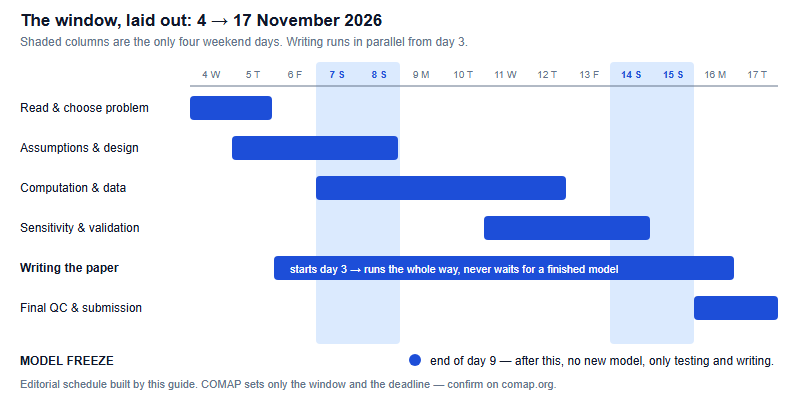
A few notes on the shape of that schedule. Days 1–2 are for reading, not solving. Read every available problem statement carefully before committing; each carries its own specific requirements, and a team that picks in the first hour usually picks on vibes. Days 2–5 are the design argument — assumptions, the choice of model family, and why that family fits this problem. That argument is the intellectual core, and it belongs in the first weekend when all four students can be in the same room.
Computation gets days 4–9, overlapping design deliberately: the first crude implementation almost always reveals that an assumption was unworkable, and you want that discovered on day five, not day eleven. Sensitivity and validation get days 8–11, because testing a model you are still redesigning is wasted effort.
Why the writing gets squeezed — three mechanisms
Teams do not decide to under-budget writing. It happens through three specific mechanisms, and each has a countermeasure.
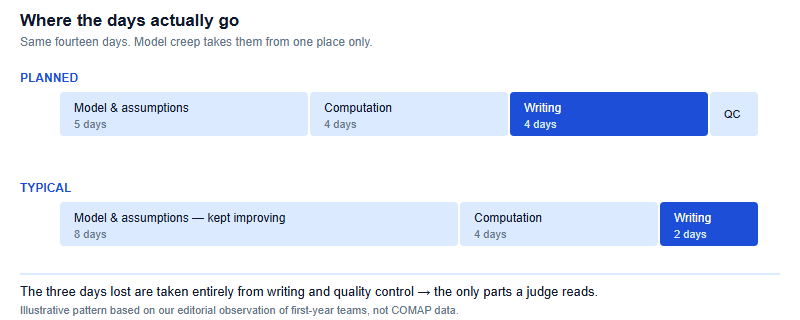
- Model creep. The model is never finished, because a model can always be made more realistic. Add a variable, add a constraint, add a second scenario. Each addition feels like progress and costs a day. Countermeasure: a declared freeze date, agreed on day one, that nobody can override alone.
- Serial thinking. Teams believe writing requires a finished model, so writing cannot start. But the problem restatement, the assumptions section, the notation table, the literature and data provenance, and the figure captions can all be drafted before a single number exists. Countermeasure: assign the writing role on day one and give that person real work from day three.
- Optimism about writing speed. Students who write English essays quickly assume a technical report is similar. It is not. A report of this length — up to 25 pages per COMAP’s contest instructions, confirm on comap.org — with consistent notation, numbered equations, captioned figures and a defensible argument in every section takes far longer per page than an essay, and it needs at least one full read-through by someone who did not write it.
The model freeze: one decision that protects the paper
If a team adopts only one rule from this article, make it this one. On day one, before you have read the problems, agree a date after which the model does not change. We suggest the end of day nine, which for 2026 is Thursday 12 November. From that moment the model is an input to the writing, not a work in progress.
The freeze is not intellectual cowardice. It is the recognition that a moderately good model, fully explained, tested and clearly written, is a stronger submission than an excellent model described in a rushed final chapter. This follows directly from what the contest is measuring: HiMCM rewards whether every modelling decision is defensible, and a decision you did not have time to defend on the page is, from the judge’s position, indistinguishable from a decision you never made.
Write the freeze into your team agreement with two clauses. First, after the freeze, the only permitted changes are corrections of outright errors — not improvements. Second, any post-freeze idea gets written into a “further work” note, which then becomes a genuine paragraph in the limitations section rather than a lost thought. That second clause converts the pressure to keep tinkering into content.
Triage: what to do if you are behind on day nine
Sometimes the freeze arrives and the model is not ready. This is common and survivable, provided the team triages honestly rather than sprinting. In priority order:
| Priority | Do this | Because |
|---|---|---|
| 1 | Reduce scope: solve a smaller, clearly stated version of the problem completely | A complete answer to a narrower question can be fully defended; a partial answer to the full question cannot |
| 2 | Write the assumptions, notation and problem restatement to final quality tonight | These are independent of your results and remove several hours from the final weekend |
| 3 | Run one round of sensitivity testing even on an unfinished model | A tested rough model reads better than an untested elegant one |
| 4 | Cut the second model you hoped to build, and say in the paper why you chose one approach | A stated, justified scope decision is legitimate; a silently abandoned half-model is visible |
| 5 | Protect the last two evenings entirely for reading the paper end to end | Inconsistent notation and a summary sheet that contradicts Section 4 are the most common avoidable faults |
Notice that nothing on that list involves working faster. Every item involves deciding what not to do, which is the skill the fourteen days are really teaching.
Rehearsing the budget before November
A time budget nobody has tried is a wish. The cheapest rehearsal is a compressed run: take an old problem, give your team a single weekend, and produce a five-page report with assumptions, a model, one test and a conclusion. The point is not the output. The point is watching where your particular team loses hours — and it is different for every team. Some lose them to data hunting, some to a disagreement nobody would resolve, some to rebuilding a spreadsheet three times.
If you look at awarded papers while rehearsing, use them to study structure and reasoning only: how sections are ordered, how an assumption gets justified, how a figure is captioned. Copying a model, prose, figures, code or citations is plagiarism and ends a team’s contest. And remember the distinction the whole exercise rests on — the paper is not a write-up of an answer, it is the argument itself, which is precisely why it cannot be produced in the last forty-eight hours.
Frequently asked questions
When exactly is the HiMCM 2026 window?
COMAP states the 2026 contest runs 4–17 November 2026, a 14-day window covering problem choice, the modelling solution and submission. Confirm on comap.org.
How many weekend days are inside the 2026 window?
Four: Saturday 7 and Sunday 8 November, then Saturday 14 and Sunday 15 November. That is our own calculation from COMAP’s stated dates.
When should a team stop changing the model?
Our editorial recommendation is the end of day nine. After the freeze, allow only error corrections; log every new idea in the limitations section instead.
How many days should writing get?
We suggest writing runs in parallel from day three, with roughly the last four days dedicated to it. Judges see only the document you submit.
This is an independent guide operated by Hanlin Education for China-based international-school students. We are not affiliated with, endorsed by, or sponsored by COMAP, which is the sole official authority for HiMCM rules, dates, registration and judging. Confirm all current details on comap.org before acting on anything here. Errors reported to us are corrected within 7 working days.