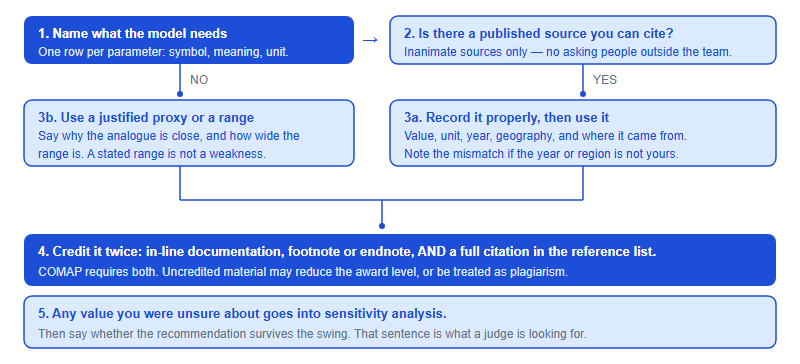
From published, inanimate sources that you credit. COMAP states teams may use any inanimate source of data or materials — computers, software, references, websites, books — but every source must be credited in-line and in a reference section, and that failing to credit data or materials may reduce your award level, or disqualify the paper if it is deemed plagiarism.
This is the least glamorous constraint in HiMCM and the one that decides the most papers. A team can pick a sensible model and still produce something a judge cannot trust, because the numbers inside the model arrived from nowhere in particular. And unlike a modelling misjudgement, a sourcing failure is not a matter of degree: COMAP names reduction of award level as an outcome, and plagiarism as grounds for disqualification. Two weeks of four people's work rests on how you handle this.
What counts as a source you have to credit
Most teams assume the rule covers datasets. COMAP's wording is much broader: failure to credit a source for data or materials — and it names pictures, graphics, charts, background information and ideas — may result in a reduction of award level, or in disqualification if deemed plagiarism. So the diagram you found that explains a mechanism, the map you screenshotted, the sentence of background you paraphrased and the framing you borrowed from an article all sit inside the rule.
| What you used | Typical example in a HiMCM paper | How to credit it |
|---|---|---|
| Numerical data | Population, traffic counts, prices, energy use | In-line note at the point of use, plus full citation in the reference list |
| A chart or figure | A published graph reproduced or redrawn | Credit in the caption; state if you redrew or recalculated it |
| A picture or map | A satellite view, a site photograph, a schematic | Caption credit, plus reference entry |
| Background information | How a process works, why a policy exists | In-line reference where the claim appears |
| An idea or approach | A modelling framing you read about | Name the source and say what you changed |
| Software or a library | A solver, a package, a documented algorithm | Reference the tool; keep it in the paper rather than sending files |
One practical note: COMAP states that any data files or supporting materials required for its problems are published on the contest website with the problems. It also warns that during the contest you may encounter sites that look like COMAP and ask you to pay for data or extra materials, says such sites are fake and that COMAP never asks anyone to purchase contest material, and asks teams to report them to the contest email address. If a page wants your money for HiMCM data, that alone tells you it is not COMAP.
Inanimate sources only, and what that rules out
The permission and the prohibition have to be read together. Yes to computers, software, references, websites and books. No to people: COMAP states that during the contest period teams may not seek help in obtaining answers, ideas or information, or in locating resources, from anyone outside their team members, and it names the advisor, other teachers, other students, and experts or professionals in a relevant field. The restriction extends to electronic social media, help and support sites, and posting or sharing any part of the problem statement or your work in any medium during the window.
Three consequences most teams discover too late:
- The interview you wanted to run is out. Surveying your own school population is ruled out too whenever people outside the team supply the information, since COMAP states teams may not seek information from any persons outside their team members during the contest period — and there is no time to design it well anyway. Published data on a comparable population is the defensible route.
- You cannot ask anyone where to find something. Note the phrase or in locating resources. Posting does anyone know where to get X data during the window is a rule problem, not a research shortcut.
- Therefore the search is a preparation task, not a contest task. Nothing stops you, in September and October, from learning your way around the statistical portals, open-data sites and reference works in the areas HiMCM problems tend to touch: transport, energy, environment, public health, sport, logistics, urban services. Build a bookmark file, with each source annotated for what it actually publishes, how far back and at what geographic resolution. That file is legal, useful and can save you a full day in November.
A data plan that survives the 25-page limit
Two submission facts govern how data appear in the paper. The whole solution is one PDF of at most 25 pages, in English and at least 12-point type; and COMAP states that programs, software and databases should not be included and are not used in judging. So your raw spreadsheet is not part of your submission. What the judge sees is whatever you summarised inside those pages.
That changes the job from collect as much as possible to collect what earns its space. A workable discipline: one compact data table in the body, giving each parameter, its value, its unit, its year and its source; any longer extract in an appendix, still inside the 25 pages; and everything else left out with a sentence saying what you excluded and why. Then check each number against three questions that judges notice.
| Check | The failure it prevents | What to write if it does not match |
|---|---|---|
| Units | Mixing per-day with per-hour, or kW with kWh, deep inside a model | State the conversion explicitly at the point of use |
| Vintage | A 2016 figure driving a 2027 recommendation without comment | Say how old the value is and why it is still usable |
| Geography or population | National averages applied to one campus or one city | Name it as a proxy and test it in sensitivity |
| Definition | Two sources counting the same quantity differently | Pick one definition, say which, and stay consistent |
This is also where data work and modelling meet. A parameter you had to proxy is a parameter you should vary, and the discipline of turning every shaky number into a sensitivity row is the same discipline described in our foundation piece on what the contest actually rewards: not confidence, but defensibility.
When the data simply do not exist
This happens in most HiMCM problems, and it is not a sign that you chose badly. Open-ended real-world briefs routinely need a quantity nobody publishes: how many people would switch behaviour at a given price, how long a task takes at a site you cannot observe, how demand splits across a day.
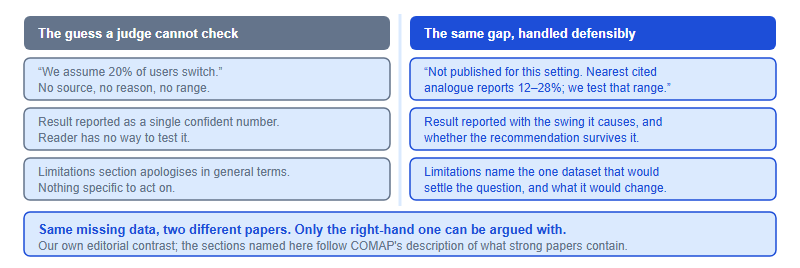
The professional response has four moves, and all four are writable in a paragraph. State plainly that the value is not published. Choose the closest published analogue and argue for its closeness, in one or two sentences that a sceptical reader can evaluate. Give a range rather than a point, wide enough to be honest. Then run the model across that range and report what changes — and, crucially, whether your recommendation flips inside it. A recommendation that holds across a wide range is a strong result. A recommendation that flips at the midpoint is also a result, provided you say so and tell the reader what data would settle it.
Studying other people's papers without borrowing their sources
COMAP encourages teams to look at the structure of Outstanding papers in terms of organisation and presentation, and to read the judges' commentaries, which describe what judges look for section by section. That is the legitimate and genuinely useful way to prepare: you learn how a summary sheet opens, where assumptions sit, how figures are captioned, how a strong limitations section sounds.
The line, however, is absolute, and there is one specific temptation worth naming because it looks harmless. Copying a reference list is plagiarism just as copying prose is. A citation is a claim that you consulted a source and that it supports the sentence it is attached to; lifting a bibliography from an awarded paper asserts something untrue about your own work, and it is easy to detect, because COMAP compares every submitted solution against all other solutions for the same problem and states that plagiarism results in disqualification. The same applies to a model, a figure, a table layout or a block of code.
If you want organised material to study from, our own compiled study pack — structure notes on awarded papers, methodology walkthroughs and templates our teachers have prepared — can be requested by scanning the WeChat QR code in the site footer. Worked material is not available for every year, and what you receive is what our teachers have put together rather than an official archive. Use it the way COMAP suggests: read for architecture and reasoning, close it, then write your own paper from your own sources. If you are early in that process, the place to start is what HiMCM asks a team to build in the first place.
Frequently asked questions
Can HiMCM teams use data from any website?
COMAP states teams may use any inanimate source, including websites, software and books, if every source is credited in-line and in the reference list.
What happens if we forget to cite a chart?
COMAP states that failing to credit data or materials may result in a reduction of award level, or disqualification if it is deemed plagiarism.
Can we email an expert for data during the contest?
No. COMAP prohibits seeking information or help locating resources from anyone outside the team, including teachers and subject experts.
Should we attach our dataset or code to the submission?
No. COMAP states programs, software and databases are not used in judging, so summarise the data inside the 25-page PDF instead.
This is an independent guide operated by Hanlin Education for China-based international-school students. We are not affiliated with, endorsed by, or sponsored by COMAP, which is the sole official authority for HiMCM rules, dates, registration, judging and academic-integrity decisions. Confirm all current details on comap.org before acting on anything here. Errors reported to us are corrected within 7 working days.