Short answer. For the HiMCM 2026 season, whose COMAP window runs 4–17 November 2026, the most efficient pre-contest rehearsal is not to solve every past paper but to train a small number of modelling archetypes drawn from COMAP’s own Previous HiMCM Problems Include list. Pick the two archetypes that stress your weakest seat — modeller, coder, writer or coordinator — and rehearse those under time pressure. Everything below is a coaching framework, not official policy; the only externally verified facts are COMAP’s window, its prior-problem titles and the contest rules cited inline.
Why Archetypes Beat a Paper Collection
COMAP’s HiMCM and MidMCM pages describe the contest as an opportunity for teams to engage and improve modelling, problem solving and writing skills, with problems that are accessible using the mathematics taught at the respective levels of the contests. In practice that means the hard part is rarely a new calculus technique; it is translating a vague real-world brief into a defensible model. A team that has already practised the translation step for a ranking problem, an optimisation problem or a simulation problem arrives at the window with a rehearsed reflex instead of a blank page.
Reading COMAP’s Prior-Problem List as Archetypes
The COMAP contest page lists prior HiMCM problems including Roller Coasters: Develop an Objective Ranking System, Drone Clusters as Sky Light Displays, Shop and Ship: Optimal Placement of Warehouses for 1-Day Ground Shipping, Swim, Bike, and Run: Minimize Congestion and Road Closures for a Triathlon and Art Gallery Security: Determine Most Secure Configuration for an Art Exhibit. COMAP presents these as example titles, and no official label attaches an archetype to each one. The five archetypes below are a Hanlin teaching framework for rehearsal only, not a claim about how COMAP classifies its problems. Each title nevertheless foregrounds a recurring reasoning task that is worth training in isolation.
Archetype 1 — Ranking (Roller Coasters)
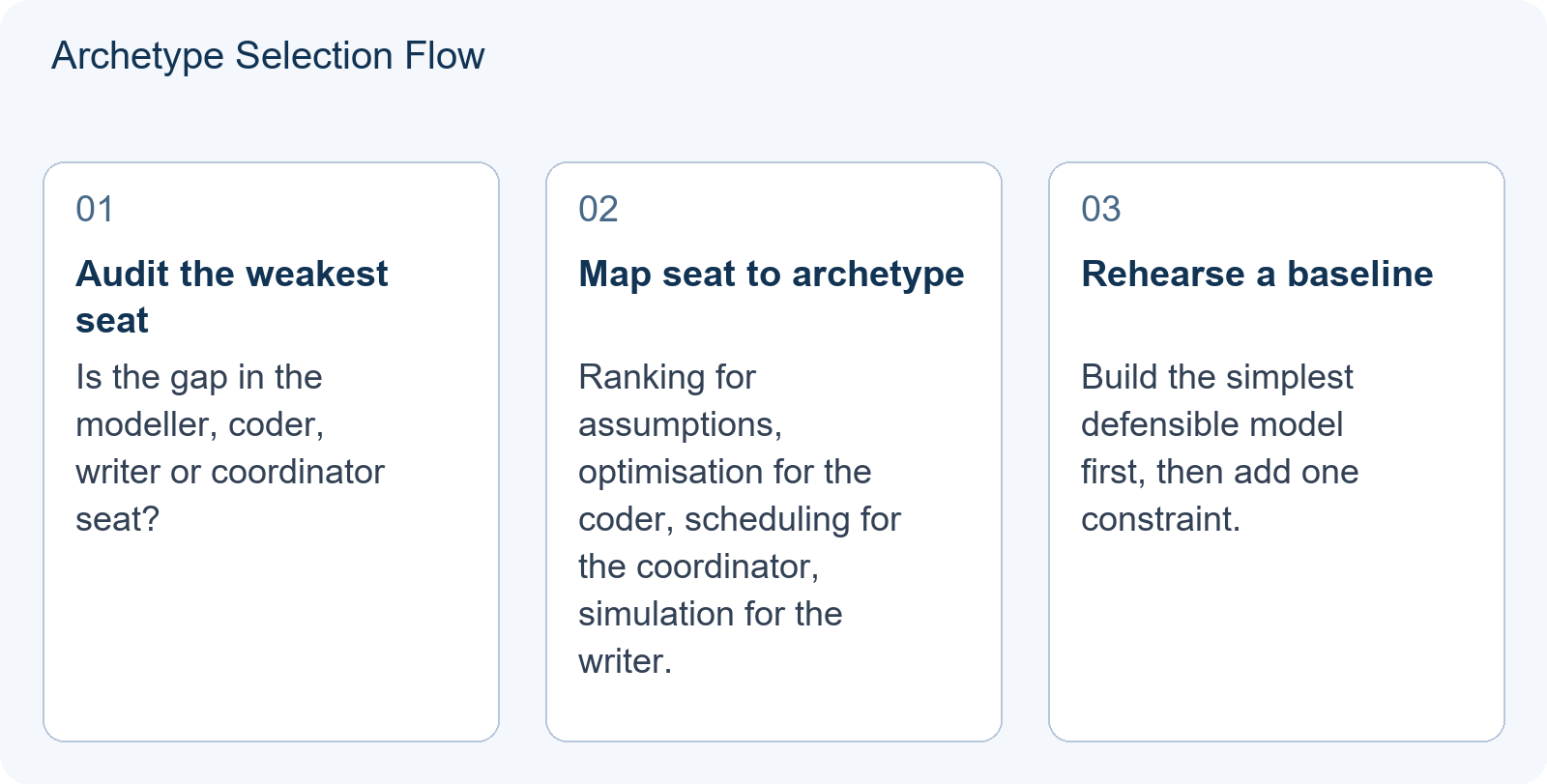
A ranking problem trains metric construction and justification. You are handed several criteria — speed, height, thrill, reliability — and asked to produce a defensible ordering. The modeller’s job is to choose weights, normalise units and write down the objective in a form a reader can audit; the writer’s job is to defend those choices without hiding behind convention. The archetype also has a built-in sensitivity drill: shift one weight by roughly 10% and check whether the top-ranked item survives. If the answer flips, the assumption that carried the ranking needs a paragraph of its own. Practising this archetype is a direct training ground for the assumption-justification habits HiMCM readers reward.
Archetype 2 — Optimisation and Placement (Shop and Ship)
A placement problem trains objective functions under spatial constraints. The Shop and Ship title already signals the ingredients: a decision variable (warehouse location), a constraint (1-day ground shipping reach), and an objective (minimise total cost or delivery time). Rehearsing this archetype forces a team to move from a narrative brief to a linear or mixed-integer formulation, or to a documented heuristic when the network is too large for exact search. It is also the archetype most likely to expose a coder-seat weakness, because the numbers have to be produced, not asserted. A useful discipline is to state the objective in one sentence before coding and re-check that sentence after every parameter change.
Archetype 3 — Congestion and Scheduling (Swim, Bike, and Run)
A congestion problem trains time-dependent flow and competing objectives. The Swim, Bike, and Run title asks teams to minimise congestion and road closures for a triathlon — meaning the model must track participant flow and closure windows simultaneously, and must weigh athlete safety against disruption to the surrounding area. Unlike a static ranking, this archetype rewards simple queueing or discrete-event logic. It is the archetype that most directly stresses the coordinator seat, because a badly timed handoff between modeller and coder shows up here as a stalled simulation rather than a broken equation.
Archetype 4 — Configuration and Coverage (Art Gallery Security)
A configuration problem trains combinatorial geometry and worst-case thinking. The Art Gallery Security title asks for the most secure configuration of an art exhibit, which reduces to a coverage problem over a shaped floor plan: place guards or sensors so that every region is visible and blind spots are eliminated at minimum cost. The modeller has to simplify irregular geometry into something a graph or grid can carry, while the writer has to communicate why the simplification does not forfeit security. The most common rehearsal mistake is losing the worst-case discipline — a configuration that looks efficient on a friendly map is not the same as one that survives an adversarial reader.
Archetype 5 — Visual Simulation Design (Drone Clusters)
A visual simulation problem trains path planning, collision avoidance and presentation. The Drone Clusters title is nominally about an aerial light show, but the underlying tasks are the ones any High-School Mathematical Contest in Modeling team should rehearse: define trajectories, prevent collisions, and describe the outcome so that a reader who cannot see the animation still understands the result. This archetype places heavy demand on the writer seat, requiring clear communication of technical simulation results to a non-programmer audience.
Matching Two Archetypes to Your Weakest Seat
HiMCM teams are up to four students, drawn from the same school or programme, and choose one problem from Problem A or Problem B once the window opens. A common planning pattern is to name four seats — modeller, coder, writer, coordinator — and to rehearse the archetype that most stresses the weakest of them. The table below summarises a suggested mapping. It is a coaching suggestion, not a rule.
| Seat | Most common weakness | Primary rehearsal archetype | Secondary rehearsal |
|---|---|---|---|
| Modeller | Arbitrary assumptions, no justification | Ranking (Roller Coasters) | Configuration (Art Gallery) |
| Coder | Data handling and run-time control | Optimisation (Shop and Ship) | Visual simulation (Drone Clusters) |
| Writer | Explaining technical results in plain English | Visual simulation (Drone Clusters) | Ranking (Roller Coasters) |
| Coordinator | Timeline control and handoffs | Scheduling (Swim, Bike, Run) | All archetypes |
Before you lock in classes, read the existing overview of HiMCM Model Family Choice: Optimization, Simulation, Ranking or Network? and note that the article is designed for the in-contest decision, not for this rehearsal step. In the pre-window period the question is not which family to pick on 4 November; it is which family to train until that date.
A Rehearsal Ladder for Whatever Time You Have Left
The 2026 window opens at 3:00 p.m. EST on 4 November, which gives a typical late-October team roughly one or two weeks of usable rehearsal time. The ladder below is a teaching illustration, not an official instruction, and is designed to be compressed into a single week if your calendar is tighter.
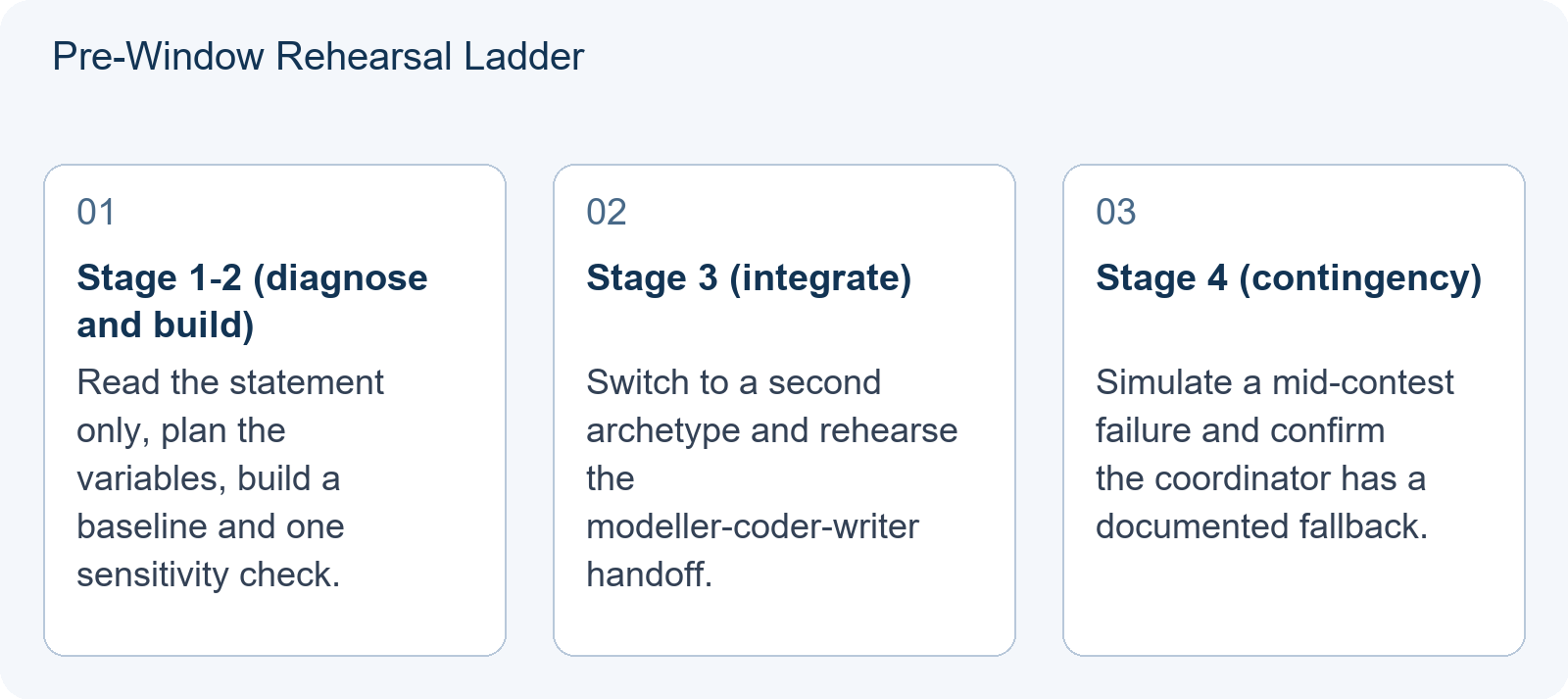
- Stage 1 — Diagnose (1–2 sessions). Choose one archetype that matches your weakest seat. Read only the problem statement; deliberately avoid model write-ups at this stage, as studying solutions too early invites copying. Write a one-page plan listing decision variables, objective and constraints before any coding begins.
- Stage 2 — Build and defend (3–4 sessions). Produce a baseline model. Add one constraint the team initially ignored. Run a single sensitivity check on the assumption you trust least. Write a two-page summary sheet that puts the recommendation first and the technical detail second.
- Stage 3 — Integrate and handoff (2–3 sessions). Move to a second archetype — ideally the one that stresses the seat adjacent to your weakest. Rehearse the handoff pattern: modeller states the objective in one sentence, coder reproduces the run from scratch, writer drafts the abstract from that sentence only.
- Stage 4 — Contingency (1 session). Simulate a mid-contest failure: a model that will not run, an assumption that is contradicted by data, a member who is offline. Check that the coordinator has a documented fallback and that the writer can still produce a coherent summary.
If your team has been studying awarded papers for technique, keep that separate from solution practice. The existing guide on How to Study HiMCM Awarded Papers Without Crossing the Plagiarism Line (2026) is a useful companion because it draws the line between learning structure and copying content — a distinction that matters most when you are rehearsing near the window.
Course Fit and Resource Preparation
Hanlin’s own pre-contest preparation programme, described in the September 2026 WeChat post, is delivered as a 28-hour pre-contest sequence covering modelling-competition overview and simulation, Python basics, linear programming and report writing. That outline maps onto several archetypes above, but a course is not a substitute for team rehearsal; the value is in bringing completed drafts and specific questions to a session, not in watching slides passively. Before deciding whether a course is the right next step, read the existing overview of HiMCM Preparation Course: What Your Team Should Learn Before the 2026 Contest and match its modules against your weakest seat. All coaching of this kind must finish before the window opens, because the COMAP rules for the contest period prohibit any discussion of the problem with anyone outside the team, including the advisor.
General event background is available at Event background.
This is an independent preparation guide, not affiliated with, endorsed by, or sponsored by COMAP.
Frequently Asked Questions
Should we try to solve every problem on COMAP’s prior list?
No. The prior-problem list on COMAP’s contest page is a set of example titles, not a rehearsal checklist. Two well-rehearsed archetypes targeting your weakest seat are worth more than five half-attempted papers.
What if no seat in the team looks weaker than the others?
Pick the archetype that most stresses handoffs rather than a single discipline. The scheduling archetype is a reasonable default, because stalled coordination shows up in the model output even when each team member’s individual work is fine.
Are these five archetypes the official COMAP categories?
No. They are a Hanlin teaching framework that converts COMAP’s example titles into trainable tasks. Real problems can blend archetypes; the point is to give rehearsal a target, not to predict what appears in 2026.