
A HiMCM preparation course should close the specific gaps between what your team already does well and what the contest demands under time pressure. This article is for families who know the High School Mathematical Contest in Modeling (HiMCM) basics and are now choosing among training options for 2026. We focus on deliverables, team-fit criteria, and how to evaluate whether a course structure matches your team’s needs—without promising outcomes no provider can guarantee.
What Pre-Contest Training Can Realistically Cover
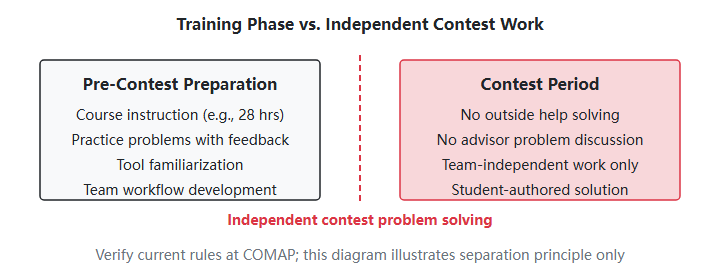
Pre-contest training is bounded by time and by what teams can absorb before the contest window. According to Hanlin’s advertised September 24, 2026 specification for 2026 preparation, their course comprises 28 hours of instruction covering: an introduction to mathematical modeling with practice problems; Python fundamentals including environment setup, variables, lists, dictionaries, loops, functions, and basic visualization; and linear programming with simple LP solving in Python. The accompanying modeling handout contains 11 modules. This is a published specification, not a promise that every participant masters all material or that seats remain available.
Twenty-eight hours is sufficient to introduce concepts and tools, not to produce automatic contest proficiency. Families should treat this as a realistic scope indicator: enough to orient a prepared team, insufficient to transform beginners into experts without additional practice.
Three Team Profiles That Benefit from Structured Preparation
Most teams entering HiMCM preparation courses have uneven skill distributions. Consider whether your team matches one of these patterns:
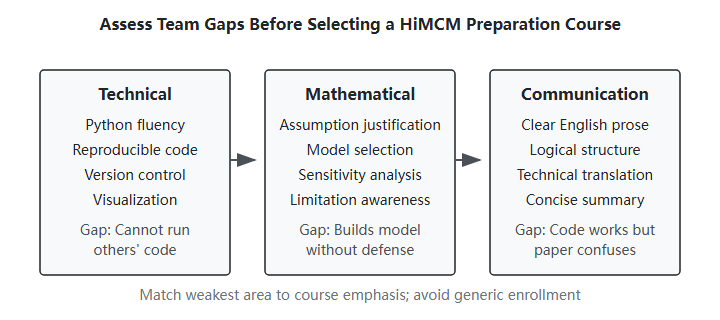
Profile A: Can code but cannot justify assumptions. The team writes Python fluently but builds models without explaining why certain variables matter, why simplifications are valid, or how sensitive results are to initial choices. They need training in model documentation and assumption validation.
Profile B: Math strong but cannot reproducibly implement. Team members understand the mathematics but produce code that crashes, produces inconsistent results across runs, or cannot be followed by teammates. They need structured implementation practice and version control habits.
Profile C: Working model but weak English synthesis. The team builds functioning models but cannot explain them clearly in the required contest paper format. They need practice translating technical work into coherent written argument.
These profiles are illustrative, not exhaustive. Your team may combine elements. The point is that a HiMCM preparation course should address specific gaps rather than uniformly cover identical material for all participants.
Course Suitability Criteria vs. Contest Eligibility
Hanlin’s course notes indicate suitability for students in Grade 9 or above with foundations in mathematics, programming, and English. These are course suitability criteria for this particular offering, not COMAP eligibility rules. COMAP’s official requirements for team composition and contest rules are maintained at https://www.comap.com/contests/himcm-midmcm. Always verify current rules directly with COMAP, as they may change.
This article is an independent coaching guide. It is not affiliated with, endorsed by, or sponsored by COMAP.
The site’s HiMCM coaching programme overview provides a starting point for comparing preparation support with the gaps identified below.
What to Prepare Before a Course-Fit Conversation
Before contacting any provider, gather the following information to assess whether their offering matches your team’s situation:
- Team composition: Grade levels, mathematics coursework completed, prior programming experience (language and approximate hours), and English writing comfort level
- Prior contest experience: Any previous math modeling competitions or team project work, with samples if available
- Technical environment: Access to computers, Python installation capability, and any institutional restrictions on software
- Time availability: Weekly hours the team can commit to preparation alongside school obligations
- Specific concerns: Which of the three profile gaps (or others) the team recognizes in their own work
Having this prepared allows a focused discussion about whether a 28-hour course structure addresses your priorities or whether additional or alternative preparation would better serve the team.
Sample Outputs to Request as Review Criteria
When evaluating any HiMCM preparation course, consider requesting or reviewing sample outputs that demonstrate the following capabilities. These are proposed review criteria for assessing course quality, not confirmed deliverables from any specific provider:
- Annotated practice model: A complete modeling attempt on a past-style problem with inline commentary explaining decisions, discarded alternatives, and acknowledged limitations
- Reproducible notebook: A Python notebook that runs from top to bottom without modification and produces identical results, with clear documentation of dependencies and environment
- Explained sensitivity comparison: A section showing how model outputs change under different parameter assumptions, with explicit discussion of which assumptions most affect conclusions
- Summary draft: A concise technical summary for pre-contest practice, demonstrating clear English synthesis of model and results
These outputs help families distinguish between courses that teach modeling concepts and those that build transferable contest skills.
Pre-Course Self-Test: A Hypothetical Allocation Problem
To assess team readiness before committing to a HiMCM preparation course, attempt this self-test scenario (not a past contest problem):
A school has limited lab space and must assign students to preferred elective courses. Each student ranks three preferences. Lab capacities vary. Some courses have prerequisites. Model a fair allocation system that maximizes students’ top preferences while respecting hard constraints. Implement a prototype in Python that accepts a small dataset and produces an assignment with a brief justification of your fairness metric.
If the team cannot identify the variables and constraints, review those foundations before choosing a training level. Teams that produce working code but cannot explain their fairness metric in writing have a specific gap to address.
Pre-Contest Training vs. Contest Work: Maintaining Separation
A critical boundary exists between preparation and performance. COMAP rules prohibit external assistance, including discussion with advisors, during the contest period. Pre-contest training must prepare teams to work independently. No provider should draft, revise, or contribute to submitted contest papers. Families should verify that any course explicitly maintains this separation and trains teams to self-sufficient execution.
For additional perspective on team structure and preparation timing, see our articles on team formation principles, team agreements, and mathematics readiness.
Evaluating Provider Proposals: Cost and Scope Questions
When requesting information from any HiMCM preparation course provider, ask for:
- Itemized quote showing what is included in the stated hours
- Frequency and format of feedback on practice work
- Terms regarding scheduling, cancellation, and any continuation options
Obtain these details in writing. Do not rely on verbal assurances about outcomes, seat availability, or implied guarantees.
Visual Summary: Team Skill Assessment
Visual Summary: Preparation-to-Contest Timeline
Frequently Asked Questions
Does completing a 28-hour HiMCM preparation course guarantee contest success?
No. Twenty-eight hours introduces modeling concepts, Python fundamentals, and linear programming techniques. It orients prepared teams but does not guarantee mastery, award recognition, or admission outcomes. Contest performance depends on team execution during the competition period, which is independent of preparation.
How do I know if my team is ready for a particular HiMCM preparation course?
Compare your team’s actual skills against the course’s stated prerequisites. Hanlin’s 2026 preparation notes indicate Grade 9+ with mathematics, programming, and English foundations. Use the self-test allocation problem in this article to identify specific gaps. If your team lacks foundational Python or cannot attempt the self-test, they may need preliminary study before structured contest preparation.
What should I ask a provider about their HiMCM preparation course deliverables?
Request itemized scope (what specific hours cover), sample outputs like those described in this article, feedback frequency and format, and written terms. Clarify that no drafting or revision of contest submissions is permitted. Obtain all commitments in writing before payment.
Source Note
This article draws on Hanlin’s September 24, 2026 course specification for 2026 HiMCM preparation, translated from “HiMCM 2026 Team Formation and Hanlin Preparation.” The description of 28 hours of instruction, Python fundamentals, linear programming, and 11-module modeling handout reflects that source. Prior Hanlin results include one team achieving Outstanding recognition in 2025; this is historical information, not a prediction or guarantee for future participants.