

2026 HiMCM Math Modeling Competition: Complete Guide & Award-Winning Strategies

HiMCM is an international high school mathematics modeling team competition hosted by COMAP. It comprehensively evaluates mathematical application, data analysis, teamwork, and English scientific writing. It is highly recognized for background enhancement in STEM and business college applications.

HiMCM Competition Full Process Guide

2026 HiMCM Competition Timeline

  • Registration Deadline: November 4, 2026
  • Competition Window Opens: November 4, 2026
  • Competition Window Closes: November 17, 2026
  • Solution Report Submission Deadline: November 17, 2026
  • Results Announcement: February 2027

Registration Fee: $100 per team (credit card payment)

HiMCM Team Formation Rules

  • Team Size: 1–4 students (3–4 recommended)
  • Grade Level: High school students in grades 9–12
  • Advisor: 1 faculty advisor required

Recommended Team Roles

  • Modeler: Strong in mathematics and physics, capable of translating real-world problems into mathematical models.
  • Programmer: Proficient in Python or MATLAB, skilled in data processing and visualization.
  • Writer: Strong academic English skills, experienced in paper writing and LaTeX formatting.

14-Day Competition Workflow

  • Problem Selection: Choose between Problem A (STEM/Environmental) and Problem B (Social Sciences/Economics).
  • Days 1–3: Read the prompt → Conduct literature review → Formulate assumptions → Establish model framework.
  • Days 4–8: Implement programming → Fit data → Generate results and charts.
  • Days 9–11: Conduct sensitivity analysis → Optimize the model → Validate results.
  • Days 12–14: Write the paper (in English) → Format (≤25 pages) → Submit anonymously.

Award Categories

  • National Outstanding (O Award): Top 1%
  • National Finalist (F Award): Top 7%
  • Meritorious Winner (M Award): Approximately 14%
  • Honorable Mention (H Award): Up to 30%
  • Successful Participant: Approximately 50%

HiMCM Award-Winning Strategy

Team Building & Preparation

  • Form a complementary team of 3–4 members; avoid having only STEM-focused students. Ideal composition: 1 modeler (calculus/statistics), 1 programmer, and 1–2 writers.
  • Complete at least two full mock exams before the competition (simulate writing a complete paper within 4 days).

Key Preparation Focus (June–October)

  • Modeling: Master classic models (optimization, prediction, queuing theory, graph theory).
  • Programming: Use Python (Pandas/Matplotlib) for data processing and visualization.
  • Writing: Carefully study 5 past Outstanding-winning papers and memorize standard templates for the executive summary, introduction, and conclusion.
  • Data Sourcing: Learn to utilize public databases such as the World Bank, NASA, and UN.

Key Elements for a Winning Paper

  • Executive Summary (Most Critical): Keep it within one page. Clearly outline the problem, methodology, results, and conclusions, highlighting key strengths.
  • Clear Modeling: Ensure reasonable assumptions, standardized formulas, and logical consistency throughout.
  • Professional Visuals: Include 3–5 high-quality charts with clear labels and annotations.
  • Sensitivity Analysis: Mandatory. It proves model stability and is the key differentiator between O/F awards and lower tiers.
  • Format Compliance: Strictly adhere to the ≤25-page limit, maintain anonymity, write entirely in English, and follow standard citation formats.

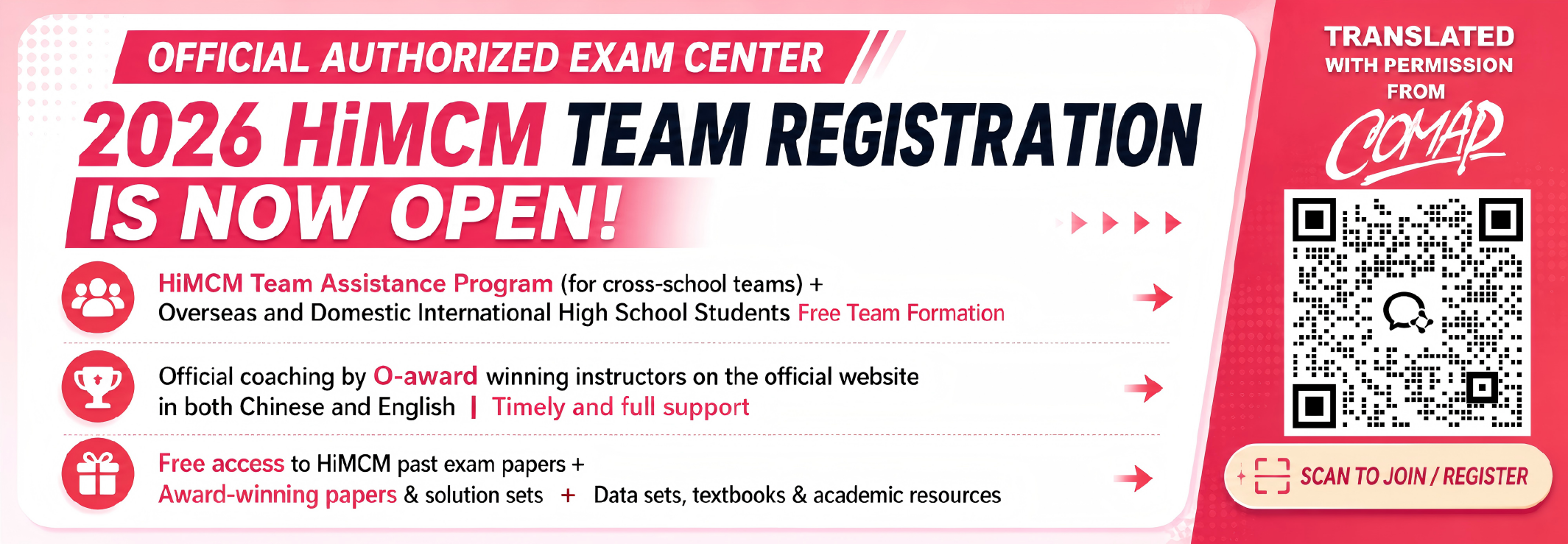
Get FREE HiMCM Preparation Materials

Scan the QR code below to access free practice papers, study guides, and past competition materials. Start preparing today!

推荐

HiMCM Competition Guide: Past Problems, A/B Difficulty Breakdown & Prep Strategies

The HiMCM competition is a premier event for students applying to top STEM programs in the US, UK, Hong Kong, and Singapore. It simultaneously assesses three core competencies: mathematical modeling, programming, and academic writing in English. The 2026 HiMCM competition kicks off in November. Unfamiliar with the problem types and difficulty levels? This article compiles the official problem themes from recent years, breaks down the real difficulty of Problem A and Problem B, and provides essential preparation strategies for both beginners and advanced teams.

What Does the HiMCM Competition Test?

Although HiMCM is a mathematical modeling competition, it is evaluated entirely through paper submissions. Each year, the organizers release two problems: Problem A and Problem B. Participating teams must choose one to solve and submit an English paper of no more than 25 pages that includes mathematical modeling.

Overview of HiMCM Problems (2022–2025)

2022 HiMCM Problems

Problem A: The Need for Bees
Modeling the ecological impact of bee populations.

Problem B: CO₂ and Global Warming
Analyzing the correlation between carbon dioxide emissions and global warming.

2023 HiMCM Problems

Problem A: Dandelions: Friend or Foe?
Evaluating the invasive species impact of dandelions.

Problem B: Electric Bus Charging
Optimizing charging schedules for urban electric bus fleets.

2024 HiMCM Problems

Problem A: To Play or Not to Play: Modeling Future Olympic Games
Decision-making on adding or removing Olympic sports.

Problem B: The Environmental Impact of High-Performance Computing
Calculating the carbon footprint of supercomputing.

2025 HiMCM Problems

Problem A: Emergency Evacuation Sweeps
Optimizing inspection routes for emergency evacuation in multi-story buildings.

Problem B: The Environmental Impact of Large Sporting Events
Sustainability assessment for major sporting events.

Difficulty Breakdown: Problem A vs. Problem B

Problem A and Problem B in the HiMCM competition focus on different domains, catering to students with varying academic backgrounds and skill sets.

Problem A: Focuses on continuous dynamics, engineering, physics, and spatial optimization. It centers on the evolutionary processes of real-world natural and engineering systems.

Problem B: Focuses on socio-economics, public affairs, multi-dimensional comprehensive evaluation, and big data statistics. It aligns closely with topics in urban governance, climate change, business, and large-scale events.

Knowledge Threshold

Problem A: Has a higher knowledge threshold. It heavily relies on advanced mathematical tools such as differential equations, dynamic systems, graph theory, integer programming, and multi-objective optimization. These topics extend beyond the standard high school mathematics curriculum and require self-study of early college-level mathematics and physics.

Problem B: Features a more accessible knowledge threshold. The primary tools include the Analytic Hierarchy Process (AHP), entropy weight method, TOPSIS, regression analysis, time series analysis, and clustering. All of these have standardized, mature templates that high school students can master in a short period without requiring advanced calculus.

Data Acquisition Difficulty

Problem A: Rarely provides complete, publicly available datasets. In most scenarios, teams must independently set simulation parameters and construct simulated datasets. When authoritative data is lacking, the reasonableness of assumptions is easily penalized by judges, making the data validation threshold higher than that of Problem B.

Problem B: Offers abundant data sources. Multi-source data can be cross-validated, making data validation easier to implement and reducing the cost of trial and error.

Suitable Student Profiles

Problem A: Best suited for teams with a solid foundation in calculus, proficiency in Python/Matlab algorithms, and strong physics/engineering logic. For zero-basis teams or those with weak mathematical backgrounds, choosing Problem A significantly increases the difficulty of winning a Meritorious (M) award or higher.

Problem B: The preferred choice for beginners, mixed arts-and-science teams, students with backgrounds in business/economics/social sciences, and teams with only basic data processing programming skills. It offers a higher certainty of securing foundational awards.

In conclusion, there is no absolute rule that "choosing Problem A makes it easier to win top awards" or "choosing Problem B guarantees an award." The actual difficulty fundamentally depends on the team's specific weaknesses.

  • Weak in mathematics, strong in writing → Problem B is more suitable;
  • Strong in mathematics, skilled in algorithm simulation, capable of independently deriving models → Problem A is more suitable;
  • Short preparation time, zero basis, seeking a stable award → Prioritize Problem B.


Get FREE HiMCM Preparation Materials

Scan the QR code below to access free practice papers, study guides, and past competition materials. Start preparing today!

推荐
Online Consultation
Online Consultation