
HiMCM is an international high school mathematics modeling team competition hosted by COMAP. It comprehensively evaluates mathematical application, data analysis, teamwork, and English scientific writing. It is highly recognized for background enhancement in STEM and business college applications.
HiMCM Competition Full Process Guide
2026 HiMCM Competition Timeline
- Registration Deadline: November 4, 2026
- Competition Window Opens: November 4, 2026
- Competition Window Closes: November 17, 2026
- Solution Report Submission Deadline: November 17, 2026
- Results Announcement: February 2027
Registration Fee: $100 per team (credit card payment)
HiMCM Team Formation Rules
- Team Size: 1–4 students (3–4 recommended)
- Grade Level: High school students in grades 9–12
- Advisor: 1 faculty advisor required
Recommended Team Roles
- Modeler: Strong in mathematics and physics, capable of translating real-world problems into mathematical models.
- Programmer: Proficient in Python or MATLAB, skilled in data processing and visualization.
- Writer: Strong academic English skills, experienced in paper writing and LaTeX formatting.
14-Day Competition Workflow
- Problem Selection: Choose between Problem A (STEM/Environmental) and Problem B (Social Sciences/Economics).
- Days 1–3: Read the prompt → Conduct literature review → Formulate assumptions → Establish model framework.
- Days 4–8: Implement programming → Fit data → Generate results and charts.
- Days 9–11: Conduct sensitivity analysis → Optimize the model → Validate results.
- Days 12–14: Write the paper (in English) → Format (≤25 pages) → Submit anonymously.
Award Categories
- National Outstanding (O Award): Top 1%
- National Finalist (F Award): Top 7%
- Meritorious Winner (M Award): Approximately 14%
- Honorable Mention (H Award): Up to 30%
- Successful Participant: Approximately 50%
HiMCM Award-Winning Strategy
Team Building & Preparation
- Form a complementary team of 3–4 members; avoid having only STEM-focused students. Ideal composition: 1 modeler (calculus/statistics), 1 programmer, and 1–2 writers.
- Complete at least two full mock exams before the competition (simulate writing a complete paper within 4 days).
Key Preparation Focus (June–October)
- Modeling: Master classic models (optimization, prediction, queuing theory, graph theory).
- Programming: Use Python (Pandas/Matplotlib) for data processing and visualization.
- Writing: Carefully study 5 past Outstanding-winning papers and memorize standard templates for the executive summary, introduction, and conclusion.
- Data Sourcing: Learn to utilize public databases such as the World Bank, NASA, and UN.
Key Elements for a Winning Paper
- Executive Summary (Most Critical): Keep it within one page. Clearly outline the problem, methodology, results, and conclusions, highlighting key strengths.
- Clear Modeling: Ensure reasonable assumptions, standardized formulas, and logical consistency throughout.
- Professional Visuals: Include 3–5 high-quality charts with clear labels and annotations.
- Sensitivity Analysis: Mandatory. It proves model stability and is the key differentiator between O/F awards and lower tiers.
- Format Compliance: Strictly adhere to the ≤25-page limit, maintain anonymity, write entirely in English, and follow standard citation formats.
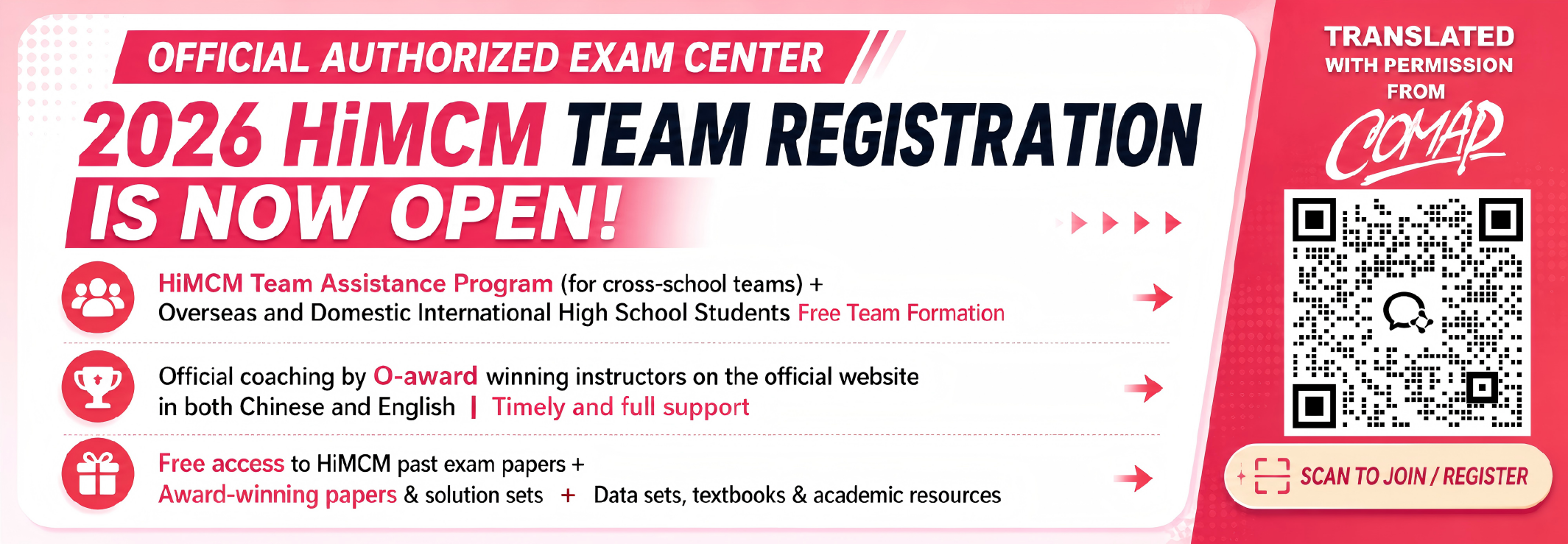
Get FREE HiMCM Preparation Materials
Scan the QR code below to access free practice papers, study guides, and past competition materials. Start preparing today!