
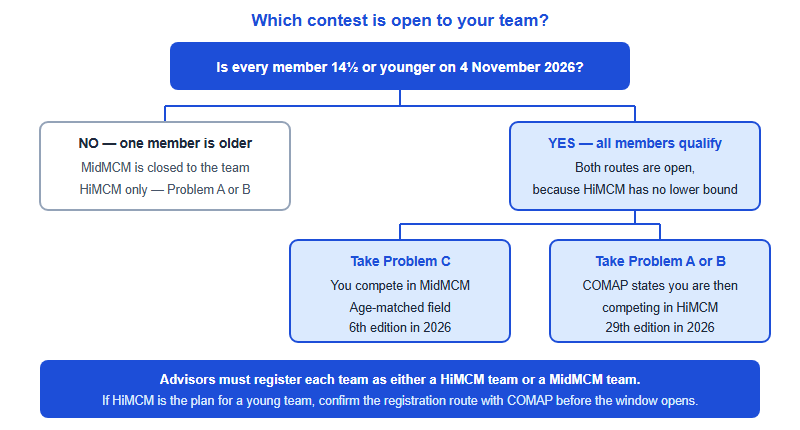
The dividing line between COMAP’s two school modelling contests is age, not grade. MidMCM is for students 14½ years or younger on the start date of the contest. HiMCM is open to “all students in high school grades or below.” Because that second phrase includes middle school, a young team is frequently eligible for both — and has a decision to make.
The eligibility line, precisely
COMAP states the two thresholds in the same sentence in its Procedures and Tips for a Great Experience article (version V20251027): a team may consist of one, two, three or four students — “high school (or below) for HiMCM and students less than 14 ½ years old on the start date of the contest for MidMCM.”
Three details in that sentence do real work:
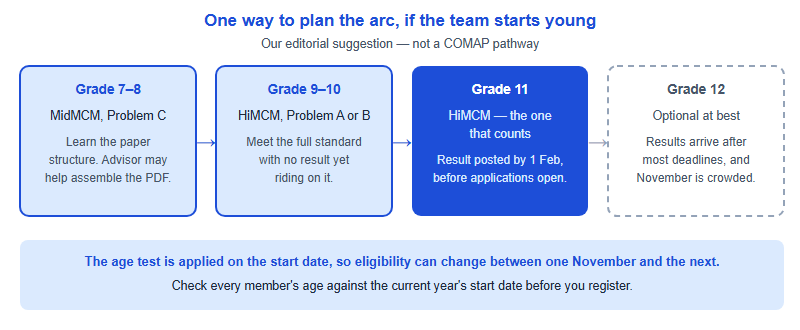
- The age test is applied on one specific day. For 2026 the window opens on 4 November, so that is the date every prospective MidMCM member is measured against. A student who turns 15 in December is still eligible; a student who turned 15 in October is not.
- Every member must qualify. COMAP states that to participate in MidMCM, all student team members must meet the age limit. One older teammate removes MidMCM as an option for the whole team.
- HiMCM has no lower bound. “High school grades or below” is a ceiling, not a floor. Nothing in that wording excludes a Grade 8 student from HiMCM.
COMAP also states that advisors must register each team as either a HiMCM team or a MidMCM team, and that both www.himcmcontest.org and www.midmcm.org land on the same contest page. For scale, comap.org describes the 2026 contest as the 29th HiMCM and the 6th MidMCM — the middle-school contest is a much younger event with a correspondingly smaller history of published papers to study.
Everything the two contests share, and the four places they differ
| HiMCM | MidMCM | |
|---|---|---|
| Who may enter | All students in high school grades or below | Every member 14½ or younger on the start date |
| Problem choice | Problem A or Problem B | Problem C — and COMAP states MidMCM teams may also choose A or B, in which case they compete in HiMCM |
| Advisor help with submission | Not permitted | Permitted for the mechanics only — scanning, file conversion, preparing the PDF. Never the solution itself |
| Field and history | 29th edition in 2026 | 6th edition in 2026 |
| Team size | One to four students, all enrolled at the same institution — COMAP makes no exceptions | |
| Contest window | 4–17 November 2026, with problems released at 3pm EST on the start day | |
| Deliverable | One English PDF, at most 25 pages, 12-point type, summary sheet first, under 20MB | |
| Outside help | Prohibited during the window from anyone outside the team, advisor included | |
| Fee | $100 per team per COMAP’s Procedures article — confirm the current fee on comap.org | |
| Results | Judging in January, posted on or before 1 February; same five recognition categories | |
Read down that table and the striking thing is how little differs. The paper standard, the page limit, the anonymity rules, the ban on outside help, the judging categories and the results date are identical. A MidMCM team is not doing an easier version of the exercise; it is doing the same exercise on a problem written for its level.
The rule that creates a genuine choice
COMAP sets out the problem structure plainly: there are three problems, one for MidMCM and two for HiMCM. HiMCM teams choose between Problem A and Problem B. Only MidMCM teams may choose Problem C. And then this: “MidMCM teams, however, may also choose either of the HiMCM problems, and if they do so they will be competing in the HiMCM contest.” Teams are free to choose any problem available at their level but should submit a solution to only one.
So the choice is real, and it is partly made at registration and partly made when the problems appear. Because COMAP also requires advisors to register each team as one contest or the other, do not infer the mechanics from the sentence above — if entering HiMCM with a young team is your plan, confirm the correct registration route with COMAP before the window opens. Roster and contest details lock at that point.
One logistical note that catches teams in China. COMAP states the problems become available at 3pm EST on the starting day, with the view link active from 3:01pm EST. In early November that converts to roughly 4am Beijing time the following morning — so no sensible team plans to read the problems at the opening bell. Confirm the release time and your own conversion on comap.org, and read all available problem statements carefully before choosing; COMAP notes each problem carries different and specific requirements.
The case for staying in MidMCM
Everything in this section and the next is our editorial judgement, not a COMAP position.
The strongest argument for Problem C is that nothing pedagogically important is lost. The skill being built — state your assumptions, justify them, choose a model and argue for that choice, test whether the conclusion survives when inputs move, then write it in English — is identical in both contests. If a thirteen-year-old spends a fortnight learning that modelling is not problem solving, the contest label on the certificate is the least valuable part of the experience.
Second, and specific to MidMCM: COMAP permits advisors to help with the mechanics of submission for MidMCM teams only — scanning pages, file conversion, preparing the PDF document — while remaining barred from helping develop the solution. That is a small allowance with a large practical effect. A capable thirteen-year-old can build a defensible model and still lose an evening to PDF assembly, page headers and file naming at 10pm on the final day.
Third, the field is age-matched. A Grade 8 team entering HiMCM is judged against papers written by Grade 12 students who have had four more years of mathematics and of writing in English.
The case for entering HiMCM early
The counter-argument is about the arc rather than the year. Because results are posted by 1 February and the paper standard is the same in both contests, an early HiMCM attempt functions as a rehearsal with real stakes. A student who first meets the 25-page English standard in Grade 9 has met it three times before the year when a result can actually be reported. The habit being rehearsed — arguing for a modelling decision rather than hunting for the right answer — is the hardest one to acquire late.
There is also a practical school-level argument. COMAP states there is no limit on the number of teams from any one school and no limit on the number of teams one advisor may advise. If your school already runs several HiMCM teams with an advisor who knows the process, joining that structure may matter more than the contest label — a young team inside an experienced programme usually beats an isolated team in the technically correct division.
The honest counterweight: a 25-page English paper is a serious lift, and COMAP designates papers that do not adequately address the problem as Unsuccessful, with no rejudging. A young team that cannot finish learns less than one that completes a Problem C paper properly.
| Choose MidMCM (Problem C) if… | Choose a HiMCM problem if… |
|---|---|
| This is the team’s first modelling contest | The team has completed a full modelling write-up before |
| English academic writing is still the binding constraint | At least one member can carry the writing and quality-control role |
| Nobody has assembled a formatted PDF under deadline before | Your school already fields HiMCM teams with an experienced advisor |
| You want the experience to be finishable, not heroic | The team is Grade 9 and planning a multi-year run |
What does not change, whichever you choose
These apply identically to both contests, and they are where most avoidable damage happens:
- Same institution, no exceptions. All members must be enrolled at the same school at the start of the contest. COMAP also states that tutoring, test-prep, contest-prep and maths or STEM learning centres are not schools for registration purposes.
- The roster locks. Members must be designated for each Team Control Number before the window opens, after which they cannot change.
- No outside help for fourteen days. No answers, ideas, information or resources from anyone outside the team — advisor, other teachers, other students, experts — and no sharing any part of the problem or your work on social media. COMAP states it monitors the internet during the contest and will disqualify or deem unsuccessful any team that violates this.
- Originality is checked mechanically. COMAP compares every submission against all other solutions to the same problem to verify originality.
- Every source must be credited. Teams may use any inanimate source — websites, books, software, data — but uncredited data, pictures, graphics, charts or ideas may result in a reduction of award level, or disqualification if deemed plagiarism.
- Prepare from published problems. COMAP encourages preparing from previous years’ problems and points to the Judges’ Commentary for what judges look for in each section; the material we send is our own compiled set, and worked material is not available for every year. Study those for structure and reasoning — copying a model, wording, figures or code from any paper is plagiarism, and our preparation resources set out how to read them safely.
Frequently asked questions
What is the age limit for MidMCM?
Every team member must be 14½ years or younger on the start date of the contest, which for 2026 is 4 November.
Can a middle school student enter HiMCM?
Yes. COMAP states HiMCM is open to all students in high school grades or below, so there is no lower age or grade bound.
Can a MidMCM team choose a HiMCM problem?
COMAP states MidMCM teams may choose Problem A or B, and if they do they compete in HiMCM. Confirm the registration route first.
Is MidMCM easier than HiMCM?
The problem is written for the level, but the paper standard is the same: one English PDF of at most 25 pages, judged on the same criteria.
This is an independent English-language guide to HiMCM for China-based international-school students, operated by Hanlin Education. It is not affiliated with, endorsed by, or sponsored by COMAP. COMAP is the sole official authority for HiMCM and MidMCM rules, dates, eligibility, fees and results — requirements change between editions, so always confirm current details on comap.org before registering or submitting. Confirmed errors are corrected within 7 working days.