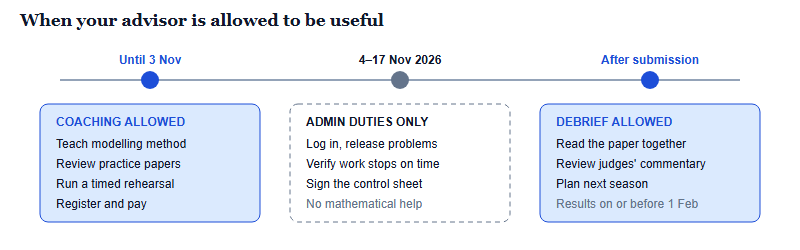
Once the HiMCM window opens on 4 November 2026, your team of up to four students is on its own. Per COMAP’s Procedures and Tips article (V20251027), teams may not seek answers, ideas, information or help locating resources from anyone outside the team — and that list explicitly includes your own advisor, other teachers, other students and subject experts. Books and software stay legal. People do not.
What the rule actually prohibits
Most contest rules that students break are broken by accident, and this is the one that catches teams hardest, because the prohibited behaviour looks exactly like ordinary studying. COMAP’s wording covers two separate acts: asking, and sharing.
On asking, the Procedures and Tips article states that during the contest period teams may not seek help “in obtaining answers, ideas, or information, or in locating resources, from any persons outside of their team members to include their advisor, other teachers, other students, and/or experts or professionals in a field relevant to the problem.” Note the reach of that sentence. It is not limited to people who would give you the answer; it covers being pointed towards a resource, which is what most students think of as harmless.
On sharing, the same article prohibits “posting or sharing any part or all of the problem statement, your team’s solution process, or any partial or complete work in any form or medium during the contest.” It names electronic social media specifically, giving emails, texting, chat rooms, interactive blogs, Twitter, Weibo and help or support sites as examples. COMAP adds that it “continually monitors the Internet during the contest period for violations of contest rules”, and that it will disqualify or deem unsuccessful any team that breaks the rule.
One sentence in that section is worth reading twice, because it is the standard everything else is judged against: “The relevant issue is one of intent: each team of students is expected to develop all of its substantive analysis and solution without the help of others.” There is no list of approved and forbidden conversations to hide behind. If the substantive analysis is not yours, the rule has been broken.
The line that decides it: people versus inanimate sources
The rule is much easier to hold in your head once you see what it is really dividing. It is not a ban on outside information — HiMCM would be impossible if it were, because it is built on real-world problems with real data. It is a ban on outside people. COMAP states that teams “may use any inanimate source of data or materials: computers, software, references, websites, books, etc.”
| During 4–17 November | Status per COMAP’s Procedures and Tips article | The condition attached |
|---|---|---|
| A textbook, a journal paper, a government statistics portal | Allowed — an inanimate source | Credit it in-line, plus a full citation in the Reference section |
| Software, code libraries, a solver, a spreadsheet | Allowed — an inanimate source | Credit them as you would a source. AI tools sit under a separate policy: COMAP permits careful use but requires teams to follow its AI use policy and append a report to the PDF — confirm the current wording on comap.org |
| A dataset you find on a public website | Allowed — an inanimate source | Uncredited data can reduce your award level, or count as plagiarism |
| Your team advisor, on anything substantive | Prohibited — named explicitly in the rule | Their permitted duties are administrative; see the next section |
| A maths teacher, a professor, a working engineer | Prohibited — “experts or professionals in a field relevant to the problem” | Applies even if you only ask which method to use |
| A student on another team, or at another school | Prohibited — “other students” | Applies in both directions: receiving and giving |
| Posting the problem or your work to a group chat | Prohibited — sharing in any form or medium | COMAP names Weibo, chat rooms and help sites as examples |
Read as a pair, those two halves say something reassuring about what the contest is testing. You are allowed a library, a computer and the whole public internet. What you are not allowed is a person who has already done the thinking. That is consistent with the point that defines the contest: HiMCM is a modelling contest rather than a timed problem-solving contest, and there is no answer key for anyone to leak. The thing being assessed is whether your team’s own chain of decisions is defensible.
What your advisor may still do
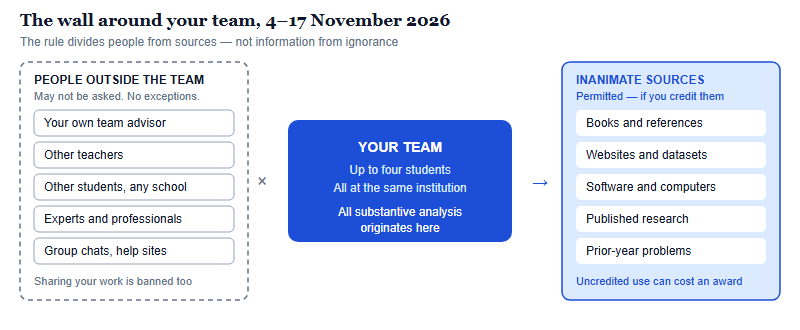
Chinese international-school teams often assume the advisor is a coach who stays on the touchline shouting instructions. Under COMAP’s rules the advisor is closer to an invigilator with administrative duties. The Procedures and Tips article gives them a defined set of tasks, and none of them involve the mathematics.
- Before the window. Registration, payment and designating team members. Any faculty or staff member at the students’ school can be the advisor, and COMAP notes they do not have to be from the mathematics department. One advisor may serve multiple teams, and there is no limit on the number of teams from one school. A student may never act as advisor.
- At the start. COMAP states the advisor must be present at the start of the contest to give the problems to the students, and that the advisor logs in to view the problems once the link becomes active.
- During the window. Nothing substantive. The advisor appears by name in the list of people a team may not consult.
- At the end. The advisor must verify that the team stops working at the end of the window, and signs the team control sheet alongside the students.
- MidMCM only. COMAP allows one narrow exception for MidMCM teams: advisors may help with mechanical submission steps such as scanning pages, file conversion or preparing the PDF, while remaining barred from helping develop the solution. This exception is stated for MidMCM, not HiMCM.
If you have worked with a teacher all autumn, the practical consequence is that all of the coaching has to happen before 4 November. That is not a loophole; it is the design. Everything your advisor can usefully teach you — how to state assumptions, how to test a model, how to structure a paper — is teachable in October and useless to hand over in November.
Why this rule bites harder for teams in China
Three features of a typical Chinese international-school setup make accidental breaches more likely, and none of them involve anyone intending to cheat.
The first is the group chat. Competition cohorts in China live on WeChat and QQ groups that mix students, alumni and teachers. A screenshot of the problem posted to a twenty-person group is not a private message; it is publication, and COMAP’s sharing ban does not carry an exception for groups you consider closed. The safest configuration is a chat that contains your four team members and nobody else, agreed before the window opens.
The second is the tutoring relationship. Many students attend a training centre alongside school, and the instinct during a hard fortnight is to bring the problem to that Saturday class. That is prohibited on two counts. The tutor is a person outside the team, and COMAP separately states that “tutoring, test-prep, contest-prep, and math- or STEM-learning centers are not considered schools/institutions for the purposes of registering and competing in COMAP contests” — so a training-centre teacher cannot be reclassified as your advisor either.
The third is the language gap, which creates a genuinely sympathetic failure mode. A team drafting in English wants someone fluent to read the paper before submission. Asking a parent, a teacher or an alumnus to review your writing means asking a person outside the team about your solution while the window is open. If your English needs support, that support has to be built into your team — which is one reason the writing role is a real role and not an afterthought.
How enforcement actually works
Enforcement runs on more than trust. COMAP states that it compares each submitted solution to all other solutions of the problem your team chose, and that the result “identifies solutions and/or parts of solutions that are exactly and/or similar to other papers”, used to verify originality. Two teams that shared an approach mid-contest are therefore not comparing themselves against a judge’s intuition; they are being compared against each other by software.
There are two distinct penalties, and they are worth separating. Uncredited use of a legitimate source — data, pictures, graphics, charts, background information, ideas — “may result in a reduction of award level, or in disqualification if deemed plagiarism”. Breaching the outside-help or sharing rule is described in stronger terms: COMAP will disqualify the team or deem it unsuccessful. The first is a grading consequence; the second ends your contest.
The same logic governs how you use past papers before November. Studying awarded solutions is genuinely valuable for seeing how strong teams organise assumptions, sensitivity work and conclusions — but they are for studying structure and reasoning only, and copying a model, prose, figures, code or citations is plagiarism that ends a team’s contest. Comparison software is precisely the mechanism that catches it.
Five habits that keep a team clean
- Close the chat before the window opens. One channel, four people, agreed in advance. Everything else goes silent from 4 November.
- Write citations as you go. Every dataset and figure gets its in-line credit and a Reference entry at the moment you use it, not on the final evening when nobody can remember the URL.
- Move all coaching into October. Ask your advisor everything now, while it is still legal and still useful.
- Treat “which method should we use?” as a team-only question. Asking an outsider to point you towards a resource is covered by the rule, even though it feels far short of asking for an answer.
- Keep a source log. A shared file listing every source and where it was used makes both the Reference section and any later question about originality trivially easy to answer.
None of this makes the fortnight lonelier than it needs to be. It clarifies what the fortnight is for. Your team has fourteen days, a real problem with no answer key, and a rule designed to keep the reasoning in the paper belonging to the four names on the roster. That is the whole point of entering a contest where the modelling decisions matter more than the final number: an award means something because nobody outside the team helped you earn it.
Frequently asked questions
Can our advisor answer a maths question during the contest?
No. COMAP names the advisor among the people a team may not consult during the window. Their in-window role is administrative.
Are we allowed to use websites and datasets we find ourselves?
Yes. COMAP permits any inanimate source, including websites, books and software, provided every source is credited in the paper.
Is posting the problem in a private class group really a breach?
Yes. Sharing any part of the problem or your work in any form or medium during the contest is prohibited, group size aside.
What happens if a team is caught getting outside help?
COMAP states it will disqualify or deem unsuccessful any team that violates the rule, and it monitors the internet during the contest.
This is an independent guide operated by Hanlin Education for China-based international-school students. We are not affiliated with, endorsed by, or sponsored by COMAP or the High School Mathematical Contest in Modeling. Contest rules, conduct requirements, dates and penalties are set by COMAP — the descriptions here follow COMAP’s Procedures and Tips article (V20251027), which accompanies but does not replace the official rules, so confirm current details on comap.org before acting on anything here. Factual errors are corrected within 7 working days of notice.