
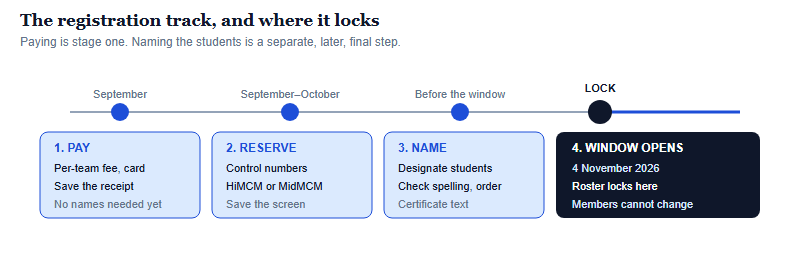
There are two deadlines buried inside HiMCM registration, and most teams only notice one. Per COMAP’s Procedures and Tips article (V20251027), an advisor can pay for and reserve team slots without naming anybody — but must designate specific students for each Team Control Number before the contest window opens, and team members cannot change after that. The names typed at that moment are what the certificates print.
Two deadlines, not one
Registration for HiMCM is a two-stage process, and the stages have different deadlines and different owners. COMAP states that advisors review contest information and register teams via the contest website prior to the contest start date, with a registration fee of $100 per team payable by major credit card through the secure site. Confirm the current fee and registration cut-off on comap.org, because both can change between editions.
What is easy to miss is the sequencing. COMAP describes it plainly: advisors “do not have to designate specific team members for each Team Control Number when initially paying for and registering the number of teams they need, BUT they will have to designate specific team members for each Team Control Number prior to the opening of the contest window. Team members cannot change after that time.”
For a school entering several teams, this is genuinely useful flexibility. A department can buy four slots in September while the maths club is still forming, then assign students later. But it also creates a trap. A school that treats payment as “registration complete” can arrive at the start of November with paid control numbers and no named students — and by then the roster deadline is the same moment the contest begins.
| Registration step | Who owns it | When it must happen | What is irreversible afterwards |
|---|---|---|---|
| Pay the per-team fee | Advisor | Before the contest start date | Save the receipt number — it is needed to continue registering |
| Reserve Team Control Numbers | Advisor | Before the contest start date | Each number is issued to one team |
| Designate each team as HiMCM or MidMCM | Advisor | At registration | COMAP states no confirmation of this designation is sent — save the screen |
| Name the students on each control number | Advisor, with the team | Before the window opens | Team members cannot change after this point |
| Check spelling and order of names | Advisor, checked by students | Same moment | This is exactly what appears on certificates |
The Team Control Number is your only identity
Once the window opens, your team stops having a name and starts having a number. COMAP requires that teams include the Team Control Number on their solution papers and all contest correspondence, and that no other identifying information appears in the submitted solution. That single number is how COMAP recognises you at every subsequent step: the paper header, the submission form, the receipt check, the results list and the certificate. The anonymity fits what is being assessed — a paper is read for the quality of its reasoning, because HiMCM is a modelling contest rather than a race to a correct answer.
Two administrative details around that number are worth handling deliberately in September rather than discovering in November.
- The HiMCM-or-MidMCM designation carries no receipt. COMAP is explicit that advisors register each team as either a HiMCM team or a MidMCM team, and adds a direct warning: you will not receive confirmation of the team and control-number designation, so print or save the screen showing which number is which. If your school runs teams in both contests, that saved screen is the only local record of which is which.
- Transposed digits are a known failure mode. COMAP notes twice that mistyping or transposing a control number is not uncommon — once about the page header, once about the submitted file name. Both times the fix is the same: check it against the saved registration screen rather than from memory.
There is also a rule that quietly shapes who can be on the roster at all. COMAP states that all students on a team must be enrolled at the same institution at the start of the contest and that it will make no exceptions, and separately that tutoring, test-prep, contest-prep and STEM-learning centres are not considered schools or institutions for the purposes of registering. A roster assembled from a training class rather than a school is not a roster that can be registered.
What the certificate prints, and what COMAP will fix later
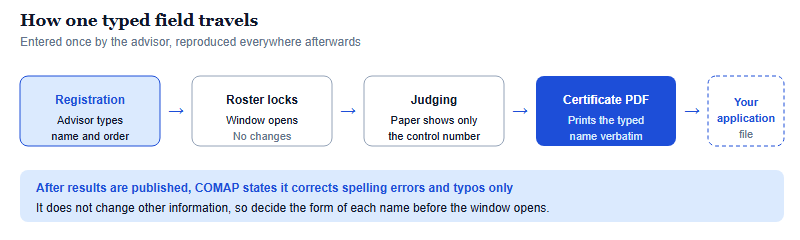
This is the part that surprises people, and it is stated twice in COMAP’s guidance because it causes recurring problems. The names your advisor types during registration are reproduced verbatim on the award and participation certificates. COMAP’s wording is that the order and spelling entered online “is exactly what will be on participation and award certificates after the contest”, and it advises advisors to check both carefully.
Afterwards, the correction policy is narrow. Once results are public, PDF certificates become available for download, and COMAP states that the spelling and order of student names is input by advisors during registration and that COMAP does not change or edit this information. If there is an error, you may email with the team number, the error and the correction — but COMAP says it will only correct spelling errors and typos, and will not change any other information.
One related worry can be dropped entirely. COMAP states that the order of student names has no bearing or importance on participation, and simply reflects what the advisor entered. There is no first author on a HiMCM certificate, so no team needs an argument about whose name goes first.
Why the spelling matters more for a China-based applicant
For a student applying to universities abroad, a certificate is not just a souvenir. It is a document that may be read next to a transcript, an activity list and a set of essays, and the useful question is whether those documents corroborate each other. An admissions reader checking an award against the rest of a file is doing exactly that: seeing whether several results across one profile point at the same student and the same interests. That cross-validation is what makes a file believable, and it works best when the paperwork is boringly consistent.
Chinese international-school students carry more name variants than most applicants, which is where the risk sits. A single student might appear as a passport pinyin name, a pinyin name with the family name first, a pinyin name with the family name last, an adopted English given name, or some hybrid of the English given name and pinyin family name. Any of those is a perfectly reasonable thing to be called. The problem is only ever inconsistency — a certificate that reads one way and a transcript that reads another creates a small question that nobody benefits from answering.
Because COMAP will only correct spelling errors and typos after the fact, choosing the form of the name is a decision to make deliberately in September, not a field to fill in quickly the night before the window opens.
If somebody drops out
The roster lock has a practical consequence that teams should plan for now, because November is a heavy month in most international-school calendars and illness, mock exams and family travel all happen.
COMAP states that each team may consist of one, two, three or four students, with four the maximum, and adds an observation worth weighing: “Historically, the best teams have four members.” Since one-, two- and three-person teams are all valid sizes, our reading is that a team which loses a member after the window opens can carry on — but COMAP’s guidance does not address mid-window withdrawals, so confirm with COMAP on comap.org if it happens to you. What it cannot do is substitute somebody in. The names are fixed at the moment the window opens.
That argues for two decisions in September. First, name four students who are realistically available across 4 to 17 November, rather than four students who are enthusiastic in September. Second, distribute the work so no single role — and in particular not the writing — sits with exactly one irreplaceable person. This is the same reasoning that makes HiMCM a genuinely different exercise from an individual maths competition: it rewards a team that has organised itself around building and defending a model rather than racing to an answer, and organisation includes redundancy.
A September roster checklist
- Confirm the school is the institution. All four students enrolled at the same school at the start of the contest; a training centre does not qualify.
- Agree the exact written form of each name — matching the form used on the student’s school records — and send it to the advisor in writing rather than verbally.
- Have each student read their own name back from the registration screen before the window opens. This is the only cheap moment to catch an error.
- Save the screen showing each control number and whether it is designated HiMCM or MidMCM. COMAP sends no confirmation of this.
- Store the receipt number with the control numbers, in a place the advisor can find in November.
- Check availability across the whole window, not just the first weekend, before the four names are final.
None of this is mathematics, and all of it is the kind of task that gets postponed because it feels trivial. It is worth twenty minutes in September precisely because every item on the list becomes impossible to change at 3pm US Eastern time on the day the problems are released — the small hours of the following morning in Beijing, so check the local equivalent on comap.org.
Frequently asked questions
Can we swap a team member after the contest starts?
No. COMAP states members must be designated before the window opens and cannot change after that time. A smaller team may still compete.
Do we have to name students when we pay?
No. COMAP allows advisors to pay for and reserve control numbers first, then designate students before the window opens.
Does the order of names on the certificate mean anything?
No. COMAP states the order has no bearing or importance and simply reflects what the advisor entered at registration.
Can a certificate be corrected if the name is wrong?
Only for spelling errors and typos. COMAP states it will not change any other information on a certificate.
This is an independent guide operated by Hanlin Education for China-based international-school students. We are not affiliated with, endorsed by, or sponsored by COMAP or the High School Mathematical Contest in Modeling. Registration steps, fees, roster deadlines and certificate policy are set by COMAP — the descriptions here follow COMAP’s Procedures and Tips article (V20251027), which accompanies but does not replace the official rules, so confirm current details on comap.org before acting on anything here. Factual errors are corrected within 7 working days of notice.