Yes. COMAP describes MCM/ICM as open to high school students as well as undergraduates, so a strong team can enter both. But MCM/ICM is not a senior HiMCM. HiMCM gives up to four students a 14-day November window and a choice of two problems; MCM/ICM gives up to three students one continuous window, from 28 January to 1 February 2027, and six problems. For most teams, HiMCM should come first.
Chinese-speaking families usually know MCM/ICM as Meisai, “the American contest”, from university campuses, and HiMCM is often presented to them as its high-school edition. The label is half right. The wrong half is what sends a Grade 10 team into a four-day sprint it is not ready for, or persuades a Grade 11 team to skip a contest it could have used well.
What the high-school Meisai label gets right, and what it gets wrong
Both contests are run by COMAP and built on the same bones. COMAP’s Procedures and Tips article for HiMCM says its 25-page limit keeps HiMCM aligned with the undergraduate contests, MCM and ICM. Both sets of instructions ask for one English PDF that opens with a summary sheet, in at least 12-point type; both tell teams not to send programs or data files with it; both require teams to state their use of AI tools; and both describe papers with a similar ladder of designations, from Successful Participant through Honorable Mention, Meritorious and Finalist to HiMCM’s Outstanding, which MCM/ICM calls Outstanding Winner. Confirm the current wording of each on comap.org.
So the craft transfers. A team that has learned to justify assumptions, run a sensitivity check and write a summary a judge reads first — the habits that make modelling different from problem solving — will use every one of them in either contest. What does not transfer is the shape of the contest around the craft: the clock, the seats and the menu of problems. One common misreading also deserves a flat correction. HiMCM is not a qualifying round. MCM/ICM needs no earlier result, and each contest is a separate registration.
The two contests side by side, from COMAP’s own documents
Every row below comes from COMAP’s contest pages and its instructions for the current editions: HiMCM in November 2026, MCM/ICM in January 2027.
| HiMCM 2026 | MCM/ICM 2027 | |
|---|---|---|
| Who may enter | All students in high school grades or below | Open to all undergraduate and high school students |
| Team size | One to four students | One to three students |
| Team membership | Same school, institution or program; COMAP’s Procedures and Tips article states that tutoring, test-prep, contest-prep and STEM-learning centres do not count | Students currently enrolled in the same school |
| Advisor | A faculty or staff member; never a student | A faculty member, staff member or student at the institution |
| Contest window | 4–17 November 2026, 14 days | 5pm EST Thursday 28 January to 8pm EST Monday 1 February 2027 |
| Problem choice | Problem A or Problem B | Six: A continuous, B discrete and C data insights (MCM); D operations research/network science, E sustainability and F policy (ICM) |
| The paper | One English PDF, summary sheet first, 25-page limit | One English PDF, summary sheet first, 25-page limit |
| Registration fee | US$100 per team | US$100 per team |
| Results | On or before 31 January 2027, per the 2026 instructions | 8 May 2027, per the 2027 instructions |
Two small inconsistencies in COMAP’s own documents are worth knowing about. Its general MCM/ICM page says awards are announced on or before 30 May each year, while the 2027 instructions give 8 May; the HiMCM Procedures and Tips article says results arrive on or before 1 February, while the 2026 instructions give 31 January. Treat the dated instructions as the working answer and check comap.org nearer the time.
Fourteen days versus one long weekend
The clock is the difference that changes everything else. HiMCM once required teams to work inside a fixed 36-hour window. COMAP’s Procedures and Tips article explains that the 14-day window replaced it to give students, advisors and parents more scheduling flexibility, and stresses that the change signals neither harder problems nor a need to spend more than 36 hours: the problems are still designed for a solution within 36 hours of work. A HiMCM team works in sessions around school, sleeps on its assumptions and comes back to them with fresh eyes.
MCM/ICM has no such rhythm. COMAP’s 2027 instructions run the contest continuously from 5pm EST on Thursday 28 January to 8pm EST on Monday 1 February, with the PDF due by 9pm EST — about 99 hours from start to finish. From China, that is 06:00 on Friday 29 January to 09:00 on Tuesday 2 February, Beijing time, with the paper due by 10:00. Registration must be completed before 3pm EST on 28 January, which is 04:00 on 29 January in Beijing, so a team cannot register over breakfast on the day it starts.
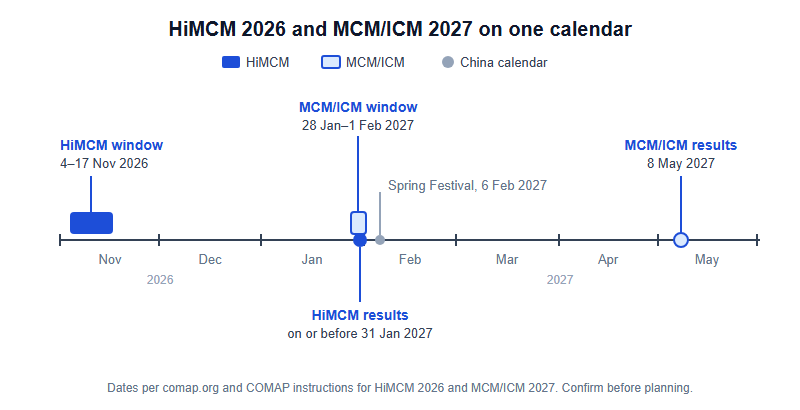
Three consequences follow, and they are our editorial reading rather than COMAP guidance. First, writing cannot wait: a fortnight forgives a paper started on day six, but in a 99-hour window the summary and assumptions need a draft by the end of the first day. Second, there is no reserve: a teammate who is ill for a day removes a third of the team for a quarter of the contest. Third, the calendar is awkward for China-based schools. The window closes four days before the 2027 Spring Festival on 6 February, when many families travel, and it can sit close to January examinations. Check both before anyone pays a registration fee.
Three seats and six problems change the team you need
HiMCM’s four seats map neatly onto the four jobs a paper needs: modelling, computation, research, and writing and quality control. COMAP’s Procedures and Tips article notes that, historically, the best HiMCM teams have had four members. MCM/ICM caps a team at three, so one person carries two jobs for four days straight. In our view the least damaging merger is research with writing, because the person gathering sources is already building the reference list and the background section, while computation needs an owner who is not also drafting prose at three in the morning.
The advisor rules differ as well. For HiMCM, any faculty or staff member at the school can advise, and COMAP states that a student can never act as the advisor. The MCM/ICM instructions allow a faculty member, a staff member or a student at the team’s institution. For a school team, a teacher remains the natural choice in both contests.
Then there is the menu. HiMCM teams choose Problem A or Problem B. MCM/ICM offers six, and COMAP labels them: A continuous, B discrete and C data insights for MCM; D operations research and network science, E sustainability and F policy for ICM. Labelled categories let a team prepare towards a type of problem — a team with two strong programmers can reasonably aim at data insights, and a team whose best asset is argument can aim at policy. Study earlier problems in your intended category for structure and reasoning only; copying a model, prose, figures, code or citations from any past paper is plagiarism that ends a team’s contest.
Which one, which year: a plan from Grade 9 to university
| Year group in 2026-27 | November 2026 | Late January 2027 | Why |
|---|---|---|---|
| Grade 9 or 10 | HiMCM, or MidMCM if every member is 14½ or younger on the start date | Skip MCM/ICM this year | A first result, and more Novembers to build on it |
| Grade 11 | HiMCM with four students | MCM/ICM with three of them, if January allows | Both results exist before Grade 12 applications begin |
| Grade 12 | HiMCM only if November is genuinely free | MCM/ICM for the experience | Results arrive after most application deadlines |
| After graduating | — | MCM/ICM in a first university year | COMAP points high school graduates towards MCM/ICM |
The Grade 11 row is the one worth dwelling on. A student who completes a fortnight’s paper in November and a four-day paper in late January holds two results from contests with different clocks and different kinds of problem, and both are published long before Grade 12 applications. An admissions reader checks an award against the transcript, the activity list and the essays; two results like these tend to corroborate each other, and a stated interest in modelling, more convincingly than a single entry — provided the activity description says which role the student held and which decision they can still defend. No result guarantees any outcome, and as our guide to HiMCM on a university application puts it, the decision you can explain travels further than the designation.
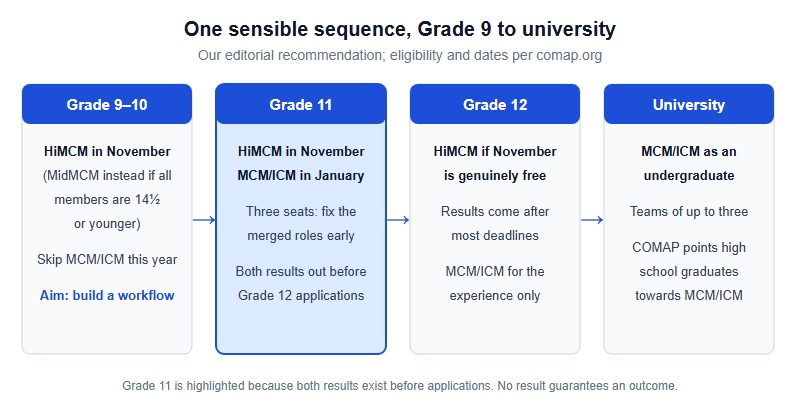
For Grade 9 and 10 teams, the case for waiting is not that MCM/ICM is closed to them — COMAP opens it to all high school students — but that a four-day sprint tests whether a workflow survives compression, and a first-year team does not yet have a workflow to compress. HiMCM is where it gets built. If the team is still deciding whether modelling suits it at all, start with what HiMCM actually asks a team to produce.
Frequently asked questions
Can high school students enter MCM/ICM?
Yes. COMAP states MCM/ICM is open to all undergraduate and high school students, in teams of one to three from the same school.
Is HiMCM simply the high-school version of MCM/ICM?
Not exactly. Both are COMAP modelling contests with similar papers, but HiMCM has four seats and 14 days; MCM/ICM has three seats and about four days, from Thursday evening to Monday evening.
Do you need a HiMCM result to enter MCM/ICM?
No. MCM/ICM has no qualifying round, so a high-school team registers for it directly, separately from any HiMCM entry.
When are MCM/ICM 2027 results released?
The 2027 MCM/ICM instructions from COMAP give 8 May 2027, well after HiMCM results, which are due by the end of January 2027.
This is an independent guide operated by Hanlin Education for China-based international-school students. We are not affiliated with, endorsed by, or sponsored by COMAP, which is the sole official authority for HiMCM and MCM/ICM rules, dates, registration and judging. Confirm all current details on comap.org before acting on anything here. Errors reported to us are corrected within 7 working days.