Mostly the mathematics you already study. COMAP sets no maths prerequisite for HiMCM, and a defensible model usually rests on rates and units, growth functions, regression, basic probability, simple optimisation, networks and step-by-step change — topics spread across IGCSE, IB, A Level and AP courses. What holds a team back is rarely a missing topic. It is five skills no syllabus exam tests, and you can check for them in ninety minutes.
Families usually ask this in September because they assume HiMCM is a harder version of AMC-style mathematics, so calculus or a modelling course must come first. It is not. Readiness is not a topic list; it is whether your team can turn a paragraph of English into variables, choose a method, defend it and write it up with the mathematics it already has.
What COMAP says about the mathematics, and what it leaves out
COMAP’s HiMCM page gives eligibility in one line — all students in high school grades or below can participate — and says the contest problems are “accessible using the mathematics taught at the respective levels” of the contests. Neither that page nor COMAP’s Procedures and Tips article names a course, level or topic a student must have completed. Three things COMAP does say define what “ready” means instead.
- The workload is bounded. The Procedures and Tips article states that the problems are designed for teams to complete a solution within 36 hours of work, spread across the 14-day window. A model that needs a term of new mathematics does not fit that envelope.
- Strong papers are defined by judgement, not technique. The same article says the best papers usually include assumptions with justifications, the modelling process, results, strengths and weaknesses, sensitivity and conclusions. None of those is a syllabus topic; each is a decision the team has to explain.
- Past problems reveal the mathematics involved. COMAP advises teams to look at previous years’ problems to understand how the problem choices differ, including in the mathematics involved. Study them, and any awarded paper, for structure and reasoning only: copying a model, prose, figures, code or citations is plagiarism, and COMAP states that plagiarism results in disqualification.
COMAP’s April 2026 preparation guide makes the same point from the other side: getting ready for HiMCM, it says, is not about working through problem after problem and memorising techniques. Take that literally before spending September on a list of named models.
The syllabus mathematics most HiMCM models rest on
This is the mapping we use when a team asks whether it has enough mathematics. The third column is deliberately loose, because specifications differ by board, level and year; the fourth is the part no course hands you.
| Modelling job | Mathematics it draws on | Where many students meet it | What HiMCM adds on top |
|---|---|---|---|
| Estimate a quantity | Ratios, percentages, unit rates, unit conversion | IGCSE onwards; used in every IB, A Level and AP course | Choosing which rates to chain, and citing each one |
| Project growth or decline | Linear, exponential and logistic functions; logarithms to fit them | IB AA and AI functions; A Level exponential models; logistic models in AP Calculus BC | Arguing why that shape matches the mechanism, and how far ahead to trust it |
| Fit a relationship to data | Scatter plots, least-squares regression, residuals, correlation | IB AA and AI statistics, with non-linear regression in AI HL; AP Statistics | Deciding whether a close fit is actually a good reason |
| Put uncertainty into numbers | Probability, expected value, binomial and normal models, simulation | IB and A Level statistics; AP Statistics, which includes estimating probabilities by simulation | Choosing input ranges and reporting a spread rather than one number |
| Compare or rank options | Weighted sums, rescaling to a common scale, matrices | Rarely a named topic; matrices in IB AI HL and A Level Further Mathematics | Defending every weight and checking whether the ranking survives a change |
| Allocate under limits | Linear inequalities, linear programming, optimisation with calculus | Calculus optimisation in IB AA and AI; linear programming in the decision-mathematics options of some A Level routes | Writing the objective and the constraints from a paragraph of English |
| Locate or route across a network | Graphs, shortest paths, spanning trees, Voronoi diagrams | IB AI, with Voronoi diagrams at SL and graph theory at HL; decision-mathematics options | Deciding what counts as a node, an edge and a cost in this problem |
| Model change step by step | Sequences, recurrence relations, differential equations, Euler’s method | IB AI HL and AA HL; AP Calculus, with slope fields in AB and BC and Euler’s method in BC | Picking a time step and an update rule you can defend |
Nothing in the left-hand columns needs a university course. Calculus helps with smooth optimisation and rates of change, but it is rarely the bottleneck. Written as a differential equation, a population that grows fast and then levels off is the logistic model; written as a yearly update in which growth shrinks as capacity fills, it is the same idea in a spreadsheet, with no calculus at all. What earns credit is whether the paper says why growth should level off, where the capacity figure came from, and how far the answer moves when the growth rate does.
One rule tilts the choice further towards mathematics you can explain: COMAP’s instructions tell teams not to send programs, software or databases, because they are not used in judging. A model counts only as far as the paper writes it out.
Five skills no syllabus exam tests
An exam question names the method, supplies clean numbers, fixes the units and guarantees that an answer exists. A HiMCM requirement does none of that, so each missing job becomes a skill — and each skill has a natural owner among the four roles: modelling, computation, research, and writing and quality control.
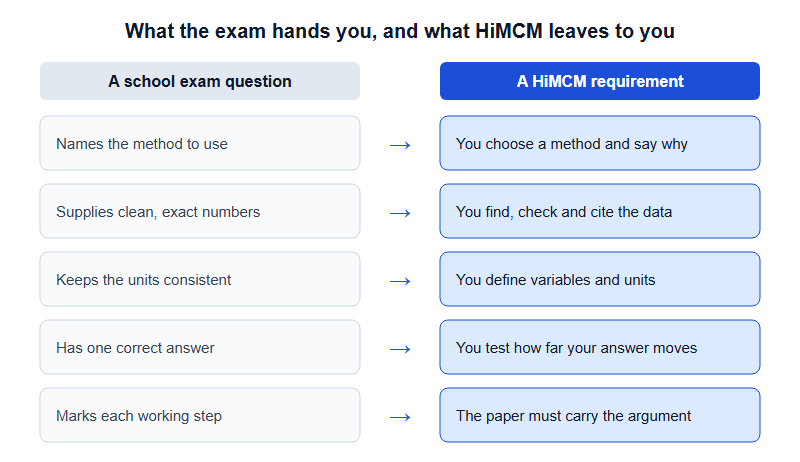
- Units and estimation (modelling). A chain of rates whose units do not cancel is the cheapest error to make and the easiest to catch: write every unit, cancel them on paper, and label each figure cited or assumed.
- Choosing a method, with reasons (modelling). Exams name the method; HiMCM never does. The skill is listing two approaches that could produce the required output, picking one, and writing a sentence about the one you rejected and why.
- Messy data, properly cited (research). Real series have missing years, changed definitions and mismatched units. COMAP allows any inanimate source — websites, books, software — but requires every source to be credited, and warns that failing to credit data or materials may reduce the award level, or lead to disqualification if deemed plagiarism.
- Computation others can reproduce (computation). One spreadsheet or one language, understood by at least two people, with every reported number traceable to a cell or a line.
- Writing it up in English (writing and quality control). Define every symbol before using it, state assumptions as assumptions, and claim exactly as much confidence as your sensitivity analysis supports — in the English COMAP requires for the whole paper.
A 90-minute readiness check for your team
Run this in September, before the roster is final, with every candidate in the room. It is our own practice format rather than COMAP material, and it deliberately avoids past HiMCM problems so nobody is recalling a published solution.
- Units chain, 15 minutes. Estimate how many litres of drinking water your school’s students use in one school day. Every number carries a unit and a label, cited or assumed, and the units must cancel on paper.
- Two curves, 20 minutes. Take any public yearly data series with at least eight values, note its source, fit a straight line and an exponential curve, and write three sentences on which you would use for a five-year projection, and why.
- Formulate, do not solve, 20 minutes. Your school can fund up to five water-refill stations and wants as many students as possible within a short walk of one. Write the decision variables, the objective and every constraint, first in words and then in symbols.
- Step rule, 20 minutes. Write the rule that takes one quantity from a time step to the next — a lunch queue minute by minute, or a club’s membership term by term — as an equation, then compute five steps in a spreadsheet.
- Score and debrief, 15 minutes. Give each student 0, 1 or 2 on each of the five skills: 2 for doing it unaided, 1 for one slip, 0 for being unable to start. Units come from task one; method choice and data handling from task two; computation from task four; written explanation from the sentences in tasks two and three.
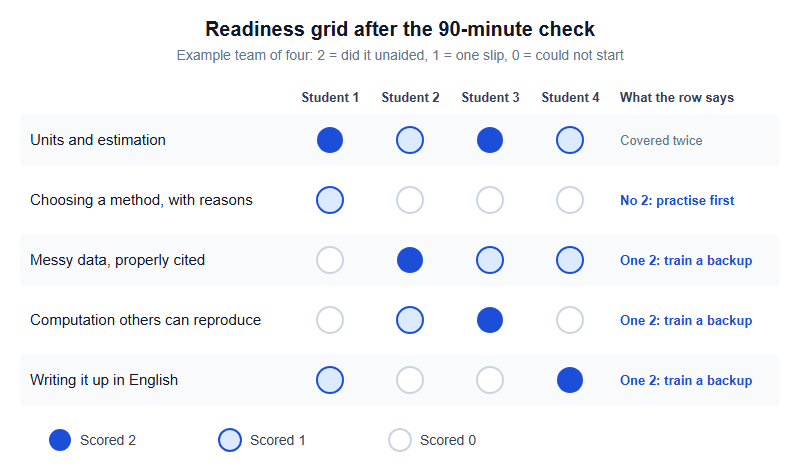
Read the grid with two rules. A skill where nobody scored 2 is the team’s first practice target for October. A skill where exactly one person scored 2 is a single point of failure: a fortnight is long enough for someone to fall ill, so train a second person now. If a row stays empty and nobody wants to fill it, recruit for that skill rather than for competition results — our team-matching page is built for that search.
Where to spend practice time before 4 November
The same grid points to different priorities in different year groups.
- Grade 9 and 10. The topic table is thinner, which matters less than it looks: units, spreadsheets and plain written explanation give the best return. If every member is 14½ or younger on the start date, MidMCM is also open, and COMAP states that a MidMCM team choosing a HiMCM problem competes in HiMCM.
- Grade 11. Most of the table is already in place. Put the hours into the two skills school courses skip: choosing between methods, and computation that two people can reproduce. Past problems are the right practice material, studied for structure and reasoning; lifting a model, prose, figures, code or citations from any past paper is plagiarism that ends a team’s contest.
- Grade 12. The mathematics is rarely the constraint; the calendar is. COMAP’s Procedures and Tips article says results are posted on or before 1 February, after most application deadlines, so enter for the experience and protect the hours.
Whatever the year group, do not spend September memorising named methods. A method your team cannot defend in its own words is a liability when the written argument is the product — and defending choices, not knowing topics, is the real difference between modelling and problem solving.
Frequently asked questions
Do you need calculus to do well in HiMCM?
Not necessarily. COMAP sets no maths prerequisite, and many defensible models use rates, functions, regression and step-by-step updates.
Can a Grade 9 student take part in HiMCM?
Yes. COMAP says all students in high school grades or below may enter HiMCM; a team may enter MidMCM only if every member is 14 and a half or younger on the start date.
Does our team need someone who can code?
Someone must compute reliably. Code is not used in judging, so a spreadsheet model can work if every step is explained in the paper.
Is HiMCM maths harder than AMC maths?
It is different rather than harder: an open-ended team problem where justifying each modelling choice matters more than technique.
This is an independent guide operated by Hanlin Education for China-based international-school students. We are not affiliated with, endorsed by, or sponsored by COMAP, which is the sole official authority for HiMCM rules, dates, registration and judging. Confirm all current details on comap.org before acting on anything here. Errors reported to us are corrected within 7 working days.