
COMAP states that HiMCM judging is completed in January and results are posted on or before 1 February each year. That single date settles a question most families never think to ask: a student who competes in Grade 12 will have applied to university before any result exists. HiMCM is, in scheduling terms, a Grade 10 and Grade 11 activity.
The rest of this article is about the two things that follow from that — when to compete, and what the contest genuinely evidences about you once you have.
The date that decides everything
Lay the 2026 cycle out end to end. The contest window is 4–17 November 2026. COMAP recommends logging in the day after the window closes to confirm your PDF was received, and states that submission status is usually posted 24–48 hours after the contest ends. Then nothing happens for over two months: judging is completed in January, with results posted on or before 1 February 2027. Certificates only become downloadable once those results are public.
Now lay the application calendar beside it. US early rounds close in the autumn. US regular decision deadlines fall in the first half of January for most institutions. The UCAS main equal-consideration deadline falls in January. Exact dates vary by institution and by cycle, so confirm each one with the university concerned and with UCAS — but the shape does not vary: essentially every Grade 12 deadline lands before 1 February.
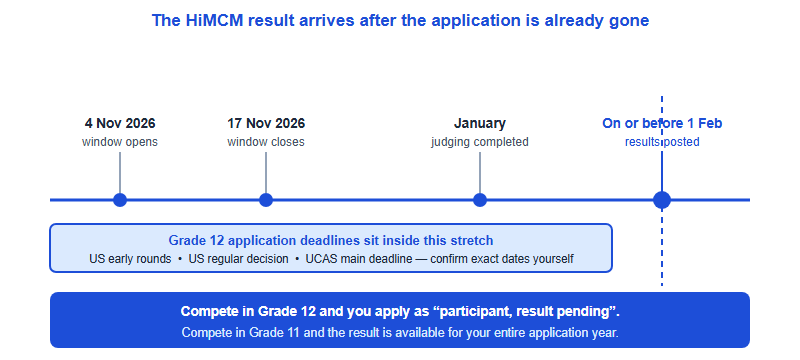
What this means, grade by grade
| You compete in November 2026 as a… | What exists by your deadline | What you can honestly write |
|---|---|---|
| Grade 12 student | A submitted paper. No result, no award designation, no certificate. | Participation only, with the result pending. Some institutions accept mid-year or additional-information updates — check each one’s policy rather than assuming. |
| Grade 11 student | The full result by 1 February 2027, roughly eight months before applications open. | Everything: the designation, the problem you chose, the model you defended, the role you owned. |
| Grade 10 student | A full result, plus time to compete again in Grade 11 with a stronger team. | Everything, and a two-year arc rather than a one-off entry. |
| Grade 8–9 student | A full result and a long runway. | Early evidence of sustained interest, which is usually more credible than a single senior-year entry. |
One practical footnote on certificates. COMAP states that the spelling and order of student names on the certificate is whatever the advisor typed during registration, that COMAP does not edit that information, and that it will correct only spelling errors and typos afterwards. If your legal name on applications differs from what appears on the certificate, that mismatch is easier to prevent in October than to explain in February.
None of this is an argument against a Grade 12 student competing. It is an argument against competing for the wrong reason. If a senior wants the experience, the honest framing is that the fortnight has to be worth it on its own terms — and the remaining questions are scheduling ones. The window opens in early November, which for many students is also mock examination season and the tail of the application run. COMAP states the problems are designed to be completed within roughly 36 hours of work spread across the 14 days, which is manageable, but only if those hours are blocked out in advance rather than hunted for later. A senior who cannot honestly find them should hand the seat to a Grade 11 teammate who can — and who will still be at the school to use the result.
What HiMCM actually evidences — and what it does not
Contest names mean very little to a reader outside your school. What carries information is the structure of what you did, and HiMCM’s structure is unusual in a way worth understanding before you decide it is the right use of your November.
Read COMAP’s own design decisions as a list of demands on the student. The team is up to four students who must all attend the same institution, and the roster locks before the window opens. The problem is open-ended and drawn from the real world; there is no answer key. The output is a single English PDF of at most 25 pages. The strongest papers, COMAP says, contain sections addressing assumptions with justifications, the modelling process, results, strengths and weaknesses, sensitivity, and conclusions. And for the entire fortnight, teams may not seek answers, ideas, information or resources from anyone outside the team — explicitly including their own advisor.
Assemble those and you get a fairly specific claim. Because the contest rewards defensible reasoning rather than a correct number, a completed HiMCM paper evidences that a student can hold a problem that has no right answer, commit to an approach, argue for that commitment in writing, in a second language, and then state where their own argument stops working — with no adult permitted to rescue them along the way. That last constraint is doing a lot of work. Very few school activities are structurally incapable of being carried by a teacher.
Equally, be clear about what it does not show. HiMCM says nothing about your individual technical ceiling or your speed under exam pressure. Those are what a timed individual olympiad demonstrates, and a modelling paper is a poor substitute for one. The two are complements, not rivals.
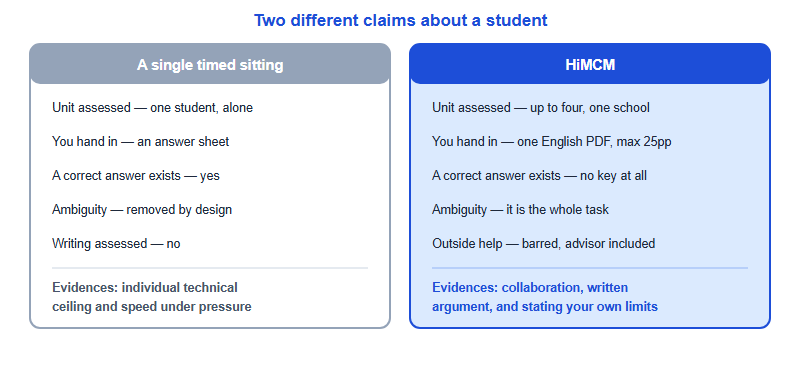
How to write about it without overclaiming
The most common mistake is leading with the award tier. COMAP recognises successful papers as Outstanding, Finalist, Meritorious, Honorable Mention or Successful Participant, with papers that do not adequately address the problem or that break the rules designated Unsuccessful or Disqualified. Those labels describe a paper. They do not describe a student, and a reader outside the contest cannot calibrate them.
What travels much further is the decision you can still defend months later — which is, after all, the thing the contest is built to reward. Some suggestions, all editorial:
- Name one modelling choice and the alternative you rejected. “We treated the queue as a discrete simulation rather than a closed-form model because the arrival data was too lumpy for the standard assumption to hold” tells a reader far more than any designation.
- Name the role you owned. Modelling, computation, research, or writing and quality control — a specific role on a four-person team is credible in a way that “participated” is not. Our team matching page sets out how those roles divide.
- Talk about the weaknesses section. Being able to say what your own model could not do is an unusual thing for a seventeen-year-old to demonstrate, and it is a section COMAP explicitly expects.
- Keep the paper. It is a real artefact you can reread before an interview. Note that your name is not on it — COMAP requires complete anonymity, with the team control number as the only identifier — so save your own copy.
- Do not claim what the contest cannot support. No competition guarantees an admission outcome, no designation should be described as a ranking against individuals, and a result you cannot explain in two sentences is not worth the line it occupies.
The honest limits
Three things are worth saying plainly to any family weighing this up.
First, the effort is real but bounded. COMAP states the problems remain “designed for teams to complete a solution within 36 hours of work”, spread across the 14-day window; the fortnight is scheduling flexibility, not extra workload. Thirty-six hours across two weeks is a genuine commitment on top of school, and in early November it collides with mock examinations. It is not, however, a year-long research project, and it should not be sold as one.
Second, the outcome is not appealable. COMAP states it will not rejudge contest papers and stands behind the designations awarded. Whatever comes back on 1 February is final, which is one more reason the submitted document has to carry the argument on its own.
Third, and most important: the value of doing HiMCM is mostly the doing. A team that spends a fortnight arguing about whether an assumption is defensible learns something that survives the contest, regardless of the label attached in February. If the only reason a student is entering is a line on a form, and that line will arrive too late to be written anyway, the honest answer is to compete a year earlier — or to do something else.
Frequently asked questions
When are HiMCM results released?
COMAP states judging is completed in January and results are posted on or before 1 February each year, after which certificates can be downloaded.
Can a Grade 12 student use a HiMCM award on their application?
Usually not. Results arrive after most deadlines, so seniors can generally report participation only — check each institution’s update policy.
Which year is best to compete in?
Grade 10 or 11, in our editorial view: results are posted by 1 February, well before the Grade 12 application cycle begins.
Does a HiMCM award improve admission chances?
No contest guarantees any admission outcome. What HiMCM gives you is a written artefact and a decision you can explain and defend.
This is an independent English-language guide to HiMCM for China-based international-school students, operated by Hanlin Education. It is not affiliated with, endorsed by, or sponsored by COMAP. COMAP is the sole official authority for HiMCM rules, dates, registration and results — requirements change between editions, so always confirm current details on comap.org before registering or submitting. Confirmed errors are corrected within 7 working days.