HiMCM teammate compatibility is the practical problem teams are facing in the final weeks before the 2026 contest, and it is not solved by CV review. For teams finalizing their rosters for the 2026 High School Mathematical Contest in Modeling (HiMCM), the question that matters is no longer “who has the strongest credentials” but “will these three or four people actually function together on Day 10 of the contest window?” Hanlin’s published team-selection guidance answers this with a concrete protocol: run a four-hour joint rehearsal on a shortened past A or B problem, then score the group on three observable signals – working-hour chronotype, tolerance for “close enough”, and whether a blocked member escalates to the group or disappears to debug alone. The drill is a coaching tool, not a COMAP rule, and it works best in the days before the 2026 registration deadline on November 4 at 2:00 PM EST, while a roster change is still possible.
The Reader’s Question: How Do We Know This Roster Will Actually Work?
The short answer: you cannot know this from a CV. Registration for the 2026 HiMCM closes on November 4, 2026 at 2:00 PM EST, and the contest window opens the same day at 3:00 PM EST, running through November 17. COMAP’s official contest page describes the format as a 14-day window in which teams download and choose their problem, complete their modelling solution, and submit electronically; teams are not required to use the full window. If a serious mismatch in working style only becomes visible in the first week of that window, the remaining days are usually too few to redo the work. The drill below exists to surface those mismatches now, while reshuffling is still cheap.
Why a Paper CV Does Not Predict Team Fit
Parents and students often select teammates by AP scores, AMC ranks, or GPA. These signals indicate individual capability; they say almost nothing about collaborative behaviour. Hanlin’s published guidance on HiMCM team selection states that across roughly the last three contest years, over 80% of Outstanding (O) and Finalist (F) awarded teams had clear role division and complementary skills established before the contest started. That number is a Hanlin teaching observation, not an official COMAP statistic. It should be read as a pattern rather than a rule: the O/F cohort is small relative to the wider field, and there is no public per-team dataset that proves causality. Even so, the observation points at something practical. Successful teams are not collections of individually strong students; they are units with a division of labour that already functions.
Two failure patterns appear repeatedly in Hanlin’s case discussions. The first is a four-person team where everyone is strong in mathematics and nobody has trained as a writer. The judges’ product is a paper, not a model, so a team that cannot narrate its own model is under-represented in the final score even when the underlying work is solid. The second is a team whose members all agree the contest is “worth trying” but disagree on how hard to try; a member preparing for a top award and a member aiming for a participation line will pull the group in opposite directions by the second week. A four-hour rehearsal does not solve either problem, but it makes both visible.
The Four-Hour Rehearsal: Choosing a Shortened Prior Problem
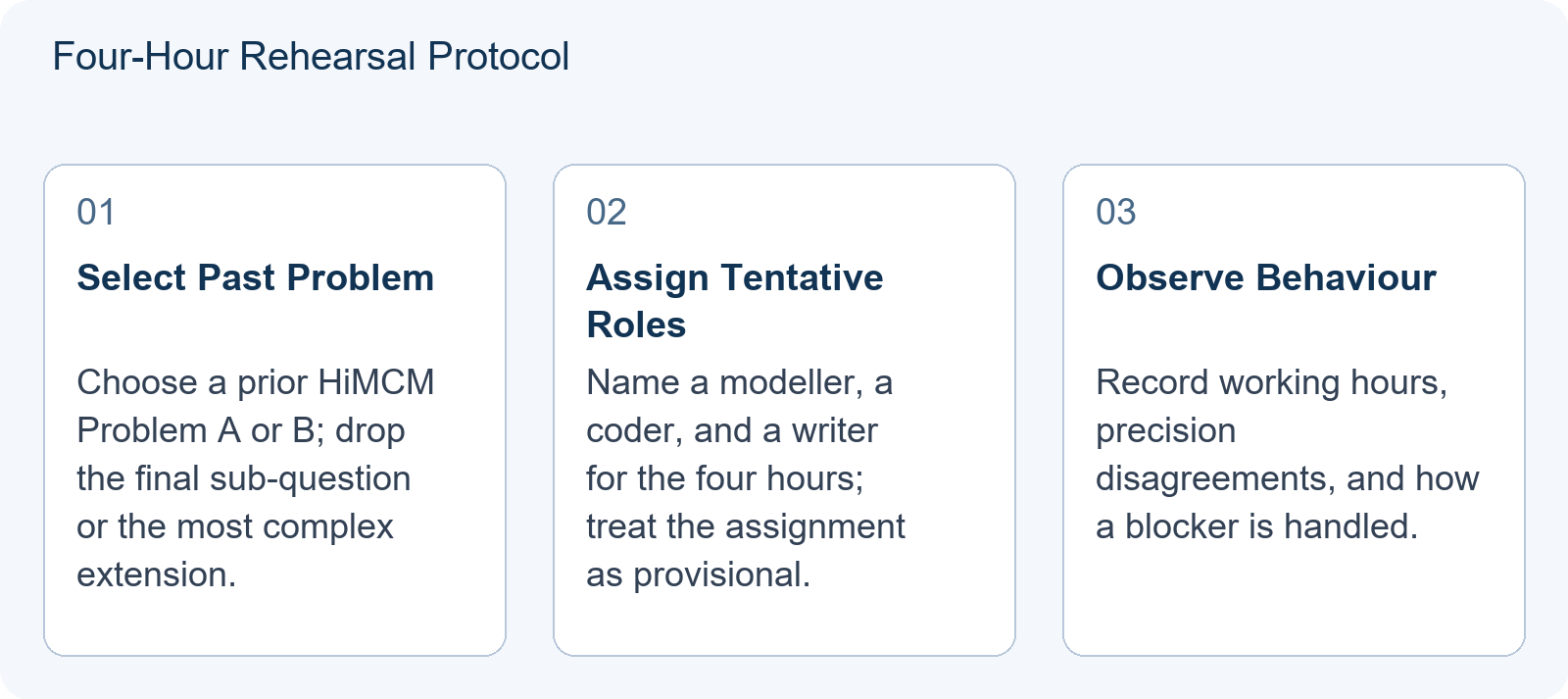
Pick one past HiMCM Problem A or Problem B. Drop the final sub-question or the most complex extension. The goal is not to produce a polished answer, but to observe how the group behaves when it is slightly stressed and slightly time-boxed. Four hours is short enough that nobody can hide behind slow preparation and long enough that the team has to make real decisions.
During the rehearsal, assign tentative roles: someone leads the mathematical formulation, someone handles data or code, someone drafts the summary and story. These roles do not have to be final. You are looking for information, not commitment. Watch how the group handles disagreement. Do they interrupt? Do they wait for permission? Do they argue about a decimal place while ignoring a structural gap? The point is not to grade the work; the point is to see behaviour that a CV cannot show. Teams interested in a deeper version of this exercise, with the roles written down and named owners, can compare notes with the decisions set out in The HiMCM Team Agreement: Five Decisions That Need a Named Owner Before the Window Opens, which covers the ownership questions teams often defer too long.
Signal 1: Working Hours and the Day-10 Cliff
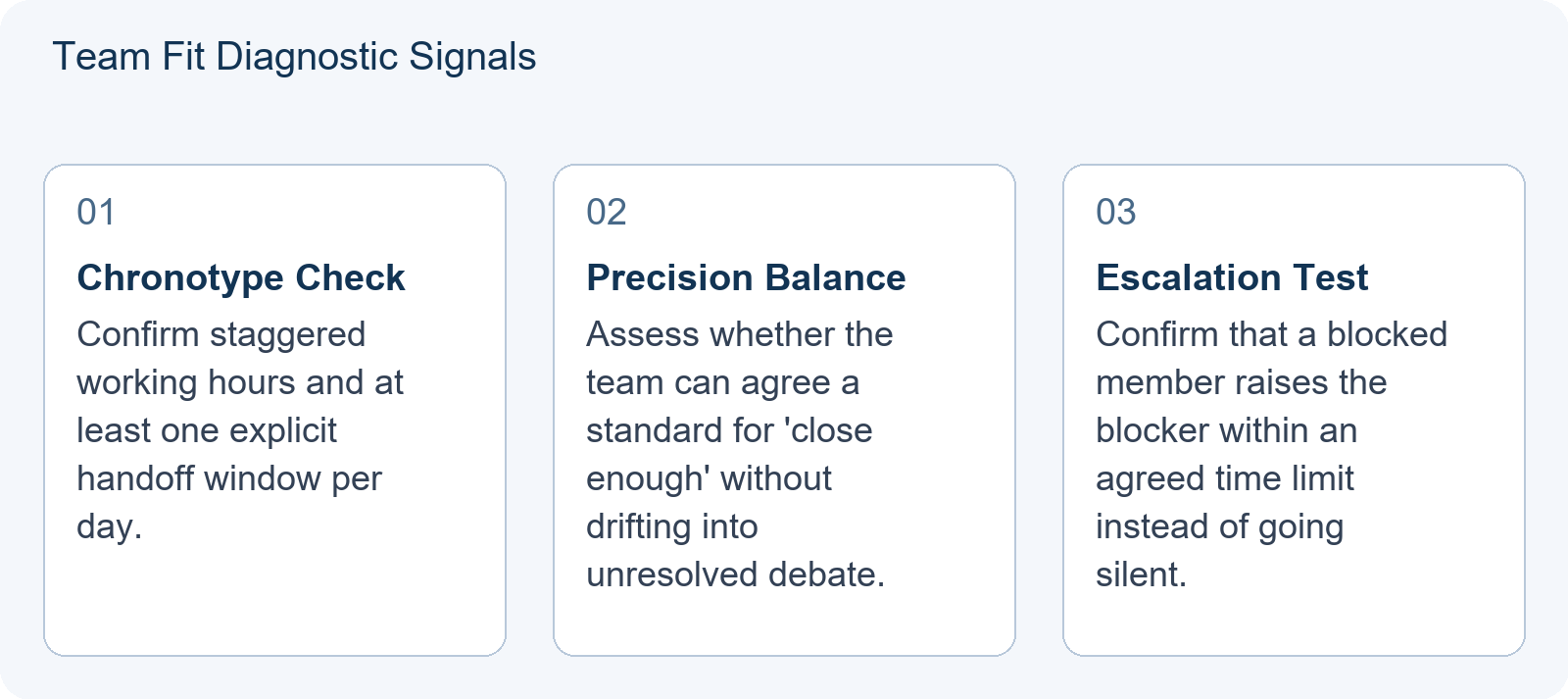
HiMCM is a marathon. Members of a real contest team almost never share the same working rhythm on every day of the window. Hanlin’s guidance asks teams to determine whether members are predominantly night-owl or early-morning types. The specific pattern that tends to cause trouble is a team where every member switches off by 11:00 PM. Progress stalls once the writing phase intensifies in the back half of the window, because no one is available to close a loop that started the previous evening. Hanlin’s guidance describes this as a cliff: the schedule looks fine through the first week and then breaks around Day 10, when parallel streams need to converge.
The fix is not to force everyone into the same schedule. It is to have staggered availability. If one member works late to finish a piece of code, another member should be available early the next morning to check the output and begin drafting. During your drill, notice who keeps checking the time and who loses track of it. Neither habit is wrong on its own, but mismatched habits without an explicit handoff rule create hidden delays. The dedicated The 14-Day Window, Budgeted: Where HiMCM Teams Lose Time and Why Writing Gets Squeezed article on this site breaks the window into phases if you want to see where those handoffs actually fall.
Signal 2: Tolerance for ‘Close Enough’: The Writer/Modeller Tension
The second signal is where the writer/modeller conflict shows up. The modeller often has a working solution with a rough edge: an assumption that is defensible but not airtight, a parameter that is estimated rather than measured. The writer wants to know whether the number can be defended in the abstract. Hanlin’s guidance identifies this as the classic HiMCM conflict: the modeller says “the result is close enough”, while the writer says “this conclusion cannot go into the summary.” The failure mode is not that either side is wrong; it is that the team has no shared standard for when “good enough” becomes “ready to publish.”
Hanlin’s teaching observation is that a team needs at least two members who actively prioritise precision, alongside at least one member who understands that a finished, slightly imperfect paper beats a perfect paper that never gets finished. During the drill, watch for a specific pattern: a member who refuses to move forward until every variable is defined, next to a member who wants to sketch the next section and revisit details later. Neither attitude is inherently correct. What matters is whether the group can agree quickly on evidence standards. If the same disagreement reappears twice in four hours, it will reappear in the actual contest, only under tighter time pressure.
Signal 3: Escalation Style: Ask the Group or Disappear for Three Days
The third signal is what happens when someone gets stuck. Hanlin’s guidance describes two patterns: a member immediately pulls the team into a short brainstorm, or a member quietly disappears to debug alone. The second pattern is described as toxic in a small team, because silence is expensive. In a four-person unit, a member who vanishes for two hours has also taken two hours away from the writer, the reviewer, and the modeller waiting on the same output.
During the rehearsal, introduce a small obstacle if one does not occur naturally: a missing dataset column, a formula that returns nonsense, an assumption that no longer fits. Then watch what happens. Does the stuck member say something within half an hour? Does the team agree on a time limit before escalating? Effective teams tend to operate with a rule such as “if a blocker lasts more than an hour, tell the group”, but the specific number matters less than the fact that the rule exists. The pre-contest decisions covered in Your HiMCM Roster Locks Before the Window Opens – and the Spelling Goes on the Certificate address related questions about when membership is truly final, which is worth reading before the November 4 deadline.
Scoring the Drill: Keep, Reshuffle, or Replace
After the four hours, hold a short debrief and score the three signals. The table below summarises what to look for.
| Signal | Green Flag | Red Flag |
|---|---|---|
| Working Hours | Staggered availability; explicit handoff rules | All members switch off at the same time; no handoff plan |
| Precision Tolerance | Team agrees on an evidence standard quickly | Repeated argument over minor details; structural gaps ignored |
| Escalation Style | Blocker raised with the group within the agreed time limit | Silent troubleshooting; teammates wait without information |
If two or more red flags appear, consider reshuffling roles before considering a roster change. Sometimes the team is compatible but the initial role assignment is wrong: a strong coder who was cast as the writer, or a natural chair who was cast as the modeller. If reassignment does not resolve the friction, and the deadline for changes is approaching, replacing a member is a legitimate option. The roster locks before the contest window opens, and certificate spelling is fixed at the same time, so changing team composition after November 4 at 2:00 PM EST is not possible.
What the Drill Does Not Prove
This exercise tests process, not content. It does not predict an award level, and it cannot turn a team without the required mathematical and writing skills into an award-winning one. It reduces the probability of a specific failure: a team that individually has the capability but collectively cannot deliver a coherent paper. Several COMAP rules still apply during the contest itself. All members must come from the same school, institution, or approved program, and no external help – including from the team’s advisor – is permitted during the contest window. The advisor handles registration, submission, and logistics; the modelling and writing are the students’ work. Nothing in the drill changes those boundaries.
General event background is available at Event background.
This is an independent preparation guide, not affiliated with, endorsed by, or sponsored by COMAP.
Frequently Asked Questions
Can we change our team roster after November 4?
Registration for the 2026 HiMCM closes on November 4, 2026 at 2:00 PM EST, and the contest window opens that afternoon at 3:00 PM EST. Because the roster is fixed at registration, confirm or swap members before that point. This is one reason to schedule the drill in the days immediately before the deadline.
Does the four-hour drill count as contest preparation?
Yes, as practice. It is a simulation on a past problem, so no output from the rehearsal can appear in your actual submission. Treat the drill as a behavioural test, not as a partial draft.
What if my team spans different time zones?
The drill quickly exposes how much shared working time you have. In a 14-day window, teams with less overlap need more explicit handoff rules: a fixed daily sync time, a shared file structure, and a named owner for each open blocker. If the drill shows almost no overlap, plan the async workflow before the window opens rather than during the first week.