The HiMCM summary sheet is the first page a judge sees, yet many teams treat it as an afterthought or a generic abstract. COMAP’s official instructions require this page to appear before your solution, references, and any appendices, all packed within a strict 25-page envelope that includes the summary itself. The summary is constrained to one page. Judges read it as a standalone document: if they cannot quickly identify what your team recommends and why it matters, the rest of your paper may not receive the attention it deserves. This article shows how to structure that critical first page, using checked teaching illustrations and a practical diagnostic you can apply to your own draft.
What COMAP Actually Requires: The Hard Constraints
Before writing a single sentence, every team must internalize the non-negotiable structural rules. According to COMAP’s official instructions for the 2026 contest, the summary sheet must be Page 1 of your submitted PDF. The 25-page envelope includes the summary sheet, the main solution, references, and any appendices. Your team’s control number must appear in the page header. The file must be a single PDF under 20 MB, named with your control number (for example, 1234.pdf), and submitted through COMAP’s online portal at forms.comap.org. After the 25 pages, you must append the AI Use Report, which has no page limit and does not count toward the 25-page total.
These constraints are not advisory. A submission that places the summary after the introduction, omits the control number, or exceeds the page envelope risks disqualification or administrative rejection before judging even begins. For the complete architectural breakdown of how these elements fit together, see The HiMCM Paper Is the Product: Summary Sheet, Section Architecture and the 25-Page Envelope (2026).
Why Leading With the Recommendation Works
The summary sheet functions as an executive brief. Judges review dozens of papers under time pressure. They do not have time to hunt for your conclusion. When you place your recommendation in the first sentence, you anchor their reading: every subsequent sentence is interpreted as support for that claim. When you bury the recommendation, you force the judge to construct your argument for you, increasing cognitive load and the risk of misinterpretation.
This principle appears in professional consulting, policy analysis, and scientific communication under names like “BLUF” (Bottom Line Up Front) or “executive summary.” For HiMCM, a clear, early recommendation signals confidence and clarity of thought. However, this is a communication best practice, not a rubric requirement. For some problems, a concise line of context before the recommendation may be necessary to orient the reader. The recommendation-first structure is optional for the appropriate problem; what matters is that the recommendation appears prominently and unambiguously on the single page.
Teaching Illustration: Strong vs. Weak Summary Structure
The following is a teaching illustration for training purposes, not an actual contest problem. All numerical outputs are explicitly assumed for pedagogical clarity and have not been derived from performed analysis, proof of global optimum, or verification of uniqueness.
Consider a team addressing a traffic optimization scenario. Here is how two versions of the same summary perform differently.
Weak Draft:
“We analyzed the traffic flow at Main Street and 5th Avenue. We collected data on vehicle counts during peak hours. Using Python, we simulated different signal timings. Our results show that changing the green light duration affects wait times. We recommend adjusting the lights.”
This draft fails on three counts. The recommendation is vague (“adjusting the lights”). The evidence is non-specific (“affects wait times”). The structure is process-oriented rather than outcome-oriented. A judge reading only this page would not know whether the team achieved anything meaningful.
Strong Revision:
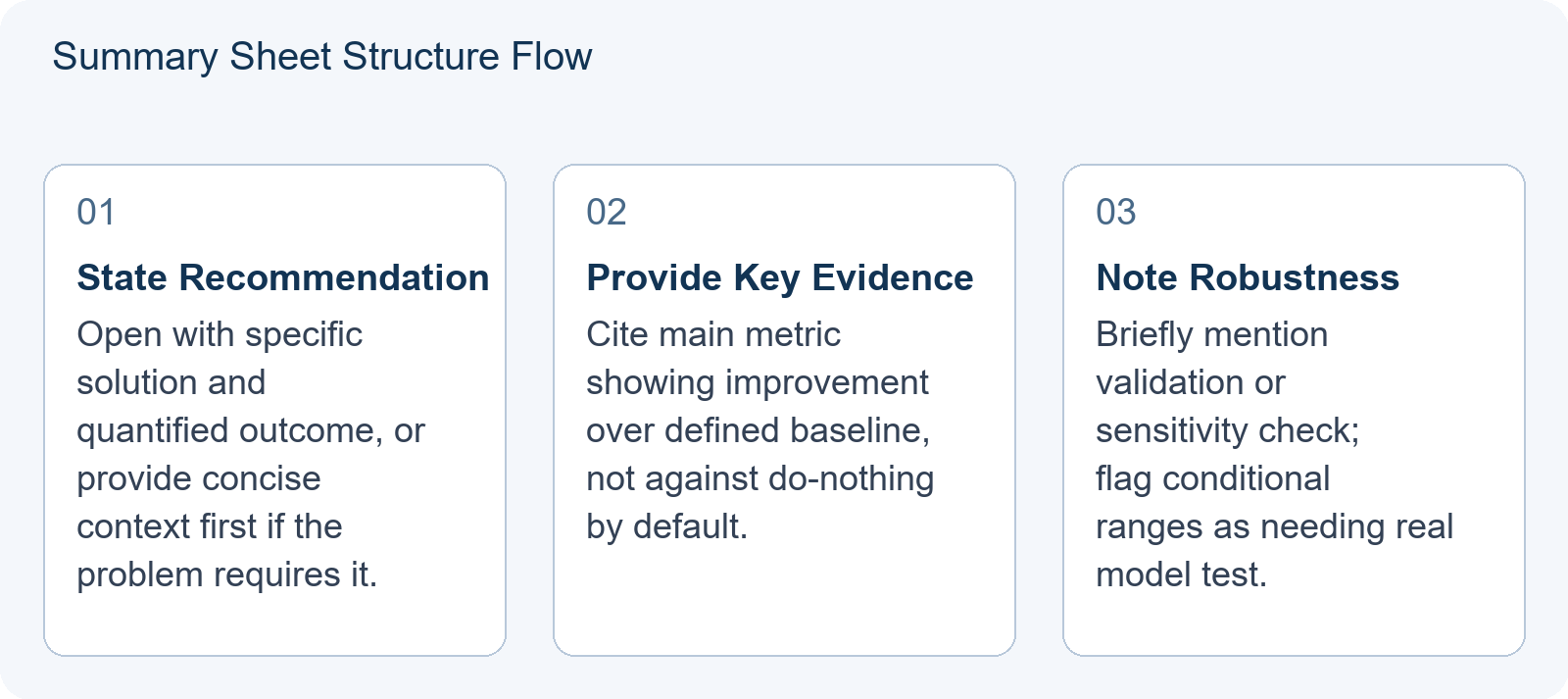
“We recommend setting the north-south green light to 45 seconds and the east-west green light to 30 seconds during peak hours. Compared to the current fixed-timing baseline of 50 seconds average wait, this configuration reduces average vehicle wait time to 39 seconds, a 22 percent reduction. Our simulation model, calibrated with observed traffic volume data, identifies this timing as a favorable local improvement for minimizing total delay. Sensitivity analysis under plus or minus 5 percent traffic volume variation suggests the result remains stable, though a real model test would be needed to confirm robustness across all conditions.”
The revised version leads with the specific recommendation. The second sentence provides the key metric (22 percent reduction from a defined baseline of 50 seconds to 39 seconds). The third sentence names the method briefly. The fourth sentence notes conditional robustness. A judge can verify the logic in seconds. Note that the baseline here is the current system, not a do-nothing scenario; teams should justify whatever baseline they choose.
Teaching Illustration: The Contrasting Case Where Detail Destroys Clarity
The following is a teaching illustration for training purposes, not an actual contest problem. All numerical outputs are explicitly assumed for pedagogical clarity.
A superficially similar approach can fail when teams overload the summary with technical apparatus. Consider a resource allocation scenario.
Over-Detailed Draft:
“Our model uses a mixed-integer linear programming formulation with binary variables x_ij representing assignment decisions. The objective function minimizes cost C equals the sum of c_ij x_ij subject to constraints A x less than or equal to b. We solved this using the branch-and-bound algorithm. The solver returned an optimal value of 1500 units. Therefore, we assign Worker 1 to Task A…”
This draft is mathematically accurate but communicatively ineffective. The reader must parse notation and algorithm names before understanding the practical implication. In HiMCM, judges include educators and professionals who may not be experts in optimization algorithms. The summary should translate the mathematical result into plain English.
Balanced Revision:
“Assigning Worker 1 to Task A and Worker 2 to Task B minimizes total labor costs to 1,500 dollars, saving 300 dollars compared to the baseline schedule of 1,800 dollars. We achieved this using a mixed-integer linear programming model that accounts for skill compatibility and shift limits. The solution is favorable under current constraints, though relaxing shift limits could yield further savings.”
This version prioritizes the business outcome (cost savings of $300 from a baseline of $1,800) while still crediting the method. It avoids unnecessary notation, which belongs in the main body. The numbers are teaching illustrations with explicitly assumed outputs.
The Diagnostic Test: Three Questions for Your Draft
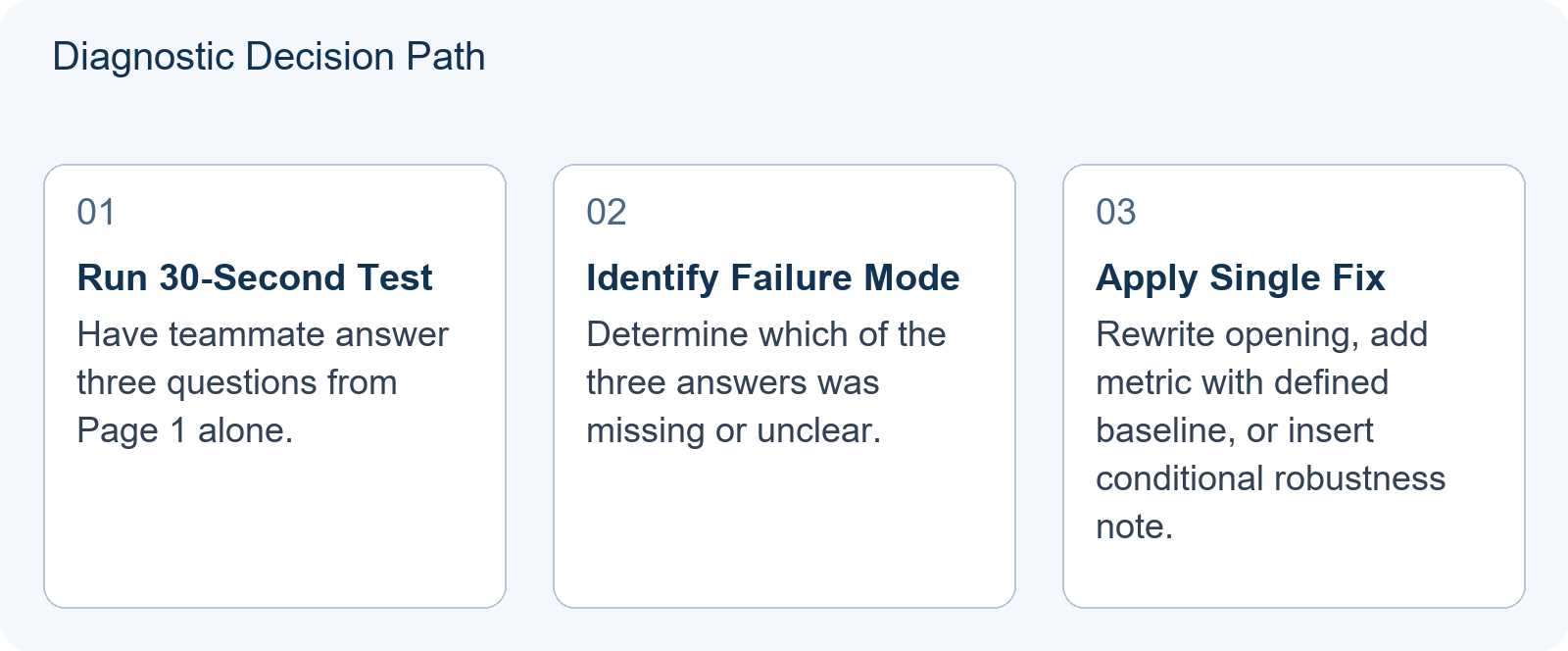
Teams need more than examples; they need a reproducible test. Print only the first page of your draft. Hand it to a teammate who has not seen the rest of the paper. Ask these three questions, in order:
- What is the main recommendation?
- How much better is it than the status quo?
- Why should I believe it?
Time the response. If your teammate cannot answer all three questions within 30 seconds, your summary needs revision. The failure mode determines your next step.
Next-Step Decision Matrix
Based on the diagnostic result, take exactly one of the following actions:
If the recommendation is unclear: Rewrite the opening sentence ten different ways until one states the outcome unequivocally. The recommendation must contain a specific noun and a specific number. “We optimize the system” fails; “We reduce average wait time by 22 percent from a 50-second baseline to 39 seconds” passes.
If the improvement over status quo is missing: Add a comparative metric in the second sentence. State the baseline and the new result. Without this comparison, the judge cannot assess significance. The baseline should reflect the actual current system, not automatically a do-nothing scenario.
If the reason to believe the result is weak: Insert one robustness check. Name a sensitivity analysis, a validation against real data, or a constraint check. This answers “why should I believe it?” without requiring the full methodology. Note that claimed robustness ranges are conditional and require real model testing to confirm.
Do not proceed to polishing language until the structure passes this test. A well-written weak structure is still weak.
Connecting Summary Technique to Full Paper Integrity
The summary sheet does not exist in isolation. Every number in the summary must be traceable to a table, figure, or equation in the main body. Before final submission, verify this correspondence. Discrepancies between summary and body are red flags for judges and can trigger questions about data integrity.
For teams whose first language is not English, clarity is paramount. Avoid idioms or overly complex sentence structures. Simple, direct statements are more effective. Resources such as Judged as Communication: How a Chinese-Curriculum Team Writes a HiMCM Paper in English offer specific advice on phrasing and tone.
Preparation Context and Further Resources
Understanding summary sheet structure helps teams assess whether their preparation is balanced. If a student builds sophisticated models but cannot explain the recommendation clearly, targeted writing practice may be more valuable than additional mathematics study. Conversely, if the model itself is flawed, no summary polish will save the paper. All coaching and preparation support referenced here is for training only; no external coach may participate during the contest window itself.
Those seeking structured preparation can review HiMCM Preparation Course: What Your Team Should Learn Before the 2026 Contest. This article outlines typical curriculum components without promising specific outcomes. For guidance on studying past awarded papers without crossing ethical lines, see How to Study HiMCM Awarded Papers Without Crossing the Plagiarism Line (2026).
Final Submission Checklist
Before uploading your PDF, verify the following: the summary sheet is Page 1; the control number appears in the page header; the file is named with your control number; the file size is under 20 MB; the AI Use Report follows the 25-page envelope; every number in the summary appears in the main body; the recommendation appears prominently on the single page. These checks take minutes and prevent administrative rejection.
Frequently Asked Questions
Can the summary sheet include graphs or tables?
There is no official ban on visuals, but the one-page limit makes extensive graphics impractical. The priority is conveying your recommendation, key metric, and robustness check clearly. If a small, essential table communicates critical information more efficiently than text, it may be included, but most teams find pure text most effective within the severe space constraint.
How long should the HiMCM summary sheet be?
It must fit on one page. COMAP specifies that the summary sheet is Page 1 and is included within the 25-page envelope. There is no official word count. Focus on clarity and completeness within the single-page constraint rather than targeting a specific word count.
Do I need to repeat the problem statement in the summary?
No. Judges are familiar with the problem statement. Start directly with your team’s answer or recommendation to maximize impact and save space. Background context belongs in the introduction section of the main body, not the summary. For some complex problems, a brief orienting clause before the recommendation may be helpful, but the recommendation should still appear prominently.