Yes, you can use AHP, TOPSIS, entropy weights or GM(1,1) grey prediction in a HiMCM paper — nothing we found in COMAP’s published instructions prescribes or bans a named method. What fails is template use: choosing the method before reading the requirements, filling a judgement matrix nobody can defend, and pasting a course’s standard paragraph where an argument should be. Five questions tell the two apart.
Many China-based students first meet modelling through Chinese-language courses built for university contests, which teach a toolbox organised by problem type. The toolbox is not the problem; the reflex it trains is. Recognising the type and reaching for the listed method runs against what HiMCM rewards: a defensible modelling decision, not a method’s name.
Why these methods arrive in HiMCM as templates
The lists are familiar to anyone who has taken such a course. Evaluation problems get the analytic hierarchy process (AHP), the entropy weight method, TOPSIS, grey relational analysis and fuzzy comprehensive evaluation. Prediction problems get GM(1,1) grey forecasting, regression, time-series models and back-propagation neural networks. Optimisation problems get linear and integer programming. As vocabulary, this is genuinely useful.
The trouble starts when the list becomes the way of choosing. COMAP’s April 2026 preparation guide says getting ready for HiMCM is not about working through problem after problem and memorising techniques, and the contest’s structure explains why. There is no answer key, so a correctly executed method earns nothing unless the paper argues that it was the right one for this requirement, with these inputs.
There is also an integrity trap that teams trained on the same course rarely see. Many handouts include ready-made method paragraphs, flowcharts and stock figures. COMAP’s Procedures and Tips article states that it compares each submitted solution with all other solutions to the same problem, flags parts that are the same or similar, and uses the result to verify originality. If thirty teams paste the same course description of AHP, those paragraphs match one another. COMAP also requires every source to be credited — ideas, charts and graphics included — and states that plagiarism results in disqualification. So describe the method in your own words and cite its source. The same applies to awarded papers: study them for structure and reasoning only, because copying a model, prose, figures, code or citations is plagiarism that ends a team’s contest.
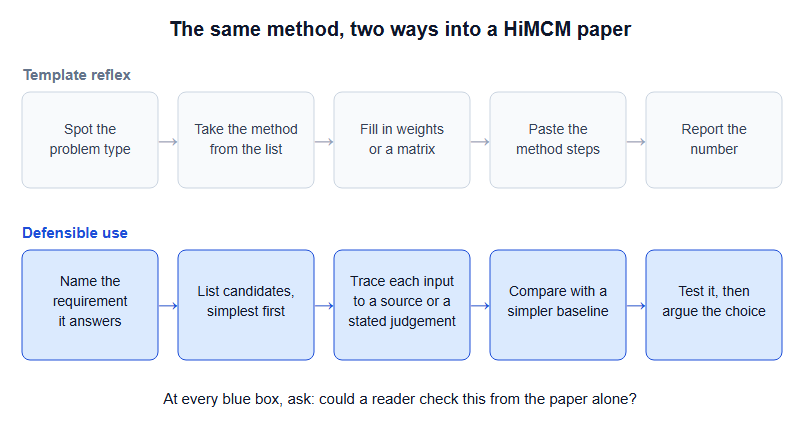
The five-question defensibility test
A method that passes all five is defensible whatever its origin; one that fails any of them is a template, however sophisticated it looks.
- Which numbered requirement does it produce? If you cannot point to the line of the problem statement that asks for a ranking, a weight or a forecast, the method is decoration.
- Where does each input come from? For every weight, score and parameter, say whether it is cited data or your team’s own judgement. Both are allowed; hiding which is which is not defensible.
- What does the simplest alternative give? Put a plain weighted sum beside TOPSIS, or a plain exponential fit beside GM(1,1). If they agree, the simpler one is easier to defend; if they disagree, the disagreement is a finding you must explain.
- How far does the answer move when the least certain input moves? Weights and short data series are usually the least certain inputs. Report the movement, not just the result.
- Could a reader rebuild the result from the paper alone? COMAP’s instructions tell teams not to send programs, software or databases with the solution, so the decision matrix, the normalisation and the formula have to be on the page.
| Method | What it actually answers | The template failure | What makes it defensible |
|---|---|---|---|
| AHP | How a decision-maker’s pairwise priorities translate into weights | A judgement matrix filled in to look consistent, with no stated reasons | A reason for each comparison, the consistency ratio, and a weight sensitivity check |
| Entropy weights | Which criteria vary most across these particular options | Treating spread as importance | Arguing why spread is the right basis here, and showing the normalisation |
| TOPSIS | Which option sits closest to the best and furthest from the worst on every criterion | One ranking reported as the answer | The decision matrix on the page, and the ranking under more than one weighting |
| GM(1,1) | An exponential trend through a short series | A long forecast from five points, validated on the same points | An argued reason for exponential behaviour, a held-out check and a short horizon |
| Neural network | A flexible fit when data are plentiful | A black box trained on a few dozen rows | A simpler baseline beaten on data the model never saw, and an explanation of the inputs |
AHP and entropy weights: whose priorities, and which spread?
AHP builds weights from pairwise comparisons — is cost more important than coverage, and by how much on a one-to-nine scale — which in professional use come from the people making the decision. In HiMCM they cannot. COMAP bars teams from seeking answers, ideas or information from anyone outside the team during the contest, explicitly including their advisor, other teachers, other students and experts, so nobody can hand the matrix to a teacher or survey a class. The comparisons are your team’s own judgement. That is acceptable if the paper says so, ties each comparison to the problem statement or a cited source, and tests what happens when the judgements change. Report the consistency ratio, which by Thomas Saaty’s widely used rule of thumb should be below 0.1, but it is not validation: it shows your comparisons agree with one another, not that they are right.
The entropy weight method looks like the cure, because its weights come from data. What it measures is spread: a criterion on which every option scores almost the same gets almost no weight, however much the client cares about it. And the result depends heavily on a step templates treat as routine, as this invented example of four candidate recycling-point sites shows.
| Criterion | Site A | Site B | Site C | Site D | Entropy weight, version 1 | Entropy weight, version 2 |
|---|---|---|---|---|---|---|
| Households within walking distance (%, higher is better) | 62 | 55 | 71 | 48 | 3% | 35% |
| Running cost (thousand US$ a year, lower is better) | 48 | 35 | 60 | 30 | 97% | 31% |
| Safety score (0–10, higher is better) | 8.1 | 8.0 | 7.9 | 8.2 | under 0.1% | 34% |
Same data, same method, two routes through one routine-looking step. In version 1, cost carries 97% of the decision and safety effectively nothing; in version 2, the three criteria weigh almost equally. Applied to the same 0–1 scores, both put Site D first, but second place swaps between Sites B and A. Reporting one version lets a normalisation make a modelling decision silently. The defensible move is to say which question the weights answer — how much the options differ, or how much each criterion matters to the client — choose the route that fits, and show the conclusion surviving the other.
TOPSIS and grey prediction: where a ranking or a forecast quietly breaks
TOPSIS ranks options by their distance from an ideal best and an ideal worst. It inherits both problems above — dependence on weights and on normalisation — and adds one of its own: adding or removing an option can reorder the others, a well-documented property it shares with AHP. None of that disqualifies it, but a single ranking is not a result until you show how it behaves, and the clearest way is to find the weight at which the recommendation changes.
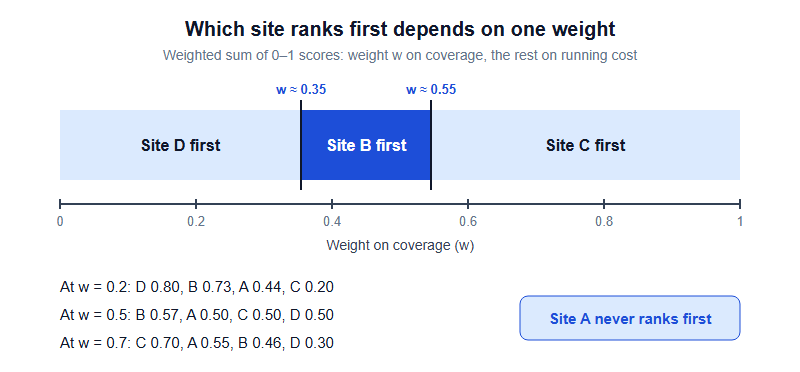
The chart keeps only the two criteria a client usually argues about. As the weight on coverage rises, the cheapest site, D, gives way to B at about 0.35, and B gives way to the widest-coverage site, C, at about 0.55. Site A, the balanced option, never ranks first at any weight. A paper that reports those switch points, and argues which side of them the client sits on, has turned an arbitrary weight into a defended recommendation. Our guide to sensitivity analysis and validation covers fitting results like this into the page budget.
GM(1,1) is popular because it runs on a handful of observations. It adds the series up cumulatively, fits a first-order linear differential equation to the running total, and differences the fitted curve back — and followed through, the forecast for the original series is an exponential curve. So a GM(1,1) paper is an exponential-growth paper, and it owes the reader a reason why growth should be exponential over the horizon it claims. The accuracy grades templates attach to it are computed on the points used to fit it, which says little about the next five years. Defensible use means stating the exponential assumption, holding back the last one or two observations and forecasting them, setting the result beside a plain exponential or linear fit, and keeping the horizon short.
Writing the method so it earns credit, not space
COMAP’s contest instructions set a 25-page limit that includes the summary sheet — confirm the current limit on comap.org — and a page spent reproducing AHP’s random-index table is a page not spent on your inputs. A practical order:
- One short paragraph on the method, with a citation to the textbook or article you learned it from, written in your own words.
- The inputs, traced: the decision matrix or data series, where every number came from, and which numbers are your own judgement.
- The rejected alternative, named: for example, that you used a weighted sum rather than TOPSIS because both gave the same top choice and the simpler method is easier to check.
- The breaking point: the weight, parameter or horizon at which the recommendation changes.
- Disclosure where it applies: if an AI tool was used for any part of the work, code included, COMAP’s contest instructions require the report to state which model was used and for what purpose, and to append a Report on Use of AI after the solution — confirm the current wording on comap.org.
None of this makes the named methods less useful. It makes them yours. The goal, as everywhere in a modelling contest rather than a problem-solving one, is a paper in which a reader can follow each choice back to a reason — and a template, by definition, is a choice with the reason left out.
Frequently asked questions
Does COMAP allow AHP or TOPSIS in a HiMCM paper?
We found no named method prescribed or banned in COMAP instructions. What matters is whether your choice and every input are justified in the paper.
Can a teacher fill in our AHP comparison matrix during the contest?
No. COMAP bars seeking ideas or information from anyone outside the team during the contest, so the judgements must be your own and stated.
Is a consistency ratio below 0.1 enough to justify AHP weights?
No. It shows your comparisons agree with each other, not that they are right. You still need a reason for each and a weight sensitivity check.
Can we reuse method paragraphs from a modelling course handout?
Not safely. COMAP compares every paper with all others on the same problem, and its instructions list verbatim text, and papers very similar to other submissions, as grounds for disqualification whether or not the text is credited, so write the method in your own words.
This is an independent guide operated by Hanlin Education for China-based international-school students. We are not affiliated with, endorsed by, or sponsored by COMAP, which is the sole official authority for HiMCM rules, dates, registration and judging. Confirm all current details on comap.org before acting on anything here. Errors reported to us are corrected within 7 working days.