Why Dimensional Analysis Matters in HiMCM
Dimensional analysis is the process of checking that the units on both sides of an equation match. In HiMCM, where teams build models combining physical quantities, economic variables, or biological rates across 14 days, a mismatched unit discovered on day ten can invalidate days of work. COMAP’s official instructions emphasize mathematical correctness and clear model assumptions as core judging criteria—both require dimensional consistency. With the 2026 contest window running November 4–17 and teams submitting a single PDF under 20 MB, there is no room to rebuild a model from scratch after discovering a unit error during final review.
This article focuses specifically on using dimensional analysis as a pre-modeling checkpoint, distinct from broader preparation strategies. For the overall paper structure, see From Problem Statement to Defensible Model: The First Two Days of a HiMCM Paper. For validation after building, see No Answer Key: How to Test Your Own HiMCM Model With Sensitivity Analysis and Validation. For contest fundamentals, see What Is HiMCM? The Contest Where Building the Model Matters More Than Solving It (2026).
Teaching Illustration 1: Population Growth Model (Hypothetical Example)
Suppose your team proposes a simple exponential growth model for a city’s population:
P(t) = P₀ × e^(r×t)
Where:
- P(t) is population at time t (unit: people)
- P₀ is initial population (unit: people)
- r is growth rate (unit: per year, or year⁻¹)
- t is time (unit: years)
The exponent r×t has units (year⁻¹) × (years) = dimensionless, which is correct because you cannot raise e to a power with units. The right side becomes people × dimensionless = people, matching the left side. This model passes dimensional analysis.
Key checkpoint: Before writing any code, write each variable’s unit explicitly. The exponent must always be dimensionless—this is a non-negotiable algebraic constraint.
Teaching Illustration 2: Traffic Flow Error and Correction (Hypothetical Example)
Now consider a traffic flow model where a student writes:
Flow = Density × Speed + Time
Here:
- Flow has units vehicles/hour
- Density has units vehicles/km
- Speed has units km/hour
- Time has units hours
Density × Speed gives (vehicles/km) × (km/hour) = vehicles/hour, which matches Flow. But adding Time (hours) to vehicles/hour is dimensionally invalid—you cannot add quantities with different dimensions. The error likely came from confusing a delay term with a flow adjustment.
Explicit correction via dimensional analysis:
The term “Time” must be converted to a flow rate (vehicles/hour) to match other terms. If average trip duration is T hours per vehicle, then each vehicle completes 1/T trips per hour. The delay-adjusted flow becomes:
Flow = Density × Speed × (1 − 1/T)
Verify: (vehicles/km) × (km/hour) × dimensionless = vehicles/hour. All terms now share the same dimension.
Alternative valid structure: Keep time in a separate constraint equation rather than mixing it into the flow definition:
Total Delay = Vehicle Count × T
This isolates the time dimension in its own equation, preserving dimensional consistency in both statements.
Diagnostic Table for Common Unit Mistakes
| Error Type | Symptom | Fix Strategy |
|---|---|---|
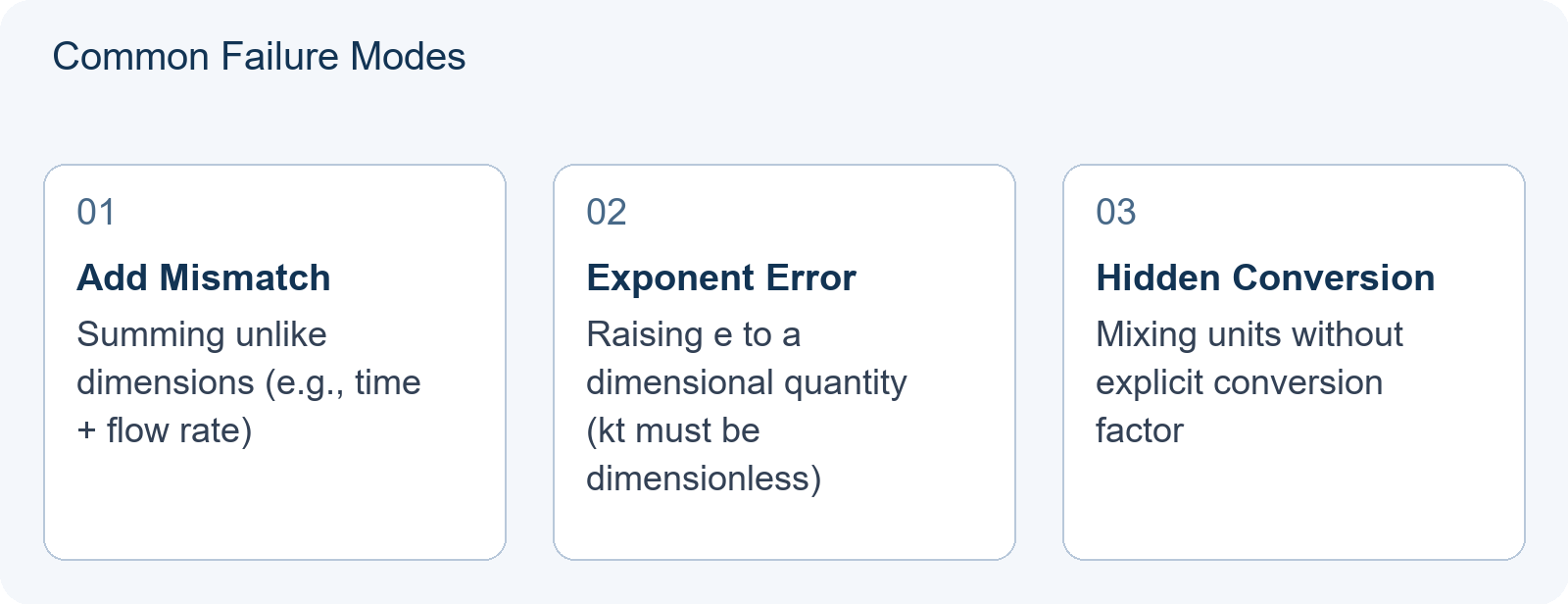
| Adding unlike units | Equation sums terms with different dimensions | Separate into distinct equations or introduce conversion factors with explicit unit cancellation |
| Exponent with units | e^(kt) where k has units | Ensure kt is dimensionless by adjusting k’s definition; k must absorb the inverse of t’s unit |
| Inconsistent variable definitions | Same symbol used for different units across sections | Standardize notation in a shared glossary before modeling; one team member owns this |
| Implicit unit conversions | Mixing minutes and hours without conversion | Convert all inputs to base SI units before computation; document conversion factors |
Targeted Practice Sequence for HiMCM Teams
To build this skill within the constraints of the 2026 season, follow these steps during practice sessions:
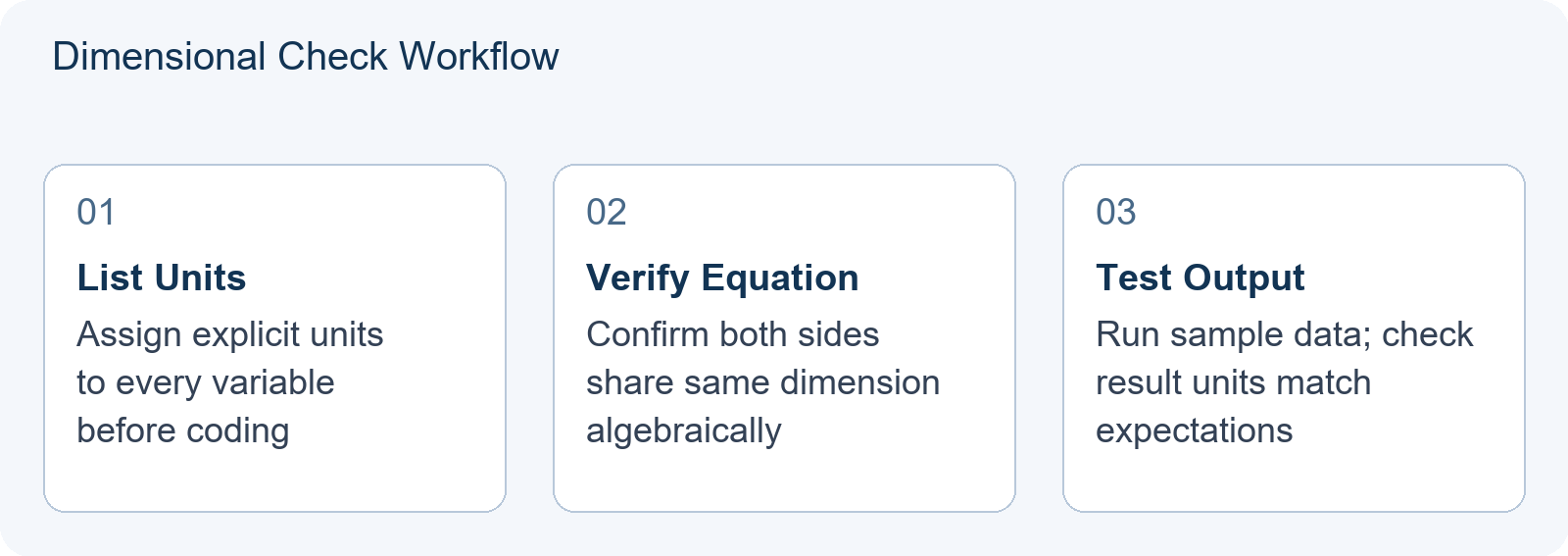
- Before coding any model, write down every variable’s expected unit in a shared glossary. Assign one team member as the unit checker.
- Check each equation for dimensional consistency manually, using unit cancellation notation. Show your work—COMAP judges evaluate reasoning, not just results.
- Run one test case with known values and verify output units match expectations. If your model predicts population in people, confirm the output is not people/year or people².
- If a discrepancy appears, trace it back to the first inconsistent step rather than patching downstream. Given the 14-day window, structural fixes on day 10 are often fatal.
Teams should integrate this routine into their workflow, treating dimensional checks as non-negotiable gateways before simulation. The 2026 rules also require teams to disclose any AI tool use in a separate report—dimensional errors discovered late are harder to explain if your model was partly generated.
What You Should Be Able to Demonstrate Next
After practicing, a learner should be able to take any proposed equation from a draft paper and: (1) state clearly whether it passes dimensional analysis, (2) identify the exact term causing failure if it does not, and (3) suggest a minimal correction that preserves the model’s intent while achieving unit consistency. This skill reduces wasted computational effort and strengthens argument coherence in the final submission—critical when judges evaluate mathematical correctness alongside communication clarity.
Frequently Asked Questions
Does COMAP explicitly require dimensional analysis in HiMCM papers?
COMAP’s official instructions do not mandate a specific section called ‘dimensional analysis,’ but judges evaluate mathematical correctness and internal consistency, which inherently includes unit coherence. The 2026 rules emphasize clear model assumptions and justified conclusions—both supported by dimensional rigor.
Can I fix unit errors after running simulations?
It is far more efficient to catch them beforehand. Post-hoc fixes often reveal deeper structural flaws that may require rebuilding the model logic. Given HiMCM’s 14-day window, discovering a unit mismatch on day ten leaves insufficient time for reconstruction.
Is this relevant for purely statistical or machine learning models?
Yes. Even in data-driven models, input features must have compatible scales and units when combined mathematically; otherwise, results become uninterpretable. Normalization addresses scale but not dimensional validity—a separate check.