For teams preparing for the 2026 HiMCM season, understanding the updated HiMCM AI use report requirements is critical. COMAP has introduced new guidelines regarding the use of Large Language Models (LLMs) and other AI tools. Unlike previous years where rules were less explicit, the 2026 policy mandates clear disclosure within your submission. This article breaks down exactly what needs to be included, how it interacts with the 25-page limit, and practical steps for compliance.
The Core Requirement: Disclosure and Placement
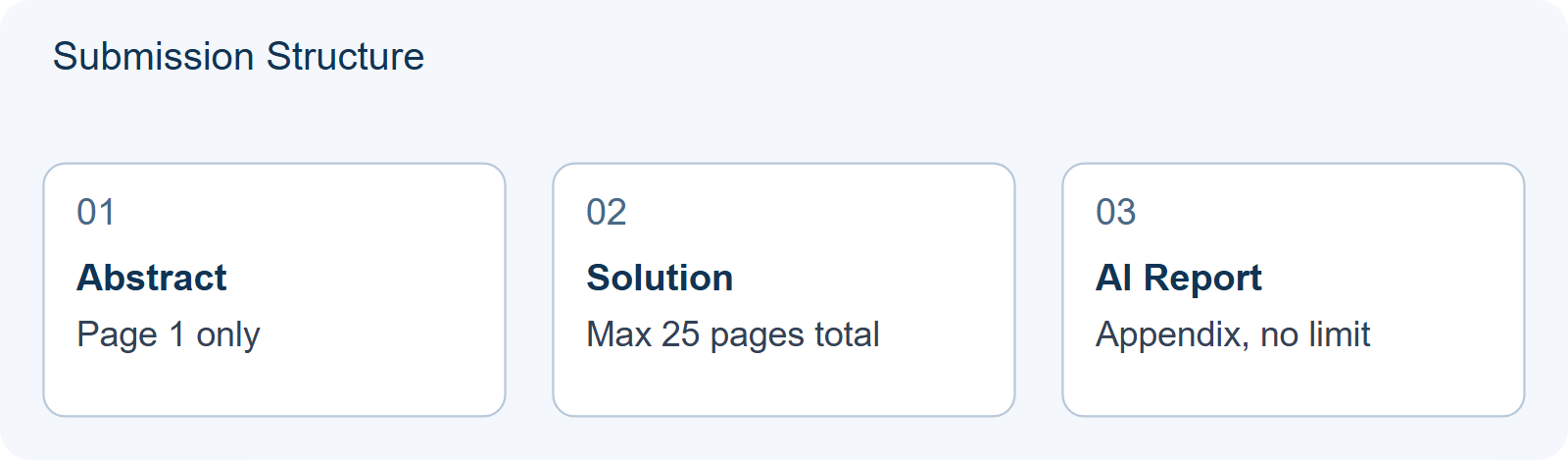
The primary rule is transparency. Your submitted PDF must clearly state whether you used LLMs or other AI tools during the competition. This includes specifying which models were used and for what purpose. Crucially, this information cannot be hidden in footnotes or ignored; it must be integrated into the document structure.
COMAP specifies two key components for handling AI usage:
- In-text Citations: You must use inline citations and a References section for any content generated by AI tools. This applies to text, code snippets, or data interpretations derived from these models.
- The AI Use Report: A dedicated section titled “AI Use Report” must be attached after the main solution. This report does not count toward the 25-page limit for the solution itself.
It is important to note that while you cite AI-generated content within the paper, you do not need to create circular citations pointing back to the AI Use Report document itself. The report serves as an explanatory appendix detailing your methodology and tool usage.
Structuring the Submission
The 2026 online submission process requires a single PDF file. The order of pages is strictly defined to ensure judges can locate all necessary components efficiently. Below is the recommended structure based on COMAP’s instructions:
| Section | Content | Page Count Impact |
|---|---|---|
| Page 1 | Team Abstract | Counts towards 25 pages |
| Pages 2–25 | Solution Paper (with inline AI citations) | Counts towards 25 pages |
| After Page 25 | References & Appendices | Does not count towards 25 pages |
| Final Section | AI Use Report | No page limit; separate from solution |
Teams often worry about whether using translation software constitutes “AI use.” The policy broadly covers “LLMs or other AI tools.” If your translation tool operates via an LLM backend (like many modern apps), it should be disclosed. If it is a traditional dictionary-based tool, it may fall outside this specific definition, but when in doubt, transparency is safer. Always describe the tool’s function in your report.
What Goes Inside the AI Use Report?
The AI Use Report is your opportunity to explain your workflow. Judges are looking for evidence that you maintained academic integrity and understood the limitations of the tools you employed. Consider including:
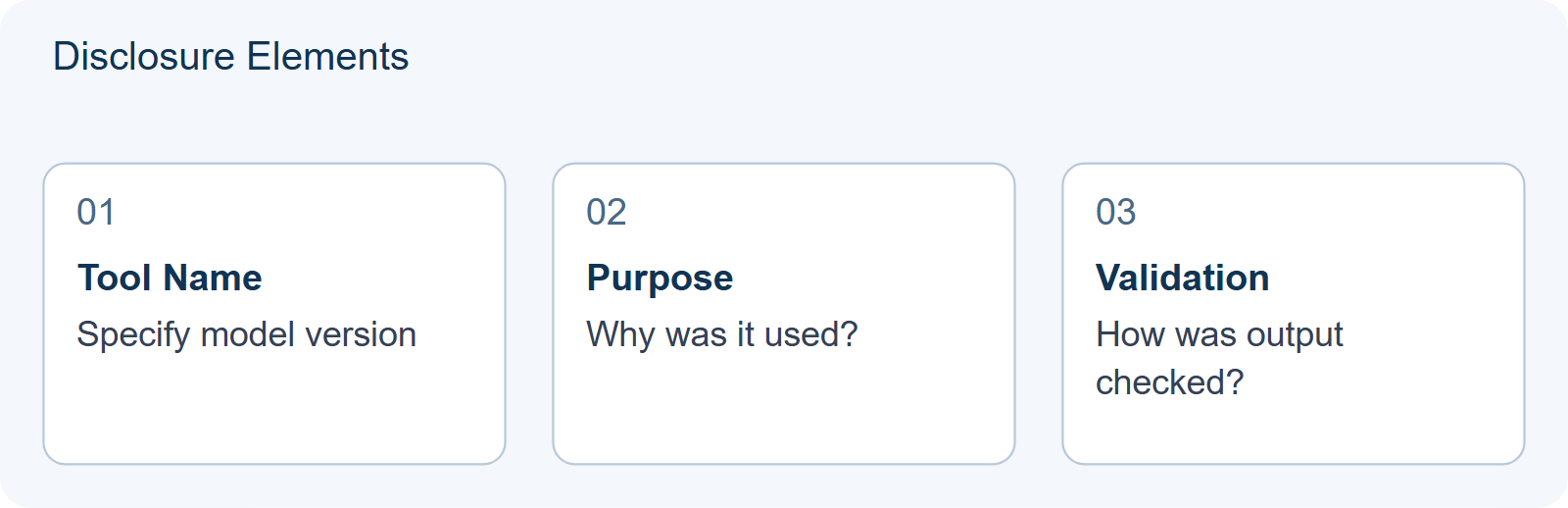
- Tool Identification: Names and versions of LLMs or AI assistants used (e.g., ChatGPT-4o, Claude 3.5).
- Purpose of Use: Did you use it for brainstorming, debugging code, summarizing literature, or drafting text? Be specific.
- Prompt Examples: Include key prompts that influenced significant parts of your model or analysis.
- Verification Steps: Explain how you validated AI-generated outputs. For instance, did you manually check mathematical derivations or run code tests?
This report helps distinguish between relying on AI for creative problem-solving versus using it as a crutch for fundamental tasks. Teams that demonstrate rigorous verification processes often present stronger cases for their modeling choices.
Common Misconceptions
A frequent error is assuming that failure to format the AI report correctly leads to immediate disqualification. While strict adherence to submission guidelines is required, minor formatting inconsistencies in the appendix are typically handled differently than missing core solution elements. However, failing to disclose AI usage entirely violates the spirit of the competition rules and could impact judging credibility.
Another misconception is that all AI assistance is prohibited. It is not. The rule is about disclosure. Using AI to generate initial ideas or refine English phrasing is acceptable if documented. Hiding such usage is not.
Preparation Checklist
To ensure smooth compliance, integrate these steps into your team agreement before the window opens. Review our guide on The HiMCM Team Agreement to assign ownership of this task.
AI Compliance Workflow
- Step 1: Log Usage
Record every AI interaction during the 14-day window. - Step 2: Cite In-Text
Add inline citations for AI-derived content in the draft. - Step 3: Draft Report
Compile tool names, purposes, and verification methods. - Step 4: Final Check
Ensure report is appended after the 25-page solution.
As you finalize your technical stack, consider how your chosen tools fit into this reporting framework. Our article on The HiMCM Toolchain offers insights on standardizing software choices across your team.
Finally, remember that the quality of your mathematical model remains paramount. AI should enhance, not replace, your analytical rigor. For students unsure about the depth of math required, review What Maths Does HiMCM Actually Use? to align your preparation with expectations.
Hypothetical Illustration: Deciding What to Disclose in the AI Use Report
To apply the disclosure guidelines effectively, consider a hypothetical scenario involving Team Alpha during their 2026 preparation. The team is modeling traffic flow optimization using Python. During the process, they encounter two distinct instances of AI interaction that require different handling strategies. First, a team member uses an LLM to generate boilerplate code for reading CSV files and plotting basic graphs. Second, another member asks the same LLM to suggest alternative mathematical formulations for the objective function, specifically comparing linear programming against non-linear approaches.
The critical decision point arises when drafting the “AI Use Report.” Should both interactions be treated with equal weight? A common mistake is to list every minor query as a significant contribution, which can dilute the report’s clarity. Alternatively, some teams might omit the code generation step entirely, assuming it is trivial. Let us compare two plausible choices for how Team Alpha handles this.
Choice A: Minimalist Disclosure. The team decides to only disclose the brainstorming session regarding the objective function. They argue that the code generated was standard library usage (Pandas/Matplotlib) and did not influence the core model logic. In the report, they state: “Used LLM for high-level algorithmic suggestions. Verified via manual derivation.”
Choice B: Comprehensive Workflow Disclosure. The team discloses both instances but categorizes them differently. They note that the LLM was used for syntax assistance on data loading scripts, which was verified by running unit tests. Crucially, they detail that the suggestion for the non-linear formulation was rejected after simulation showed instability, leading them back to a linear approach. The report states: “LLM assisted with boilerplate coding (verified via execution) and provided initial hypothesis generation for objective functions (evaluated and refined through sensitivity analysis).”
What changes the decision here is the concept of verification impact. Choice A risks appearing opaque if judges suspect hidden dependencies or if the boilerplate code contained subtle errors that affected results. Choice B demonstrates rigorous academic integrity by showing exactly where AI entered the workflow and, more importantly, where human judgment took over. It highlights that the AI was a tool for efficiency and ideation, not a substitute for validation.
For your own preparation, use this reusable self-check before finalizing your report:
| Self-Check Question | Action if Yes | Action if No |
|---|---|---|
| Did the AI output directly change a key assumption or result? | Include detailed prompt and verification method. | Mention briefly under “syntax/boilerplate” category. |
| Was the AI output accepted without modification? | Explain why no changes were needed (e.g., simple formatting). | Describe the specific edits made by humans. |
| Is the tool’s role ambiguous to an outsider? | Clarify the boundary between AI suggestion and human decision. | No action required; description is clear. |
This illustrative example underscores that transparency is not just about listing tools, but about narrating the intellectual journey. By distinguishing between mechanical assistance and conceptual input, you provide judges with a clearer picture of your team’s analytical rigor. Remember, the goal is to show that while AI accelerated certain tasks, the mathematical reasoning and final validation remained firmly under human control.
Frequently Asked Questions
Do I need to cite the AI Use Report itself in my paper?
No. You cite AI-generated content within the paper using inline citations. The AI Use Report is a separate appendix explaining your usage, not a source you reference in the text.
Is Google Translate considered an AI tool requiring disclosure?
If the tool uses LLM technology, it likely falls under 'other AI tools.' To be safe, disclose its use if it significantly altered your text. Traditional dictionary lookups generally do not require this level of reporting.
Will I be disqualified if my AI report is formatted incorrectly?
COMAP emphasizes clear disclosure. While major violations risk penalties, minor formatting errors in the appendix are less severe than omitting the report entirely. Ensure the report is present and follows the 'after 25 pages' rule.