
Teams often lose marks in HiMCM not because their final model is too simple, but because they never show why it needed to be complex. A baseline model—a deliberately simple first attempt that you later improve—gives the judges a reference point. Without it, every choice looks arbitrary. With it, every refinement looks earned.
What a Baseline Model Actually Does
A baseline model serves three purposes in a HiMCM paper:
- Anchor: It fixes a measurable starting point so later comparisons are meaningful.
- Diagnostic: It reveals which assumptions hurt most and which simplifications are safe.
- Rhetorical: It shows the reader that you explored simpler options before committing to complexity.
The trap is building one reflexively. A baseline that takes six hours to construct and two paragraphs to dismiss wastes time and page space. The skill is knowing when the baseline will pay for itself.
Worked Hypothetical Example 1: When the Baseline Earns Its Keep
Teaching illustration—constructed for strategy practice, not an official HiMCM problem.
Problem setting: A city wants to optimize emergency vehicle dispatch after a natural disaster. Your team considers a full agent-based simulation with individual driver behavior, traffic light states, and real-time damage updates.
Step 1: Build the Baseline
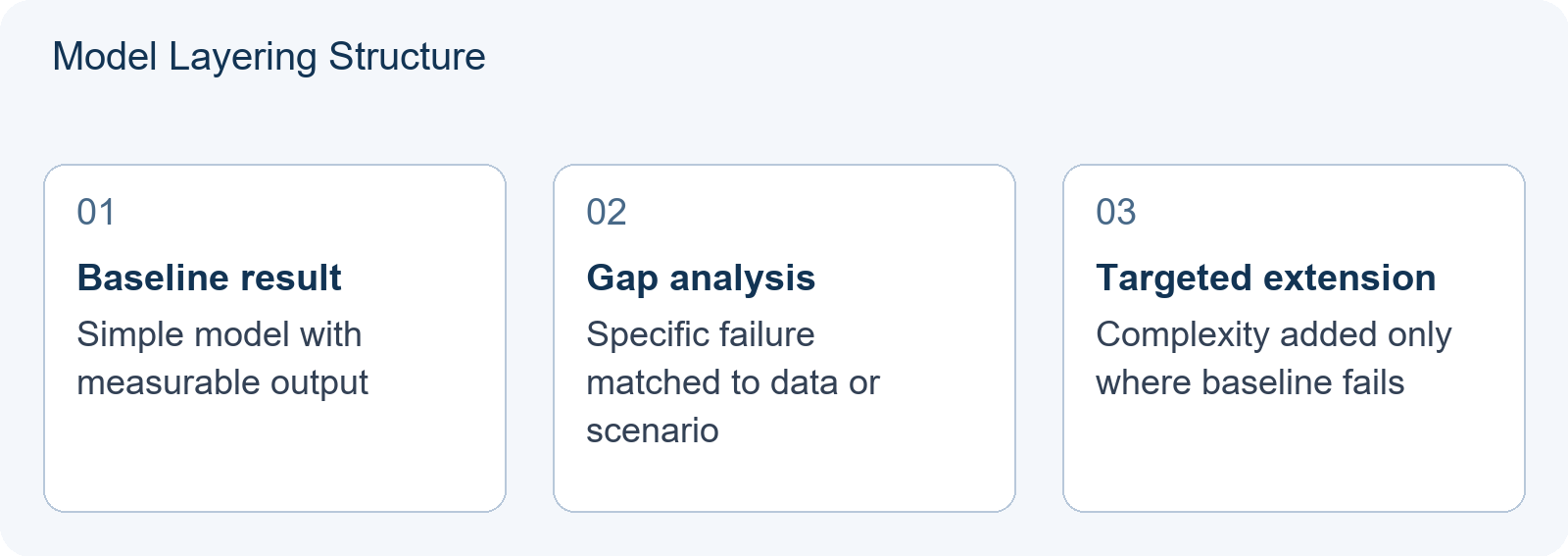
Start with a deterministic queueing model: nearest available vehicle assigned by straight-line distance, travel time estimated from posted speed limits. No simulation, no randomness, no GIS layer. Compute average response time across the historical incident set. Suppose this yields a mean response time of 8.4 minutes for the 47 incidents in the training data.
Step 2: Identify the Gap
The baseline assumes roads are intact and speeds are constant. Compare its predicted response times against actual post-disaster records (if provided) or against reasonable damage scenarios. When bridge outages are included, the actual mean rises to 14.2 minutes—a 69 percent increase. The baseline underestimates response time by 40 percent when bridge outages are included. That gap is now a concrete justification for complexity.
Step 3: Layer Complexity with a Clear Claim
Introduce the agent-based model, but frame it as a targeted repair: “We replace the constant-speed assumption with a dynamic road-network update, triggered by damage reports. This raises fidelity where the baseline fails most—cross-river corridors—without adding computation where straight-line distance already suffices.” The baseline made the complex model’s scope defensible.
Worked Hypothetical Example 2: Where the Baseline Fails and What to Do Instead
Teaching illustration—constructed for strategy practice, not an official HiMCM problem.
Problem setting: Predict seasonal dandelion spread across a region given temperature and soil data.
The Temptation
A team might build a baseline of uniform exponential growth across the entire region, then layer a spatial diffusion term, then add temperature-dependent carrying capacity. The baseline here is trivial: it will always be wrong by orders of magnitude because spatial heterogeneity is the entire phenomenon. The uniform-growth baseline predicts 340 percent coverage by month six; the actual patchy data shows 12 percent coverage with high variance. The baseline teaches nothing.
The Better Move
Skip the uniform-growth baseline. Instead, construct a structured simple model: patch-level logistic growth with fixed, spatially varying parameters. This is still simple—no dispersal kernel, no temporal parameter fitting—but it captures the key feature (space matters). Use it to show that ignoring dispersal between patches causes systematic bias in high-connectivity zones, with prediction error rising to 28 percent in riparian corridors versus 4 percent in isolated fields. Now the dispersal extension has a precise target, not a vague justification.
Diagnostic Table: Should You Build a Baseline?
| Question | Build a Baseline | Skip to Structured Simple |
|---|---|---|
| Does the problem have a natural “no-interaction” or “uniform” case? | Yes | No uniform case exists |
| Will the baseline’s failure mode teach you where to add complexity? | Yes | Failure is obvious without building it |
| Can you validate the baseline against data or extreme cases quickly? | Yes | No quick validation possible |
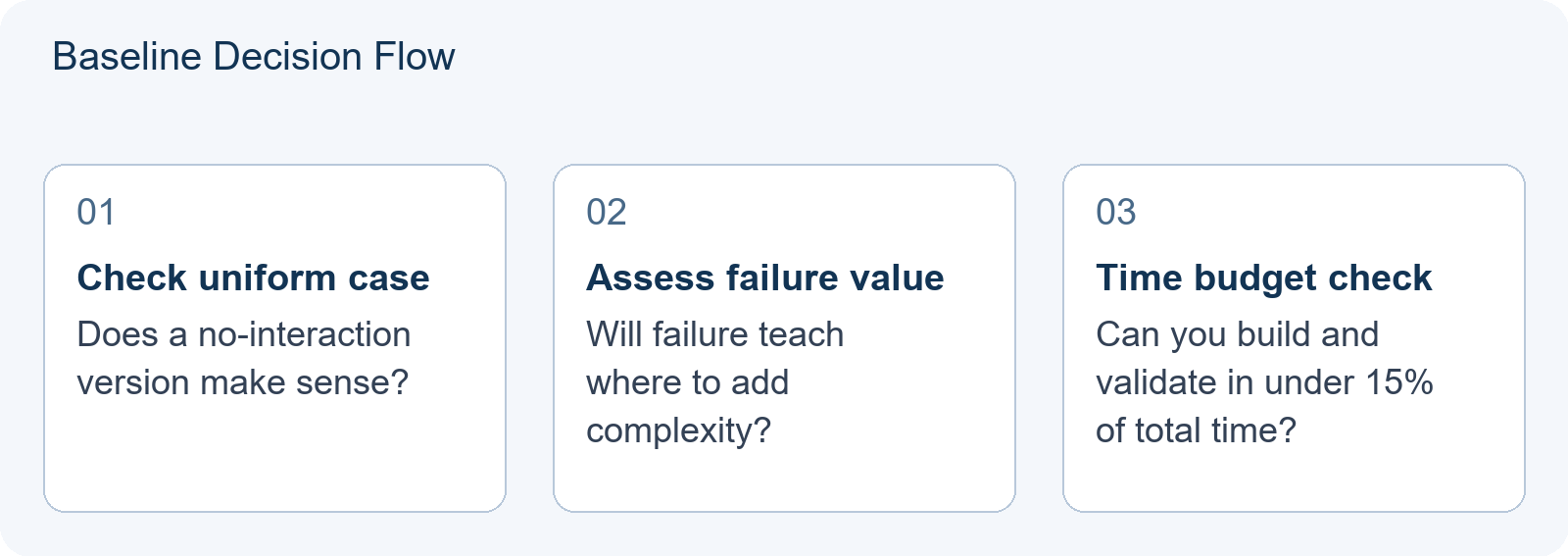
| Does the baseline cost less than 15% of total modeling time? | Yes | Even simple version is expensive |
If you answer “yes” to at least three rows, the baseline is worth building. Otherwise, invest in a structured simple model that already encodes the problem’s essential feature.
A Common Mistake: The Baseline as Afterthought
Some teams build their sophisticated model first, then append a paragraph: “For comparison, a simple linear regression yields R² = 0.61.” This reads as dismissal, not exploration. The baseline must appear before the complex model, and its limitations must motivate specific design choices in what follows. Judges look for reasoning chains, not catalogues of attempted methods.
Another frequent error is the “strawman baseline”—deliberately weakening the simple model so the complex one shines. Judges recognize this instantly. A valid baseline uses standard methods correctly applied; its failure must be genuine, not engineered.
Time and Page Budget Realities
With only 14 days from problem release to submission deadline, every hour matters. A baseline that consumes two days without yielding actionable insight drains resources from sensitivity analysis, validation, and writing. The 25-page limit compounds this pressure: a baseline needs space to present results, compare against data, and articulate the gap that justifies extension. Typically one to two pages suffice, including a table of results and clear assumptions. If your baseline demands more, question whether it is truly simple or whether the problem calls for a structured simple model instead.
Targeted Practice Sequence
To internalize this decision skill:
- Deconstruct one O- or F-awarded paper from the The HiMCM Study Pack Library Is Open: Awarded Papers, Methodology, and LaTeX Tools. Mark where the authors introduce a baseline, how long they spend on it, and exactly which limitation justifies each subsequent extension.
- Practice the 10-minute test. Given a new problem statement, decide in ten minutes whether to build a baseline or a structured simple model. Write your reasoning in two sentences. Compare with a teammate.
- Review the HiMCM AI Use Report: What COMAP Requires Beyond the 25-Page Limit and How to Format It to understand how model justification documentation fits alongside the 25-page solution and AI disclosure rules.
What You Should Be Able to Demonstrate Next
After working through these examples, you should be able to open an unseen HiMCM problem and, within the first hour, decide whether a baseline model will strengthen your paper or dilute it. You should also be able to write the transition from baseline to extension in one clear paragraph that names a specific limitation and links it to a specific model feature.
For structured preparation, see our HiMCM Preparation Course: What Your Team Should Learn Before the 2026 Contest. For registration logistics, review HiMCM Advisor ID: How to Get It, Keep It Valid, and Why Submission Fails Without It. The site footer contains current season dates and registration guidance.
Frequently Asked Questions
How much space should a baseline model take in a 25-page HiMCM paper?
Typically one to two pages, including a table of results and a clear statement of assumptions. The baseline exists to justify later choices, not to showcase exhaustive analysis. If it needs more space, consider whether a structured simple model would communicate the same point more efficiently.
Can a baseline model ever be the final submission model?
Rarely at the award level, but occasionally yes. If the problem constraints genuinely favor simplicity and your baseline outperforms complex alternatives on validation data, defend that choice explicitly. Judges reward justified simplicity over unnecessary complexity. Most teams, however, will need at least one targeted extension to address a gap the baseline reveals.
What if my team disagrees on whether to build a baseline?
Apply the diagnostic table together as a timed exercise. If you still disagree after 15 minutes, build the baseline version first as a team—its results often resolve the debate empirically. The time lost to a quick baseline is usually less than the time lost to unresolved disagreement about model architecture.